Answer: (D) 4
Concept: In a dot and cross diagram every electron of an atom is drawn on its shells. Each shared pair between two atoms holds one electron from each, so to get an atom's configuration before bonding we count its own symbols (crosses for A, dots for B), shell by shell.
Step 1 — Count the electrons of atom A.
Atom A's electrons are the crosses. Its inner shell has 2. Its outer shell has a pair at the top, a pair at the bottom and one cross in each of the two shared pairs, that is 2 + 2 + 1 + 1 = 6. So A is 2, 6 (oxygen, atomic number 8).
Step 2 — Count the electrons of each atom B.
Atom B's electrons are the dots. Its first shell has 2 and its second shell 8. Its outer shell has three pairs of its own plus one dot in the shared pair, that is 6 + 1 = 7. So B is 2, 8, 7 (chlorine, atomic number 17).
Step 3 — Check the bonding makes sense.
Oxygen needs 2 electrons and each chlorine needs 1, so oxygen shares one pair with each of two chlorine atoms and every atom reaches an octet. The molecule is Cl2O, which fits the formula AB₂. Row 4 gives A = 2, 6 and B = 2, 8, 7.
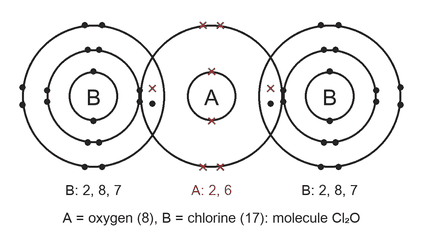
Watch out: The shared pairs belong to both atoms AFTER bonding; before bonding each atom had only its own electron of each pair, so count one, not two, for each shared pair.
Why the other options are wrong:
- (A) 1: row 1 gives A as 2, 4 and B as 2, 8, 6; an atom with 4 valence electrons would share four pairs and one with 6 would share two, but the figure shows A sharing two pairs and each B one pair.
- (B) 2: row 2 gives A as 2, 4; an atom with 4 valence electrons shares four pairs, but A in the figure shares only two.
- (C) 3: row 3 gives 2, 8 and 2, 8, 8, which are the configurations of the noble gases neon and argon; such atoms already have an octet and do not share electrons.
Therefore, before combining, A is 2, 6 and B is 2, 8, 7, which is row 4, option (D).

