
Opening your dashboard
Class 10 Physics Chapter 6: Spectrum Solutions
88 textbook questions with step-by-step answers, free to read, for ICSE 2026-27.
Get talked through Ch 6, not just shown the answer
Reading a finished solution is not the same as being able to do it. The AI tutor takes one question at a time and works it with you, in your own words, until you can.
- Ask it out loud, in your own words
- It gives you the next step, not the answer
- Stuck on part (ii)? Start there
88 questions with solutions
1–6 marks · Mixed difficulty
- 11 mark
Question 1
When a white light ray falls on a prism, the ray at its first surface suffers :
Solve with AIAnswer
(A) no refraction
(B) only dispersion
(C) only deviation
- Correct
(D) both deviation and dispersion.
Answer: (D) both deviation and dispersion.
Concept: Dispersion is the splitting of white light into its colours. It happens because the refractive index (μ) of glass is slightly different for each colour: it is least for red light and greatest for violet light, so each colour bends by a different amount.
Step 1 — See what happens to the direction.
At the first surface the white ray passes from air into glass at an angle, so it slows down and bends towards the normal. This change of direction is deviation.
Step 2 — See what happens to the colours.
Glass has a different refractive index for each colour, so each colour bends by a slightly different amount on entering. The colours therefore begin to separate inside the prism; this is dispersion.
Step 3 — Put the two together.
Both changes happen at the same first surface, so the ray suffers deviation and dispersion together.
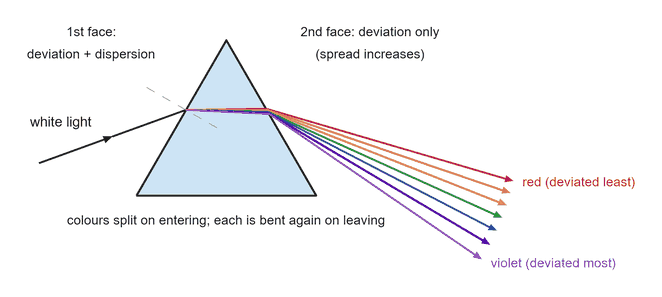
Watch out: The colours cannot separate unless the light bends, so dispersion never happens without deviation.
Why the other options are wrong:
- (A) no refraction: the ray enters a denser medium at an angle, so it does refract (bend) at the first surface.
- (B) only dispersion: the colours separate only because each one bends by a different amount, so there cannot be dispersion without deviation.
- (C) only deviation: glass bends each colour by a different amount, so the bending also separates the colours; deviation does not happen alone for white light.
Therefore, at the first surface the white ray suffers both deviation and dispersion, option (D).
- 21 mark
Question 2
When a ray of white light falls on a prism, which of the following statements are correct ?
Solve with AIAnswer
(A) The dispersion of white light occurs at the first surface of the prism.
(B) The deviation of light rays occurs at both the surfaces of the prism.
(C) The prism does not produce colours, but it only splits the various colours present in the white light.
- Correct
(D) All of the above.
Answer: (D) All of the above.
Concept: Follow the light face by face: what happens where it enters the prism, what happens where it leaves, and where the colours come from.
Step 1 — Check statement (A).
On entering the first face, each colour bends by a different amount because the refractive index of glass differs from colour to colour. So the colours separate at the first surface: statement (A) is true.
Step 2 — Check statement (B).
The light bends towards the normal at the first face and away from the normal at the second face. Both bends turn it towards the base and add up to the total deviation: statement (B) is true.
Step 3 — Check statement (C).
White light already contains all the colours. The prism does not make new colours; it only separates the ones that are present: statement (C) is true.
Step 4 — Choose the option.
All three statements are correct, so the complete answer is the option that includes all of them.
Watch out: A single true statement is not the full answer when the question asks which statements are correct.
Why the other options are wrong:
- (A) The dispersion of white light occurs at the first surface of the prism: statement (A) is true, but choosing it alone leaves out the true statements (B) and (C).
- (B) The deviation of light rays occurs at both the surfaces of the prism: statement (B) is true, but choosing it alone leaves out the true statements (A) and (C).
- (C) The prism does not produce colours, but it only splits the various colours present in the white light: statement (C) is true, but choosing it alone leaves out the true statements (A) and (B).
Therefore, all the statements are correct, option (D).
- 31 mark
Question 3
The correct arrangement of colours in an increasing order of their wavelengths is :
Solve with AIAnswer
- Correct
(A) Violet < Green < Red
(B) Red < Green < Violet
(C) Green < Violet < Red
(D) Green < Red < Violet
Answer: (A) Violet < Green < Red
Concept: The book's table of the visible spectrum (VIBGYOR), in order of increasing wavelength: violet 4000–4460 Å, indigo 4460–4640 Å, blue 4640–5000 Å, green 5000–5780 Å, yellow 5780–5920 Å, orange 5920–6200 Å and red 6200–8000 Å (1 nm = 10 Å, 1 Å = 10⁻¹⁰ m).
Step 1 — Read the wavelengths from the table.
Violet lies from 4000 Å to 4460 Å, green from 5000 Å to 5780 Å and red from 6200 Å to 8000 Å.
Step 2 — Arrange them from shortest to longest.
An increasing order starts with the shortest wavelength, so violet comes first, then green, and red last.
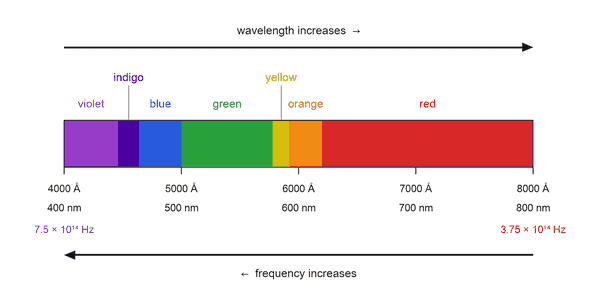
Watch out: "increasing order" means from the smallest value to the largest; do not reverse it.
Why the other options are wrong:
- (B) Red < Green < Violet: it is the decreasing order of wavelength (red is the longest, not the shortest).
- (C) Green < Violet < Red: it puts green before violet, but green has the longer wavelength.
- (D) Green < Red < Violet: it puts violet last, but violet has the shortest wavelength of the three.
Therefore, the increasing order of wavelength is violet < green < red, option (A).
- 41 mark
Question 4
Out of red, blue and violet, which colour has the greatest speed in vacuum ?
Solve with AIAnswer
(A) red
(B) blue
(C) violet
- Correct
(D) all have the same speed
Answer: (D) all have the same speed
Concept: In vacuum every colour travels at the same speed, 3 × 10⁸ m s⁻¹. Inside glass the speed is the speed in vacuum divided by the refractive index (v = c ÷ μ), and the refractive index μ of glass is smallest for red and largest for violet, so red travels fastest in glass and violet slowest.
Step 1 — Note where the speed is asked.
The question asks about the speed in vacuum, not in glass.
Step 2 — Recall the speed of light in vacuum.
Every colour of light is an electromagnetic wave, and all electromagnetic waves travel at the same speed in vacuum.
Step 3 — Compare red, blue and violet.
The speed in vacuum does not depend on the colour (wavelength), so red, blue and violet all travel at this same speed.
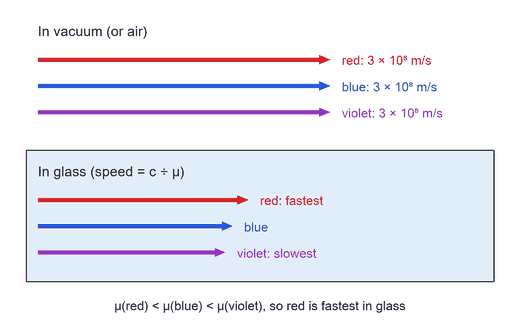
Watch out: Colours travel at different speeds only inside a medium such as glass (red fastest, violet slowest); in vacuum they are equal.
Why the other options are wrong:
- (A) red: red is the fastest only inside a medium such as glass, not in vacuum.
- (B) blue: blue is not faster than red in any medium; in vacuum it has the same speed as red.
- (C) violet: violet is in fact the slowest in glass; in vacuum it has the same speed as the others.
Therefore, red, blue and violet all have the same speed in vacuum, option (D).
- 51 mark
Question 5
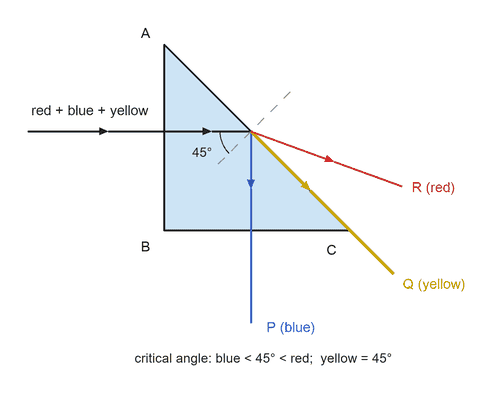
A beam consisting of red, blue and yellow colours is incident normally on the face AB of an isosceles right-angled prism ABC as shown in the figure given below . Critical angle of glass-air interface for yellow colour is 45°.
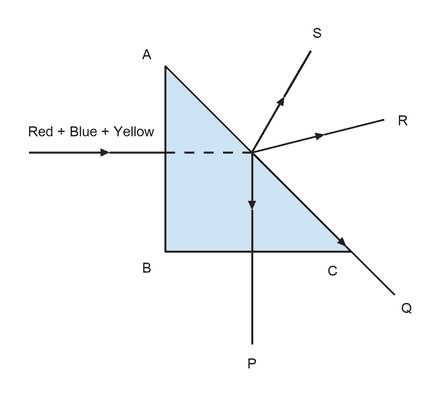
Out of the four emergent rays P, Q, R and S, which one is for the yellow colour :
Solve with AIAnswer
(A) P
- Correct
(B) Q
(C) R
(D) S
Answer: (B) Q
Concept: When light goes from glass to air, it is totally internally reflected if its angle of incidence is GREATER than the critical angle; at exactly the critical angle the refracted ray grazes along the surface (angle of refraction 90°); below the critical angle it refracts out. A colour with a larger refractive index has a smaller critical angle (sin C = 1/μ), and μ increases from red to yellow to blue.
Step 1 — Follow the beam into the prism.
The beam falls normally on face AB (angle of incidence 0°), so it goes straight in without bending.
Step 2 — Find the angle of incidence at face AC.
The prism is isosceles and right-angled at B, so the angle at A is 45°. The beam runs parallel to BC and meets face AC at an angle of incidence of 45°.
Step 3 — Decide what yellow light does.
For yellow light the critical angle is exactly 45°, so i = C. At the critical angle the refracted ray makes 90° with the normal, so yellow light grazes along face AC. That is ray Q.
Step 4 — Check the other colours.
Blue has a larger refractive index than yellow, so its critical angle is less than 45°; since i = 45° is greater, blue is totally internally reflected and leaves through BC as ray P. Red has a smaller refractive index, so its critical angle is more than 45°; it refracts out of AC, bending away from the normal, as ray R.
Watch out: Total internal reflection needs i GREATER than C; at exactly i = C the ray grazes the surface.
Note: in the printed figure the rays R and S are only rough sketches. A real ray passing from glass into air at AC bends AWAY from the normal, so the red ray leaves below the horizontal, as drawn in the solution figure; the key (Q for yellow) is not affected.
Why the other options are wrong:
- (A) P: P is the ray that is totally internally reflected at AC and leaves through BC; that is blue light, whose critical angle is below 45°.
- (C) R: R stands for the ray refracted out of AC into air; that is red light, whose critical angle is above 45°.
- (D) S: S is not the path of any of the three colours: blue is totally reflected (P), yellow grazes along AC (Q) and red refracts out (R), and there is no fourth colour in the beam.
Therefore, the emergent ray for yellow light is Q, option (B).
- 61 mark
Question 6
The frequency of violet light is Hz. Its wavelength in nm is :
Solve with AIAnswer
(A) 7500 nm
(B) 4000 nm
- Correct
(C) 400 nm
(D) 750 nm
Answer: (C) 400 nm
Concept: Speed, frequency and wavelength are linked by c = fλ, so the wavelength is the speed of light divided by the frequency. The speed of light is 3 × 10⁸ m s⁻¹, and one nanometre is 10⁻⁹ m.
Step 1 — Write what is given.
The frequency is f = 7.5 × 10¹⁴ Hz and the speed of light is c = 3 × 10⁸ m s⁻¹.
Step 2 — Find the wavelength in metre.
Divide the speed of light by the frequency.
Step 3 — Change metre into nanometre.
Since 1 nm = 10⁻⁹ m, divide by 10⁻⁹.
Step 4 — Check that it is sensible.
A wavelength of 400 nm (4000 Å) is the violet end of the visible spectrum, as it should be.
Watch out: 4000 is the wavelength in ångström, not in nanometre; 1 nm = 10 Å.
Why the other options are wrong:
- (A) 7500 nm: 7500 nm comes from mixing up the powers of ten; it would be far beyond the visible range (infrared).
- (B) 4000 nm: 4000 is the wavelength in ångström (4000 Å), not in nanometre.
- (D) 750 nm: 750 nm is near the red end; light of that wavelength has a frequency of 4 × 10¹⁴ Hz, not 7.5 × 10¹⁴ Hz.
Therefore, the wavelength of the violet light is 400 nm, option (C).
- 71 mark
Question 7
The correct order of angle of deviation of indigo, green, yellow and red colours is :
Solve with AIAnswer
- Correct
(A)
(B)
(C)
(D)
Answer: (A)
Concept: A prism deviates (turns) light towards its base. The larger the refractive index of the prism for a colour, the more that colour is bent, so violet (largest μ) is deviated the most and red (smallest μ) the least.
Step 1 — Order the colours by wavelength.
From the spectrum (VIBGYOR), indigo has the shortest wavelength of the four, then green, then yellow, and red the longest.
Step 2 — Turn this into the order of deviation.
The shorter the wavelength, the larger the refractive index of glass and so the larger the deviation. The order of deviation is therefore the reverse of the order of wavelength.

Watch out: Deviation is greatest for the SHORTEST wavelength, so the order of deviation reverses the order of wavelength.
Why the other options are wrong:
- (B) : it puts green above indigo, but indigo has the shorter wavelength, so indigo is deviated more.
- (C) : it puts red first, but red has the longest wavelength and is deviated the least.
- (D) : it is the complete reverse of the correct order (red is deviated least, not most).
Therefore, the correct order of deviation is δ_I > δ_G > δ_Y > δ_R, option (A).
- 81 mark
Question 8
Assertion (A) : When a ray of light is refracted through a rectangular glass slab, there is no dispersion of light.
Reason (R) : Dispersion of light is the phenomenon of splitting of white light into its constituent colours.
Solve with AIAnswer
(A) both A and R are true and R is the correct explaination of A
- Correct
(B) both A and R are True and R is not the correct explanation of A
(C) assertion is false but reason is true
(D) assertion is true but reason is false
Answer: (B) both A and R are True and R is not the correct explanation of A
Concept: In an assertion–reason item, judge the assertion (A) and the reason (R) separately as true or false, and then decide whether R correctly explains A.
Step 1 — Judge the assertion.
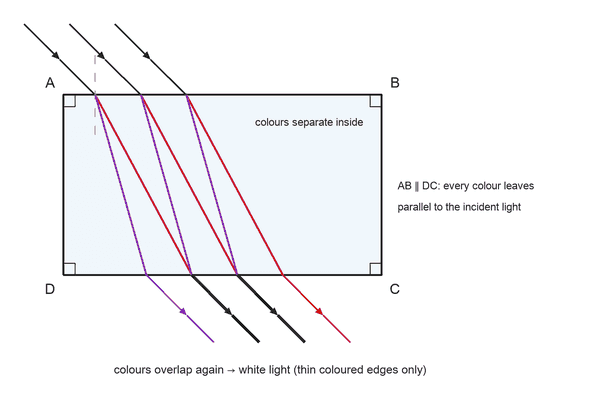
In a rectangular glass slab the two refracting faces are parallel. The colours do separate a little inside the slab, but at the second face each colour bends back by the same amount and leaves parallel to the incident ray. Colours from neighbouring parts of the beam overlap again, so white light comes out and no spectrum is seen. So the assertion is true (there is no net dispersion).
Step 2 — Judge the reason.
Dispersion is indeed the splitting of white light into its constituent colours. So the reason is a true statement.
Step 3 — Decide whether R explains A.
The reason only defines dispersion; it does not say why a slab produces none. The real explanation is that the slab's faces are parallel, so the second face undoes the separation made by the first. So R does not explain A.
Watch out: A correct definition is not automatically the explanation; ask whether R gives the CAUSE of A.
Why the other options are wrong:
- (A) both A and R are true and R is the correct explaination of A: R is true, but it is only the definition of dispersion; it does not explain why a slab gives no spectrum.
- (C) assertion is false but reason is true: the assertion is true: no spectrum comes out of a rectangular slab.
- (D) assertion is true but reason is false: the reason is true: it is the correct definition of dispersion.
Therefore, both A and R are true, but R is not the correct explanation of A, option (B).
- 91 mark
Question 9
Assertion (A) : A beam of white light gives a spectrum on passing through a hollow prism.
Reason (R) : The speed of light outside the prism is same as the speed of light inside the prism.
Solve with AIAnswer
(A) both A and R are true and R is the correct explaination of A
(B) both A and R are True and R is not the correct explanation of A
- Correct
(C) assertion is false but reason is true
(D) assertion is true but reason is false
Answer: (C) assertion is false but reason is true
Concept: In an assertion–reason item, judge the assertion (A) and the reason (R) separately as true or false, and then decide whether R correctly explains A.
Step 1 — Judge the assertion.
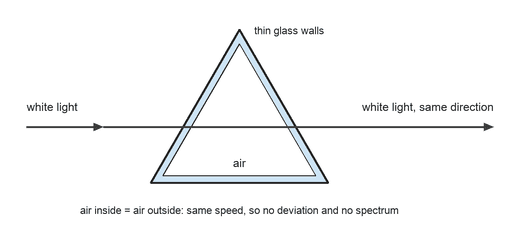
A hollow prism is filled with air, the same medium as outside. Light does not change speed on entering it, so it is not bent and its colours are not separated. Its thin glass walls are parallel-sided, so they act like thin slabs and do not change the direction of the light either. No spectrum is formed, so the assertion is false.
Step 2 — Judge the reason.
Inside and outside the hollow prism the light travels through air, so its speed is the same in both. The reason is true.
Step 3 — Link them.
The assertion is false and the reason is true; in fact the reason is exactly why the assertion fails.
Watch out: A prism disperses light only when its material has a refractive index different from the surrounding medium.
Why the other options are wrong:
- (A) both A and R are true and R is the correct explaination of A: it says the assertion is true, but a hollow (air-filled) prism gives no spectrum.
- (B) both A and R are True and R is not the correct explanation of A: it also says the assertion is true, which it is not.
- (D) assertion is true but reason is false: the reason is true, not false: the speed of light is the same in the air inside and outside the prism.
Therefore, the assertion is false but the reason is true, option (C).
- 101 mark
Question 10
How does the speed of light in glass change on increasing the wavelength of light ?
Solve with AIWritten solution
Solution:
Concept: In vacuum every colour travels at the same speed, 3 × 10⁸ m s⁻¹. Inside glass the speed is the speed in vacuum divided by the refractive index (v = c ÷ μ), and the refractive index μ of glass is smallest for red and largest for violet, so red travels fastest in glass and violet slowest.
Step 1 — Link wavelength with refractive index.
For glass, the refractive index μ is larger for shorter wavelengths (violet) and smaller for longer wavelengths (red).
Step 2 — Link refractive index with speed.
The speed of light in glass is v = c ÷ μ, so a smaller μ means a higher speed.
Step 3 — Combine the two.
As the wavelength increases, μ decreases, so the speed in glass increases. Red light therefore travels fastest in glass and violet light slowest.
Watch out: This is true only inside a medium; in vacuum every wavelength travels at the same speed.
Therefore, the speed of light in glass increases as the wavelength of light increases.
- 112 marks
Question 11
Which colour of white light travels (a) fastest (b) slowest, in glass ?
Solve with AIWritten solution
Solution:
Concept: In vacuum every colour travels at the same speed, 3 × 10⁸ m s⁻¹. Inside glass the speed is the speed in vacuum divided by the refractive index (v = c ÷ μ), and the refractive index μ of glass is smallest for red and largest for violet, so red travels fastest in glass and violet slowest.
Step 1 — Find the smallest and largest refractive index.
Glass has the smallest refractive index for red light (longest wavelength) and the largest for violet light (shortest wavelength).
Step 2 — Answer part (a).
The speed in glass is v = c ÷ μ, so the colour with the smallest μ is the fastest: red light.
Step 3 — Answer part (b).
The colour with the largest μ is the slowest: violet light.
Watch out: Do not say that all colours have the same speed; that is true only in vacuum.
Therefore, (a) red light travels fastest and (b) violet light travels slowest in glass.
- 121 mark
Question 12
Name the subjective property of light related to its wavelength.
Solve with AIWritten solution
Solution:
Concept: A subjective property is one that depends on how our eye and brain respond, not only on the light itself. The eye senses light of different wavelengths as different colours.
Step 1 — Link wavelength with what we see.
Light of each wavelength in the visible range produces its own sensation in the eye; for example, light of about 7000 Å is seen as red and light of about 4200 Å as violet.
Step 2 — Name the property.
This sensation, which depends on the wavelength, is the colour of the light. It is called subjective because it is the response of our eye, not a quantity measured on the light.
Therefore, the subjective property of light related to its wavelength is its colour.
- 132 marks
Question 13
What is the range of wavelength of the spectrum of white light in (i) Å, (ii) nm ?
Solve with AIWritten solution
Solution:
Concept: The visible spectrum of white light runs from violet (shortest wavelength) to red (longest wavelength). 1 nm = 10 Å.
Step 1 — Write the range in ångström.
Violet starts at about 4000 Å and red ends at about 8000 Å.
Step 2 — Change ångström into nanometre.
Divide each value by 10, since 10 Å make 1 nm.
Watch out: 1 nm is 10 Å, not 100 Å, so the numbers in nm are ten times smaller.
Therefore, the wavelength range of white light is (i) about 4000 Å to 8000 Å, (ii) about 400 nm to 800 nm.
- 141 mark
Question 14
Name four colours of the spectrum of white light which have wavelength longer than blue light.
Solve with AIWritten solution
Solution:
Concept: The book's table of the visible spectrum (VIBGYOR), in order of increasing wavelength: violet 4000–4460 Å, indigo 4460–4640 Å, blue 4640–5000 Å, green 5000–5780 Å, yellow 5780–5920 Å, orange 5920–6200 Å and red 6200–8000 Å (1 nm = 10 Å, 1 Å = 10⁻¹⁰ m).
Step 1 — Use the order of the colours.
In VIBGYOR the wavelength increases from violet to red: violet, indigo, blue, green, yellow, orange, red.
Step 2 — Pick the colours after blue.
Every colour that comes after blue has a longer wavelength than blue: green, yellow, orange and red.
Watch out: Violet and indigo come BEFORE blue, so their wavelengths are shorter, not longer.
Therefore, four colours with wavelength longer than blue are green, yellow, orange and red.
- 151 mark
Question 15
How will the dispersion of light through a prism change if the prism is made of diamond instead of glass ?
Solve with AIWritten solution
Solution:
Concept: The spread of colours (dispersion) depends on how much the refractive index of the prism material changes from red to violet; the bigger that difference, the more widely the colours fan out.
Step 1 — Compare diamond with glass.
Diamond has a much higher refractive index than glass (about 2.42 against about 1.5), and its refractive index also changes much more from red to violet.
Step 2 — Work out the effect.
Every colour is deviated more in diamond, and the difference between the deviation of violet and of red is larger, so the colours are spread out more widely. This is why a cut diamond flashes with colours.
Therefore, the dispersion will be greater with a diamond prism than with a glass prism.
- 163 marks
Question 16
Name three factors on which the deviation produced by a prism depends and state how does it depend on the factors stated by you.
Solve with AIWritten solution
Solution:
Concept: A prism deviates light towards its base. How much it deviates depends on how the light meets the prism, what the prism is made of and its shape, and the light itself.
Step 1 — Factor 1: the angle of incidence.
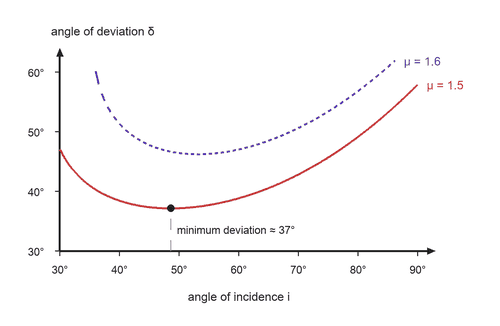
As the angle of incidence increases, the deviation first decreases, reaches a minimum value (minimum deviation), and then increases again.
Step 2 — Factor 2: the material (refractive index) of the prism.
The higher the refractive index of the material, the greater the deviation; for example, a flint-glass prism deviates light more than a crown-glass prism.
Step 3 — Factor 3: the colour (wavelength) of light.
The shorter the wavelength, the larger the refractive index and so the greater the deviation: violet is deviated the most and red the least.
Step 4 — Read the graph.
The graph shows factor 1 for a 60° prism of refractive index 1.5: the deviation falls to a minimum of about 37° and then rises. The upper curve (μ = 1.6) shows factors 2 and 3: a material of higher refractive index, or light of shorter wavelength, gives more deviation at every angle.
(The deviation also increases with the angle of the prism, which is a fourth factor.)
Watch out: The deviation does not keep increasing with the angle of incidence; it passes through a minimum first.
Therefore, the deviation depends on (1) the angle of incidence (it first decreases to a minimum, then increases), (2) the material of the prism (greater for a higher refractive index) and (3) the wavelength of light (greater for a shorter wavelength).
- 172 marks
Question 17
How does the deviation produced by a triangular prism depend on the colour (or wavelength) of light incident on it ?
Solve with AIWritten solution
Solution:
Concept: A prism deviates (turns) light towards its base. The larger the refractive index of the prism for a colour, the more that colour is bent, so violet (largest μ) is deviated the most and red (smallest μ) the least.
Step 1 — Link colour with refractive index.
The refractive index of glass is greater for shorter wavelengths: it is largest for violet and smallest for red.
Step 2 — Link refractive index with deviation.
A colour with a larger refractive index is bent more at both faces, so it is deviated more.
Step 3 — State the order.
So the deviation increases as the wavelength decreases. In order of increasing deviation: red, orange, yellow, green, blue, indigo, violet.
Watch out: Red light is deviated LEAST, even though it has the longest wavelength.
Therefore, the deviation increases as the wavelength decreases: violet light is deviated the most and red light the least.
- 182 marks
Question 18
(a) Write the approximate wavelength for (i) blue, and (ii) red light.
(b) The wavelength of violet and red light are 4000Å and 8000Å respectively. Which of the two has higher frequency ?
Solve with AIWritten solution
Solution:
Concept: The book's table of the visible spectrum (VIBGYOR), in order of increasing wavelength: violet 4000–4460 Å, indigo 4460–4640 Å, blue 4640–5000 Å, green 5000–5780 Å, yellow 5780–5920 Å, orange 5920–6200 Å and red 6200–8000 Å (1 nm = 10 Å, 1 Å = 10⁻¹⁰ m). Since all colours travel at the same speed c, the frequency is f = c ÷ λ.
Step 1 — Answer (a)(i): blue.
Blue light covers 4640 Å to 5000 Å, so its approximate wavelength is about 4800 Å (480 nm).
Step 2 — Answer (a)(ii): red.
Red light covers 6200 Å to 8000 Å, so a typical value is about 7000 Å (700 nm); the longest red waves reach 8000 Å, the end of the visible range.
Step 3 — Find the frequency of violet light for (b).
Change 4000 Å into metre (1 Å = 10⁻¹⁰ m) and divide c by the wavelength.
Step 4 — Find the frequency of red light.
Do the same with 8000 Å.
Step 5 — Compare.
Violet light has twice the frequency of red light, because its wavelength is half as long.

Watch out: A shorter wavelength means a HIGHER frequency, since f = c ÷ λ.
Note: any value inside each colour's band is accepted as "approximate"; 8000 Å is the very end of the red band, so about 7000 Å is the more typical value for red.
Therefore, (a) blue ≈ 4800 Å and red ≈ 7000 Å (red spans 6200–8000 Å); (b) violet light has the higher frequency (7.5 × 10¹⁴ Hz against 3.75 × 10¹⁴ Hz for red).
- 192 marks
Question 19
Write the seven prominent colours present in white light in the order of increasing wavelength.
Solve with AIWritten solution
Solution:
Concept: The book's table of the visible spectrum (VIBGYOR), in order of increasing wavelength: violet 4000–4460 Å, indigo 4460–4640 Å, blue 4640–5000 Å, green 5000–5780 Å, yellow 5780–5920 Å, orange 5920–6200 Å and red 6200–8000 Å (1 nm = 10 Å, 1 Å = 10⁻¹⁰ m).
Step 1 — Start with the shortest wavelength.
Violet has the shortest wavelength (about 4000 Å), so it comes first.
Step 2 — Follow the spectrum to the longest.
Moving along the spectrum the wavelength keeps increasing through indigo, blue, green, yellow and orange, up to red (about 8000 Å), which comes last.
Watch out: VIBGYOR is the order of INCREASING wavelength; read backwards (ROYGBIV) it is the order of increasing frequency.
Therefore, in order of increasing wavelength: violet, indigo, blue, green, yellow, orange, red (VIBGYOR).
- 202 marks
Question 20
Name the seven prominent colours of the white light spectrum in order of their increasing frequencies.
Solve with AIWritten solution
Solution:
Concept: All colours of light, and all electromagnetic waves, travel at the same speed in vacuum, c = 3 × 10⁸ m s⁻¹. Speed, frequency f and wavelength λ are linked by c = fλ, so a shorter wavelength means a higher frequency.
Step 1 — Link frequency with wavelength.
All colours travel at the same speed c, so f = c ÷ λ. The longest wavelength therefore has the lowest frequency.
Step 2 — Reverse the order of wavelength.
The order of increasing wavelength is VIBGYOR, so the order of increasing frequency is the reverse, from red to violet.
Step 3 — Check with the end values.
Red has the lowest frequency, about 3.75 × 10¹⁴ Hz, and violet the highest, about 7.5 × 10¹⁴ Hz.
Watch out: Increasing frequency is the REVERSE of increasing wavelength.
Therefore, in order of increasing frequency: red, orange, yellow, green, blue, indigo, violet.
- 212 marks
Question 21
The wavelengths for the light of red and blue colours are nearly m and m respectively.
(a) Which colour has greater speed in vacuum ?
(b) Which colour has greater speed in glass ?
Solve with AIWritten solution
Solution:
Concept: In vacuum every colour travels at the same speed, 3 × 10⁸ m s⁻¹. Inside glass the speed is the speed in vacuum divided by the refractive index (v = c ÷ μ), and the refractive index μ of glass is smallest for red and largest for violet, so red travels fastest in glass and violet slowest.
Step 1 — Answer (a): speed in vacuum.
In vacuum the speed of light does not depend on the wavelength. Both red (7.8 × 10⁻⁷ m) and blue (4.8 × 10⁻⁷ m) light travel at the same speed, c = 3 × 10⁸ m s⁻¹.
Step 2 — Answer (b): speed in glass.
Red light has the longer wavelength, so glass has a smaller refractive index for it. Since v = c ÷ μ, red light travels faster in glass than blue light.
Watch out: The wavelengths given are needed only for part (b); in vacuum all wavelengths travel at the same speed.
Therefore, (a) both colours have the same speed in vacuum, 3 × 10⁸ m s⁻¹; (b) red light has the greater speed in glass.
- 222 marks
Question 22
Define the term dispersion of light.
Solve with AIWritten solution
Solution:
Concept: Dispersion is the splitting of white light into its colours. It happens because the refractive index (μ) of glass is slightly different for each colour: it is least for red light and greatest for violet light, so each colour bends by a different amount.
Step 1 — State the definition.
Dispersion of light is the splitting of white (polychromatic) light into its constituent colours on passing through a transparent medium such as a glass prism.
Step 2 — Give the reason in one line.
It happens because the refractive index of the medium is different for different colours, so each colour bends by a different amount.
Step 3 — Give an example.
A glass prism splits sunlight into the seven colours violet, indigo, blue, green, yellow, orange and red.
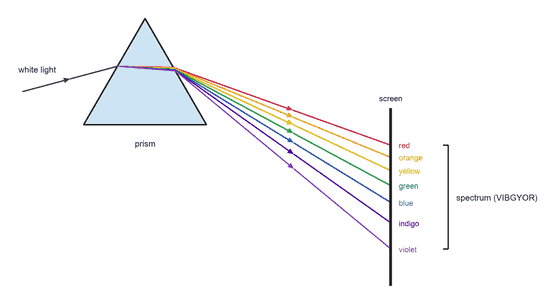
Therefore, dispersion is the splitting of white light into its constituent colours by a transparent medium such as a prism.
- 232 marks
Question 23
What do you understand by the term spectrum ?
Solve with AIWritten solution
Solution:
Concept: When white light is dispersed by a prism, its colours fall on a screen side by side in order of wavelength.
Step 1 — Define a spectrum.
The coloured band obtained on a screen when white light is dispersed by a prism is called a spectrum.
Step 2 — Say what it contains.
For white light it shows the seven colours violet, indigo, blue, green, yellow, orange and red, in that order.
Step 3 — Give the general meaning.
More generally, a spectrum is the arrangement of the components of a radiation in order of their wavelengths (or frequencies).
Therefore, a spectrum is the coloured band (VIBGYOR) of the components of white light, arranged in order of wavelength, obtained on a screen after dispersion.
- 243 marks
Question 24
A ray of white light is passed through a glass prism and a spectrum is obtained on a screen.
(a) Name the seven colours of the spectrum in order.
(b) Do the colours have the same width in the spectrum ?
(c) Which colour of the spectrum of white light deviates (i) the most, (ii) the least ?
Solve with AIWritten solution
Solution:
Concept: A prism deviates (turns) light towards its base. The larger the refractive index of the prism for a colour, the more that colour is bent, so violet (largest μ) is deviated the most and red (smallest μ) the least.
Step 1 — Answer (a): the order of colours.
From the base side upwards on the screen the colours are violet, indigo, blue, green, yellow, orange and red (VIBGYOR): violet, deviated most, is nearest the base and red, deviated least, is nearest the apex.
Step 2 — Answer (b): the widths.
No, the colours do not have the same width. Each colour covers a different range of wavelengths (in the book's table red spans 6200–8000 Å, that is 1800 Å, but yellow only 5780–5920 Å, that is 140 Å), and a glass prism spreads the violet–blue end out more than the red end.
Step 3 — Answer (c)(i): most deviated.
Violet is deviated the most, because glass has the largest refractive index for violet light.
Step 4 — Answer (c)(ii): least deviated.
Red is deviated the least, because glass has the smallest refractive index for red light.
Watch out: The colour nearest the BASE of the prism is violet, the most deviated one.
Therefore, (a) VIBGYOR from the base side up; (b) no, the colours have different widths; (c) (i) violet deviates the most, (ii) red the least.
- 252 marks
Question 25
How would the dispersion of light change if the prism is submerged in water instead of air ? Will the spread of the constituent colours remain the same ?
Solve with AIWritten solution
Solution:
Concept: The bending at each face of a prism depends on the refractive index of glass RELATIVE to the surrounding medium, μ(relative) = μ(glass) ÷ μ(medium), not on the refractive index of glass alone.
Step 1 — Find the relative refractive index in each case.
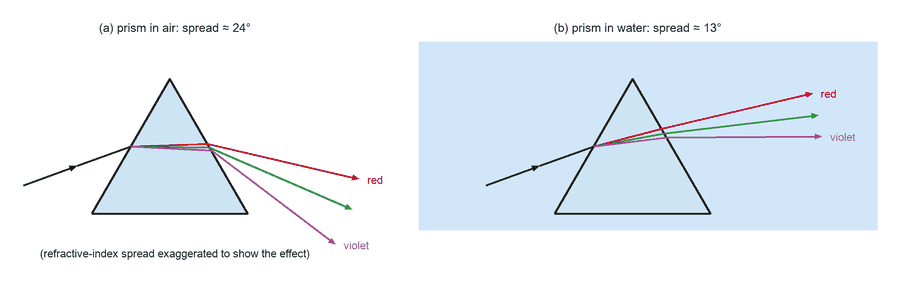
In air the relative refractive index is about 1.5. In water (μ = 1.33) it falls to about 1.13.
Step 2 — See the effect on the deviation.
A smaller relative refractive index means each colour bends less at both faces, so every colour is deviated less.
Step 3 — See the effect on the spread.
The relative refractive indices for red and for violet also come closer together, so the colours separate less and the spectrum becomes narrower. In the figure the same prism spreads the colours over about 24° in air but only about 13° in water.
Watch out: The prism's glass is unchanged, but what matters is how different it is from the medium around it.
Therefore, the dispersion decreases in water, and the spread of the constituent colours does not remain the same; it becomes narrower.
- 264 marks
Question 26
Explain the cause of dispersion of white light through a prism.
Solve with AIWritten solution
Solution:
Concept: Dispersion is caused by the variation of the refractive index (and so of the speed of light) of the prism material with the wavelength (colour) of light.
Step 1 — White light is a mixture.
White light contains seven colours, each with its own wavelength, from violet (shortest) to red (longest).
Step 2 — Same speed in air, different speeds in glass.
In vacuum (or air) all the colours travel at the same speed. In glass the speed depends on the wavelength: red travels fastest and violet slowest.
Step 3 — So each colour has its own refractive index.
Since μ = c ÷ v, the refractive index of glass is least for red (fastest) and greatest for violet (slowest).
Step 4 — So each colour bends by a different amount.
When white light enters the prism, each colour is refracted by a different amount: violet bends the most and red the least, so the colours separate inside the prism. At the second face each colour bends again, the separation increases, and a spectrum is formed.
Watch out: The prism does not create the colours; it only separates colours already present in white light.
Therefore, the cause of dispersion is that the refractive index of glass (the speed of light in it) is different for different wavelengths, so each colour is deviated by a different amount.
- 275 marks
Question 27
Explain briefly, with the help of a neat labelled diagram, how does white light get dispersed by a prism.
On which surface of a prism, there is both dispersion and deviation of light, and on which surface of the prism, there is only deviation of light ?
Solve with AIWritten solution
Solution:
Concept: Dispersion is the splitting of white light into its colours. It happens because the refractive index (μ) of glass is slightly different for each colour: it is least for red light and greatest for violet light, so each colour bends by a different amount.
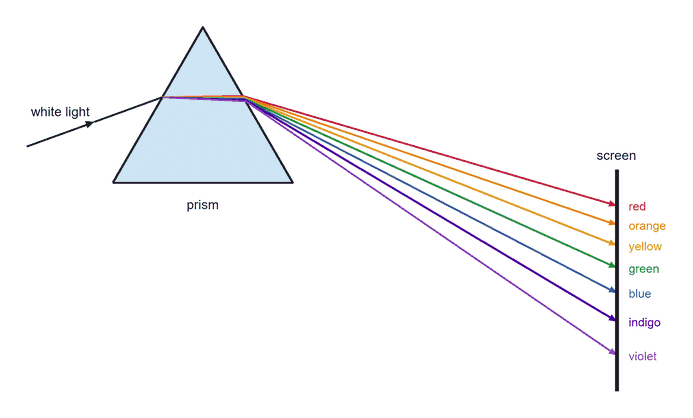
Step 1 — Set up the experiment.
A narrow beam of white light falls on the first face of a glass prism, and a white screen is placed beyond the second face.
Step 2 — What happens at the first face.
On entering the glass, the colours are refracted by different amounts, because the refractive index differs for each colour. The colours therefore separate inside the prism (dispersion), and the whole beam bends towards the base (deviation).
Step 3 — What happens at the second face.
At the second face each colour is refracted again, away from the normal. The colours, already separated, are bent further towards the base, so their separation increases.
Step 4 — What is seen on the screen.
The screen shows a spectrum, VIBGYOR: violet, deviated most, nearest the base and red, deviated least, nearest the apex.
Step 5 — Name the surfaces.
At the first surface there is both dispersion and deviation. At the second surface there is only deviation: the colours separated at the first face are bent further, but no new splitting takes place.
Watch out: The colours split at the FIRST face; the second face only bends the colours that are already separate.
Therefore, white light is dispersed because each colour has a different refractive index in glass; there is both dispersion and deviation at the first surface and only deviation at the second surface.
- 284 marks
Question 28
The diagram shown below in Fig. 6.8 shows the path taken by a narrow beam of yellow monochromatic light passing through an equiangular glass prism. If the yellow light is replaced by a narrow beam of white light incident at the same angle, draw another diagram to show the passage of white light through the prism and label it to show the effect of the prism on the white light.
 Solve with AI
Written solution
Solution:
Concept: In Fig. 6.8 the yellow light passes through the equiangular prism parallel to its base, which is the position of minimum deviation. White light contains yellow along with colours of shorter and longer wavelength, which the prism bends by different amounts.
Step 1 — Yellow keeps its old path.
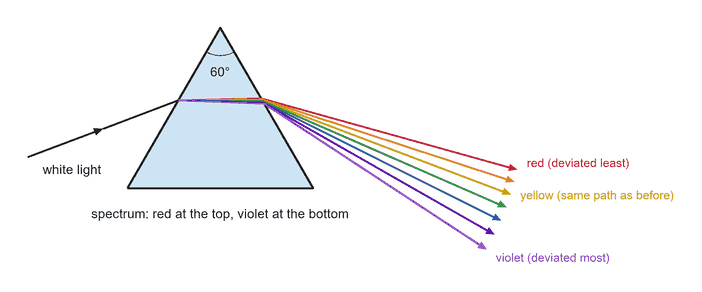
At the same angle of incidence, yellow light has the same refractive index as before, so it follows exactly the same path: parallel to the base inside the prism.
Step 2 — Shorter wavelengths bend more.
Green, blue, indigo and violet have shorter wavelengths, so glass has a larger refractive index for them; they are deviated more, towards the base.
Step 3 — Longer wavelengths bend less.
Orange and red have longer wavelengths, so they are deviated less than yellow.
Step 4 — Draw and label the result.
A spectrum fans out from the second face, with red at the top (deviated least) and violet at the bottom (deviated most).
Watch out: The colour that was at minimum deviation (yellow) still passes parallel to the base; the others do not.
Therefore, the prism disperses the white light into a spectrum: yellow follows its old path, red is deviated least (top) and violet most (bottom).
- 294 marks
Question 29
Fig. 6.9 shows a thin beam of white light from a source S striking on one face of a prism.

(a) Complete the diagram to show the effect of the prism on the beam and to show what is seen on the screen.
(b) If a slit is placed in between the prism and the screen to pass only the light of green colour, what will you then observe on the screen ?
(c) What conclusion do you draw from the observation in part (b) above ?
Solve with AIWritten solution
Solution:
Concept: A prism splits white light into its colours; a single colour picked out of the spectrum cannot be split any further.
Step 1 — Answer (a): complete the diagram.
The prism disperses the white light. A spectrum is seen on the screen with red at the top (deviated least) and violet at the bottom (deviated most): red, orange, yellow, green, blue, indigo, violet.
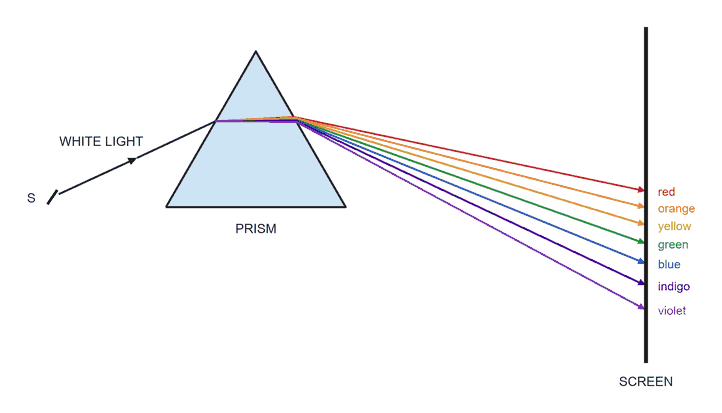
Step 2 — Answer (b): pass only green light.
A card with a slit is placed so that the spectrum falls on it and only the green light goes through the slit. The screen then shows only a green patch of light.

Step 3 — Answer (c): the conclusion.
The green light is not split any further by the slit or by another prism. So green light is a single colour (monochromatic), and white light is a mixture of several colours (polychromatic).
Watch out: The slit does not make the light green; it only selects the green part already present in the spectrum.
Therefore, (a) a spectrum with red at the top and violet at the bottom; (b) only a green patch is seen; (c) green is a single (monochromatic) colour, while white light is a mixture of colours.
- 304 marks
Question 30
(a) A beam of monochromatic light undergoes minimum deviation through an equiangular prism. How does the beam pass through the prism with respect to its base ?
(b) If white light is used in the same way as in part (a) above, what change do you expect in the emergent beam ?
(c) What conclusion do you draw about the nature of white light in part (b) ?
Solve with AIWritten solution
Solution:
Concept: At minimum deviation the path through an equiangular prism is symmetrical: the angle of incidence equals the angle of emergence, and the ray inside makes equal angles with the two faces.
Step 1 — Answer (a): the monochromatic beam.
Because the path is symmetrical, the beam inside the prism makes equal angles with the two equal faces, so it passes parallel to the base.
Step 2 — Answer (b): white light used the same way.
The emergent beam is split into its constituent colours and a spectrum is formed. The colour for which the prism is at minimum deviation still passes parallel to the base; violet is deviated the most and red the least.
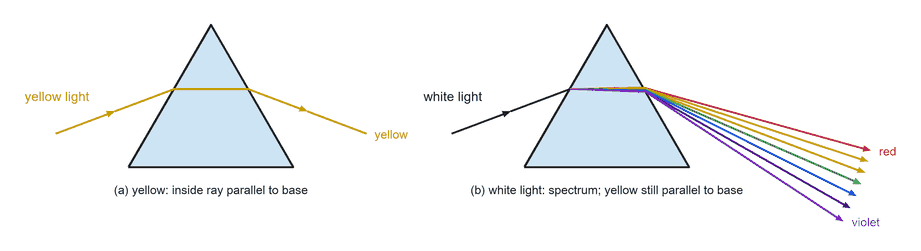
Step 3 — Answer (c): the conclusion.
Since the prism only separates the light, the colours must already be present in white light. So white light is polychromatic, a mixture of light of several colours (wavelengths).
Therefore, (a) the beam passes parallel to the base; (b) the emergent beam is dispersed into a spectrum; (c) white light is a mixture of several colours (polychromatic).
- 313 marks
Question 31
Calculate the frequency of yellow light of wavelength 550 nm. The speed of light is .
Solve with AIWritten solution
Solution:
Concept: Light is a wave, so its speed, frequency and wavelength are linked: speed = frequency × wavelength, c = fλ.
Given: wavelength λ = 550 nm, speed of light c = 3 × 10⁸ m s⁻¹.
Step 1 — Change the wavelength into metre.
Since 1 nm = 10⁻⁹ m, multiply 550 by 10⁻⁹.
Step 2 — Rearrange the formula for f.
Divide both sides of c = fλ by λ.
Step 3 — Substitute and calculate.
Put in the speed of light and the wavelength.
Step 4 — Check that it is sensible.
This lies between the frequencies of red light (3.75 × 10¹⁴ Hz) and violet light (7.5 × 10¹⁴ Hz), as it should for yellow, a colour in the middle of the spectrum.
Watch out: Change nm into m before dividing; 550 nm is 5.5 × 10⁻⁷ m, not 5.5 × 10⁻⁹ m.
Therefore, the frequency of the yellow light is about 5.45 × 10¹⁴ Hz.
- 323 marks
Question 32
The frequency range of visible light is from Hz to Hz. Calculate its wavelength range. Take speed of light .
Solve with AIWritten solution
Solution:
Concept: Since c = fλ, the wavelength is the speed of light divided by the frequency, so the HIGHEST frequency gives the SHORTEST wavelength. One ångström is 10⁻¹⁰ m.
Given: f₁ = 7.5 × 10¹⁴ Hz, f₂ = 3.75 × 10¹⁴ Hz, c = 3 × 10⁸ m s⁻¹.
Step 1 — Find the wavelength for the highest frequency.
Divide c by 7.5 × 10¹⁴ Hz.
Step 2 — Find the wavelength for the lowest frequency.
Divide c by 3.75 × 10¹⁴ Hz.
Step 3 — Write the range.
The shorter end (4000 Å) is violet and the longer end (8000 Å) is red.
Watch out: The higher frequency belongs to the SHORTER wavelength, so the ends of the range swap over.
Therefore, the wavelength range of visible light is 4 × 10⁻⁷ m to 8 × 10⁻⁷ m, that is 4000 Å to 8000 Å (400 nm to 800 nm).
- 331 mark
Question 33
When an electromagnetic wave passes from one medium to the other, which property remains unchanged ?
Solve with AIAnswer
(A) speed
(B) wavelength
(C) direction of travel
- Correct
(D) frequency
Answer: (D) frequency
Concept: The frequency of a wave is set by its source: it is the number of waves the source sends out each second. The medium cannot change it. For any wave, speed v = fλ.
Step 1 — See what happens to the speed.
When the wave enters a new medium its speed changes; light, for example, is slower in glass or water than in air.
Step 2 — See what happens to the wavelength.
Since v = fλ and f stays the same, the wavelength changes in the same ratio as the speed.
Step 3 — See what stays the same.
The source keeps sending the same number of waves each second, so the frequency is unchanged.

Watch out: The colour of light depends on its frequency, which is why light does not change colour on entering water.
Why the other options are wrong:
- (A) speed: the speed is different in different media (for light, less in glass than in air).
- (B) wavelength: the wavelength changes along with the speed, because λ = v ÷ f and f is fixed.
- (C) direction of travel: the direction changes when the wave meets the boundary at an angle (refraction), so it is not always unchanged.
Therefore, the frequency remains unchanged, option (D).
- 341 mark
Question 34
Two waves A and B have wavelengths 0·01 A° and 9000 A° respectively. The waves A and B are :
Solve with AIAnswer
(A) Gamma wave and ultraviolet wave respectively.
(B) Microwave and infrared wave respectively.
(C) Radiowave and gamma wave respectively.
- Correct
(D) Gamma wave and infrared wave respectively.
Answer: (D) Gamma wave and infrared wave respectively.
Concept: The electromagnetic spectrum in order of increasing wavelength (book's ranges): gamma rays (below 0.1 Å), X-rays (0.1 Å to 100 Å), ultraviolet (100 Å to 4000 Å), visible light (4000 Å to 8000 Å), infrared (8000 Å to 1 mm), microwaves (1 mm to 1 m) and radio waves (above 1 m). All of them travel at 3 × 10⁸ m s⁻¹ in vacuum.
Step 1 — Place wave A.
Wave A has a wavelength of 0.01 Å, which is shorter than 0.1 Å, so it lies in the gamma-ray range.
Step 2 — Place wave B.
Wave B has a wavelength of 9000 Å (900 nm). This is just longer than 8000 Å, the red end of the visible spectrum, so it lies in the infrared range (8000 Å to 1 mm).

Watch out: A larger number of ångström means a LONGER wavelength; 9000 Å is beyond red, not beyond violet.
Why the other options are wrong:
- (A) Gamma wave and ultraviolet wave respectively: B cannot be ultraviolet: ultraviolet is shorter than 4000 Å, while B is 9000 Å.
- (B) Microwave and infrared wave respectively: A cannot be a microwave: microwaves are 1 mm to 1 m long, while A is only 0.01 Å.
- (C) Radiowave and gamma wave respectively: A is not a radio wave (radio waves are longer than 1 m), and B is not a gamma wave.
Therefore, A is a gamma wave and B is an infrared wave, option (D).
- 351 mark
Question 35
The correct arrangement of the following radiations in an increasing order of their wavelengths is :
X-rays, infrared rays, gamma rays, microwaves.
Solve with AIAnswer
(A) gamma rays, infrared rays, X-rays, microwaves
(B) gamma rays, X-rays, microwaves, infrared rays
- Correct
(C) gamma rays, X-rays, infrared rays, microwaves
(D) X-rays, gamma rays, infrared rays, microwaves
Answer: (C) gamma rays, X-rays, infrared rays, microwaves
Concept: The electromagnetic spectrum in order of increasing wavelength (book's ranges): gamma rays (below 0.1 Å), X-rays (0.1 Å to 100 Å), ultraviolet (100 Å to 4000 Å), visible light (4000 Å to 8000 Å), infrared (8000 Å to 1 mm), microwaves (1 mm to 1 m) and radio waves (above 1 m). All of them travel at 3 × 10⁸ m s⁻¹ in vacuum.
Step 1 — Recall the full order.
From the shortest wavelength to the longest: gamma rays, X-rays, ultraviolet, visible, infrared, microwaves, radio waves.
Step 2 — Pick out the four given radiations.
Keeping that order, the four given ones are gamma rays (below 0.1 Å), X-rays (0.1–100 Å), infrared rays (8000 Å to 1 mm) and microwaves (1 mm to 1 m).
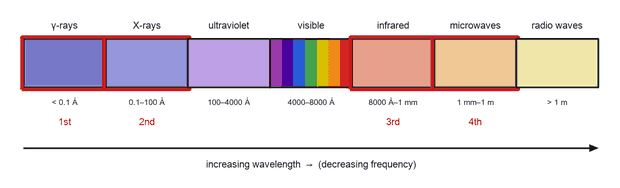
Watch out: "increasing order of wavelength" starts with the SHORTEST wavelength, gamma rays.
Why the other options are wrong:
- (A) gamma rays, infrared rays, X-rays, microwaves: it puts infrared before X-rays, but X-rays have a much shorter wavelength.
- (B) gamma rays, X-rays, microwaves, infrared rays: it puts microwaves before infrared, but microwaves have the longer wavelength.
- (D) X-rays, gamma rays, infrared rays, microwaves: it puts X-rays before gamma rays, but gamma rays have the shortest wavelength of all.
Therefore, the increasing order of wavelength is gamma rays, X-rays, infrared rays, microwaves, option (C).
- 361 mark
Question 36
A radiation P is focused by a proper device on the bulb of a thermometer. Mercury in the thermometer shows a rapid increase. The radiation P is :
Solve with AIAnswer
- Correct
(A) infrared radiation
(B) visible light
(C) ultraviolet radiation
(D) X-rays.
Answer: (A) infrared radiation
Concept: Infrared radiation has a strong heating effect, which is why it is also called heat radiation. Ultraviolet radiation is known instead for its chemical action, and X-rays for their penetrating power.
Step 1 — Note what the thermometer shows.
A rapid rise of the mercury means that the radiation strongly heats the thermometer bulb.
Step 2 — Match the effect with the radiation.
The radiation with a strong heating effect is infrared. When it is focused on the bulb it is absorbed, the bulb is heated strongly and the mercury rises rapidly; this is also how infrared is detected just beyond the red end of a spectrum.

Watch out: Visible light also warms things a little, but the RAPID rise points to infrared, the heat radiation.
Why the other options are wrong:
- (B) visible light: visible light has only a slight heating effect, so the mercury would rise slowly.
- (C) ultraviolet radiation: ultraviolet radiation has no noticeable heating effect; it is detected by its chemical action.
- (D) X-rays: X-rays are detected by their effect on a photographic plate and by fluorescence, not by heating a thermometer.
Therefore, the radiation P is infrared radiation, option (A).
- 371 mark
Question 37
The most energetic electromagnetic radiations are :
Solve with AIAnswer
(A) microwaves
(B) ultraviolet waves
(C) X-rays
- Correct
(D) gamma rays.
Answer: (D) gamma rays.
Concept: The shorter the wavelength of an electromagnetic wave (the higher its frequency), the more energy it carries and the more penetrating it is.
Step 1 — Compare the wavelengths.
Of the four, gamma rays have the shortest wavelength (below 0.1 Å) and so the highest frequency.
Step 2 — Decide which is most energetic.
The shortest wavelength carries the most energy, so gamma rays are the most energetic. This is why they are so penetrating and can kill living cells.

Watch out: X-rays are very energetic too, but gamma rays have an even shorter wavelength.
Why the other options are wrong:
- (A) microwaves: microwaves have a long wavelength (1 mm to 1 m), so they carry little energy.
- (B) ultraviolet waves: ultraviolet waves are longer than X-rays and gamma rays, so they carry less energy.
- (C) X-rays: X-rays are energetic, but less so than gamma rays, which have a shorter wavelength still.
Therefore, the most energetic electromagnetic radiations are gamma rays, option (D).
- 381 mark
Question 38
Column X shows the kinds of electromagnetic waves and column Y shows their applications.
Column X Column Y (A) Infrared rays (i) in remote-controlled gadgets (B) Radio waves (ii) for transmission (C) X-rays (iii) for detection of bone fractures (D) Ultraviolet rays (iv) absorption by atmospheric ozone layer Choose the correct pairing :
Solve with AIAnswer
- Correct
(A) A-(i) B-(ii) C-(iii) D-(iv)
(B) A-(iv) B-(iii) C-(ii) D-(i)
(C) A-(i) B-(ii) C-(iv) D-(iii)
(D) A-(iii) B-(ii) C-(i) D-(iv)
Answer: (A) A-i B-ii C-iii D-iv
Concept: Each kind of electromagnetic wave is matched with its best-known use or property from the chapter.
Step 1 — Match infrared rays.
A TV remote control sends invisible infrared signals, so infrared rays pair with use i, remote-controlled gadgets.
Step 2 — Match radio waves.
Radio and TV programmes are broadcast by radio waves, so radio waves pair with use ii, transmission.
Step 3 — Match X-rays.
X-rays pass through flesh but are stopped by bone, so they pair with use iii, detecting bone fractures.
Step 4 — Match ultraviolet rays.
The ozone layer absorbs most of the sun's ultraviolet rays, so ultraviolet pairs with item iv, absorption by the ozone layer.
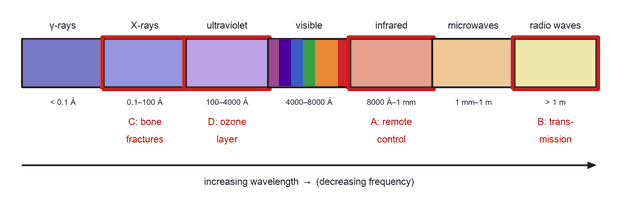
Watch out: Check every pair, not just the first one; one wrong pair makes the whole option wrong.
Why the other options are wrong:
- (B) A-iv B-iii C-ii D-i: it pairs infrared with the ozone layer and ultraviolet with remote controls; both pairs are wrong.
- (C) A-i B-ii C-iv D-iii: it pairs X-rays with the ozone layer and ultraviolet with bone fractures; both pairs are wrong.
- (D) A-iii B-ii C-i D-iv: it pairs infrared with bone fractures and X-rays with remote controls; both pairs are wrong.
Therefore, the correct pairing is A with i, B with ii, C with iii and D with iv, option (A).
- 392 marks
Question 39
(a) Arrange the following radiations in the order of their increasing wavelength :
X-rays, infrared rays, radio waves, gamma rays, and micro waves.
(b) Name the radiation which is used for satellite communication.
Solve with AIWritten solution
Solution:
Concept: The electromagnetic spectrum in order of increasing wavelength (book's ranges): gamma rays (below 0.1 Å), X-rays (0.1 Å to 100 Å), ultraviolet (100 Å to 4000 Å), visible light (4000 Å to 8000 Å), infrared (8000 Å to 1 mm), microwaves (1 mm to 1 m) and radio waves (above 1 m). All of them travel at 3 × 10⁸ m s⁻¹ in vacuum.
Step 1 — Answer (a): place each radiation.
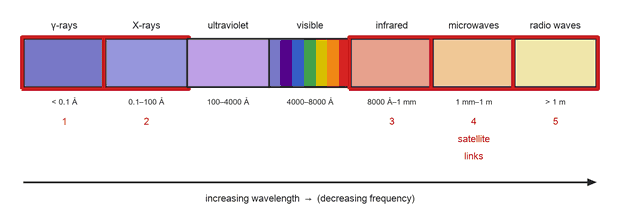
Gamma rays are shorter than 0.1 Å, X-rays are 0.1–100 Å, infrared is 8000 Å to 1 mm, microwaves are 1 mm to 1 m and radio waves are longer than 1 m.
Step 2 — Write them from shortest to longest.
Increasing wavelength means starting with the shortest: gamma rays, X-rays, infrared rays, microwaves, radio waves.
Step 3 — Answer (b): satellite communication.
Microwaves pass easily through the atmosphere and can be sent as a narrow beam, so they carry signals to and from satellites.
Watch out: Do not start with radio waves; they have the LONGEST wavelength.
Therefore, (a) gamma rays, X-rays, infrared rays, microwaves, radio waves; (b) microwaves are used for satellite communication.
- 402 marks
Question 40
A wave has a wavelength nm. (a) Name the wave. (b) State its one property different from light.
Solve with AIWritten solution
Solution:
Concept: The electromagnetic spectrum in order of increasing wavelength (book's ranges): gamma rays (below 0.1 Å), X-rays (0.1 Å to 100 Å), ultraviolet (100 Å to 4000 Å), visible light (4000 Å to 8000 Å), infrared (8000 Å to 1 mm), microwaves (1 mm to 1 m) and radio waves (above 1 m). All of them travel at 3 × 10⁸ m s⁻¹ in vacuum.
Step 1 — Change the wavelength into ångström.
Since 1 nm = 10 Å, multiply by 10.
Step 2 — Answer (a): name the wave.
A wavelength of 0.01 Å is shorter than 0.1 Å, so the wave is a gamma ray.
Step 3 — Answer (b): one property different from light.
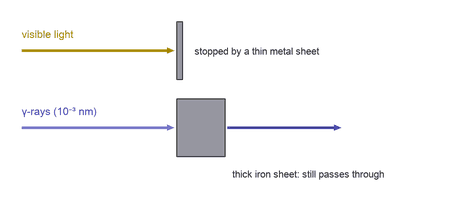
Gamma rays have a very high penetrating power: they can pass through thick sheets of metal such as iron, while light is stopped even by a thin metal sheet. (They are also invisible.)
Watch out: 1 nm = 10 Å, so a wavelength in nm becomes TEN times bigger as a number in Å.
Therefore, (a) the wave is a gamma ray; (b) unlike light, it has a very high penetrating power.
- 412 marks
Question 41
(a) Name the high energetic invisible electro-magnetic wave which helps in the study of the structure of crystals.
(b) State one more use of the wave named in part (a).
Solve with AIWritten solution
Solution:
Concept: X-rays are highly energetic, invisible electromagnetic waves of wavelength 0.1 Å to 100 Å, which is about the same as the spacing between atoms in a crystal.
Step 1 — Answer (a): name the wave.
Because their wavelength is close to the spacing of atoms, X-rays are diffracted by the rows of atoms in a crystal, and the pattern they make reveals how the atoms are arranged. So the wave is X-rays.
Step 2 — Answer (b): one more use.
X-rays pass through flesh but are stopped by bone, so a broken bone shows up clearly on an X-ray photograph; they are used to detect fractures in bones.

Therefore, (a) the wave is X-rays; (b) X-rays are also used to detect fractures in bones.
- 421 mark
Question 42
State the name and the range of wavelength of the invisible electromagnetic waves beyond the red end of the visible spectrum.
Solve with AIWritten solution
Solution:
Concept: The red end of the visible spectrum is at about 8000 Å (800 nm). The invisible radiation just beyond it is infrared radiation, also called heat radiation.
Step 1 — Name the waves.
The invisible waves just beyond the red end are infrared radiation.
Step 2 — Give the range.
Infrared starts at the red end, about 8000 Å (800 nm), and extends to about 1 mm (10⁷ Å).

Therefore, the waves are infrared radiation, with wavelength from about 8000 Å (800 nm) to 1 mm.
- 431 mark
Question 43
Give the range of wavelength of the electromagnetic waves visible to us.
Solve with AIWritten solution
Solution:
Concept: The visible spectrum runs from violet (shortest wavelength) to red (longest wavelength); our eyes cannot see wavelengths outside this range.
Step 1 — Find the short end.
Violet light, at the short end, has a wavelength of about 400 nm (4000 Å).
Step 2 — Find the long end.
Red light, at the long end, has a wavelength of about 800 nm (8000 Å).
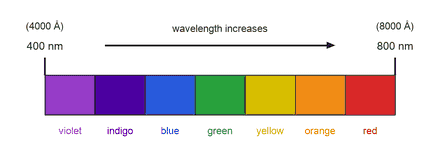
Therefore, the waves visible to us have wavelengths from about 400 nm to 800 nm (4000 Å to 8000 Å).
- 442 marks
Question 44
Name the region just beyond (i) the red end, and (ii) the violet end, of the spectrum.
Solve with AIWritten solution
Solution:
Concept: The visible spectrum has red at its long-wavelength end and violet at its short-wavelength end. Invisible radiations lie just beyond each end.
Step 1 — Answer (i): beyond the red end.
Just beyond the red end the wavelength is longer than 8000 Å; this region is infrared.
Step 2 — Answer (ii): beyond the violet end.
Just beyond the violet end the wavelength is shorter than 4000 Å; this region is ultraviolet.
Watch out: "infra" means below (below red in frequency) and "ultra" means beyond (beyond violet in frequency).
Therefore, (i) the region just beyond the red end is infrared; (ii) the region just beyond the violet end is ultraviolet.
- 452 marks
Question 45
Name the radiation which can be detected by (a) a thermopile (b) a solution of silver chloride.
Solve with AIWritten solution
Solution:
Concept: Invisible radiations are detected by their effects: infrared by its heating effect and ultraviolet by its chemical action.
Step 1 — Answer (a): thermopile.
A thermopile turns heat into a small electric current. Infrared radiation heats it, so the galvanometer connected to it shows a deflection. A thermopile detects infrared radiation.
Step 2 — Answer (b): silver chloride.
Silver chloride is changed chemically by ultraviolet radiation; a paper soaked in its solution turns first violet and then dark brown. It detects ultraviolet radiation.

Therefore, (a) a thermopile detects infrared radiation; (b) silver chloride solution detects ultraviolet radiation.
- 462 marks
Question 46
Name the radiations of wavelength just (a) longer than m, (b) shorter than m.
Solve with AIWritten solution
Solution:
Concept: The visible spectrum runs from about 4 × 10⁻⁷ m (violet) to 8 × 10⁻⁷ m (red); infrared lies beyond red and ultraviolet beyond violet. 1 nm = 10⁻⁹ m.
Step 1 — Change the wavelengths into nanometre.
Divide each by 10⁻⁹ m.
Step 2 — Answer (a).
A wavelength of 800 nm is the red end, so radiation just longer than this is infrared.
Step 3 — Answer (b).
A wavelength of 400 nm is the violet end, so radiation just shorter than this is ultraviolet.
Therefore, (a) radiation just longer than 8 × 10⁻⁷ m is infrared; (b) radiation just shorter than 4 × 10⁻⁷ m is ultraviolet.
- 472 marks
Question 47
Name the material of prism required for obtaining the spectrum of (a) ultraviolet light, (b) infrared radiations.
Solve with AIWritten solution
Solution:
Concept: To obtain the spectrum of a radiation, the prism must let that radiation pass through. Ordinary glass absorbs ultraviolet radiation and most of the infrared, so other materials are used.
Step 1 — Answer (a): ultraviolet.
Quartz transmits ultraviolet radiation, while glass absorbs it, so a quartz prism is used.
Step 2 — Answer (b): infrared.
Rock salt (sodium chloride) transmits infrared radiation, while glass absorbs most of it, so a rock-salt prism is used.
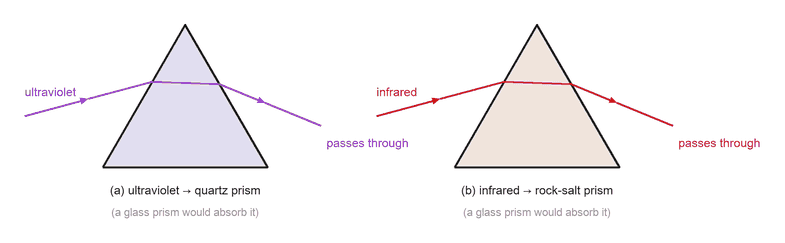
Therefore, (a) a quartz prism is needed for ultraviolet light; (b) a rock-salt prism is needed for infrared radiation.
- 481 mark
Question 48
Name the radiations which are absorbed by the green house gases in the earth's atmosphere.
Solve with AIWritten solution
Solution:
Concept: The earth, warmed by the sun, gives out heat as long-wavelength (infrared) radiation. Greenhouse gases such as carbon dioxide, water vapour and methane absorb this radiation.
Step 1 — Follow the energy.
Sunlight passes through the atmosphere and warms the earth's surface. The warm earth then gives out infrared radiation.
Step 2 — Name what the gases absorb.
Greenhouse gases absorb this infrared radiation and send part of it back towards the earth, which keeps the surface warm (the greenhouse effect).
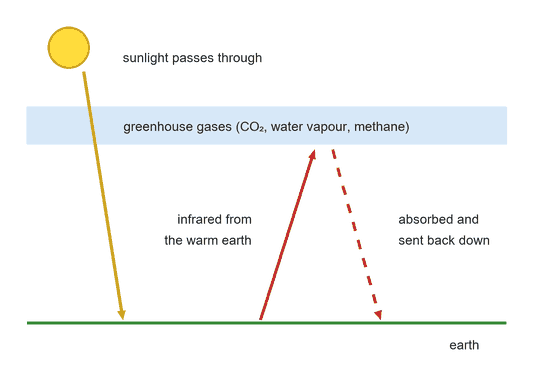
Therefore, the greenhouse gases absorb infrared radiations.
- 493 marks
Question 49
(a) Give a list of at least five radiations. in the order of their increasing wavelength, which make up the complete electromagnetic spectrum.
(b) Name the radiation mentioned by you in part (a) which has the highest penetrating power.
Solve with AIWritten solution
Solution:
Concept: The electromagnetic spectrum in order of increasing wavelength (book's ranges): gamma rays (below 0.1 Å), X-rays (0.1 Å to 100 Å), ultraviolet (100 Å to 4000 Å), visible light (4000 Å to 8000 Å), infrared (8000 Å to 1 mm), microwaves (1 mm to 1 m) and radio waves (above 1 m). All of them travel at 3 × 10⁸ m s⁻¹ in vacuum.
Step 1 — Answer (a): list the radiations.
In order of increasing wavelength the complete electromagnetic spectrum is: gamma rays, X-rays, ultraviolet rays, visible light, infrared rays, microwaves and radio waves.
Step 2 — Give their ranges.
The table lists each radiation with its approximate wavelength range.
Radiation Approximate wavelength range Gamma rays less than 0.1 Å X-rays 0.1 Å to 100 Å Ultraviolet 100 Å to 4000 Å Visible light 4000 Å to 8000 Å Infrared 8000 Å to 1 mm Microwaves 1 mm to 1 m Radio waves more than 1 m 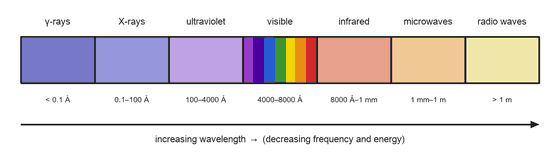
Step 3 — Answer (b): highest penetrating power.
Gamma rays have the shortest wavelength, so they carry the most energy and are the most penetrating; they can pass even through thick metal sheets.
Therefore, (a) gamma rays, X-rays, ultraviolet, visible light, infrared, microwaves, radio waves; (b) gamma rays have the highest penetrating power.
- 503 marks
Question 50
A wave has wavelength 50 Å. (a) Name the wave. (b) State its speed in vacuum. (c) State its one use.
Solve with AIWritten solution
Solution:
Concept: The electromagnetic spectrum in order of increasing wavelength (book's ranges): gamma rays (below 0.1 Å), X-rays (0.1 Å to 100 Å), ultraviolet (100 Å to 4000 Å), visible light (4000 Å to 8000 Å), infrared (8000 Å to 1 mm), microwaves (1 mm to 1 m) and radio waves (above 1 m). All of them travel at 3 × 10⁸ m s⁻¹ in vacuum.
Step 1 — Answer (a): name the wave.
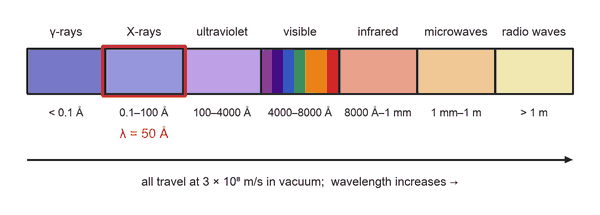
A wavelength of 50 Å lies between 0.1 Å and 100 Å, which is the X-ray range, so the wave is an X-ray.
Step 2 — Answer (b): speed in vacuum.
All electromagnetic waves travel at the speed of light in vacuum, whatever their wavelength.
Step 3 — Answer (c): one use.
X-rays pass through flesh but are stopped by bone, so they are used to detect fractures in bones. (They are also used to study the structure of crystals.)
Therefore, (a) the wave is an X-ray; (b) its speed in vacuum is 3 × 10⁸ m s⁻¹; (c) it is used to detect bone fractures.
- 513 marks
Question 51
Name three radiations and their wavelength range which are invisible and beyond the violet end of the visible spectrum.
Solve with AIWritten solution
Solution:
Concept: The electromagnetic spectrum in order of increasing wavelength (book's ranges): gamma rays (below 0.1 Å), X-rays (0.1 Å to 100 Å), ultraviolet (100 Å to 4000 Å), visible light (4000 Å to 8000 Å), infrared (8000 Å to 1 mm), microwaves (1 mm to 1 m) and radio waves (above 1 m). All of them travel at 3 × 10⁸ m s⁻¹ in vacuum.
Step 1 — Move beyond the violet end.
Beyond the violet end (4000 Å) the wavelength gets shorter and shorter, and all the radiations there are invisible.
Step 2 — List the three radiations with ranges.
Next to violet is ultraviolet, then X-rays, then gamma rays.
- Ultraviolet rays: about 100 Å to 4000 Å (10 nm to 400 nm), next to violet;
- X-rays: about 0.1 Å to 100 Å (0.01 nm to 10 nm);
- Gamma rays: less than 0.1 Å (below 0.01 nm), the shortest of all.
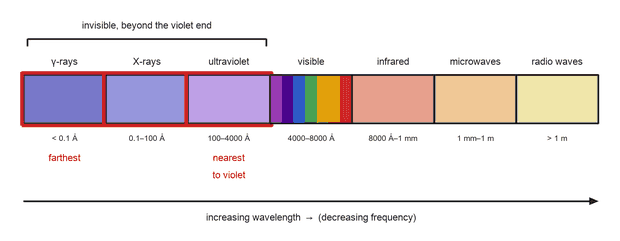
Therefore, beyond the violet end lie ultraviolet rays (100–4000 Å), X-rays (0.1–100 Å) and gamma rays (below 0.1 Å).
- 522 marks
Question 52
What do you understand by the invisible spectrum ?
Solve with AIWritten solution
Solution:
Concept: Our eyes can see only wavelengths from about 4000 Å to 8000 Å. The rest of the electromagnetic spectrum cannot be seen.
Step 1 — Define the invisible spectrum.
The part of the electromagnetic spectrum that our eyes cannot see is called the invisible spectrum.
Step 2 — Say where it lies.
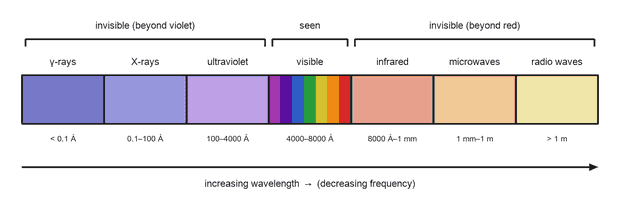
It lies on both sides of the visible spectrum: beyond the violet end are ultraviolet rays, X-rays and gamma rays; beyond the red end are infrared rays, microwaves and radio waves.
Step 3 — Say how it is detected.
These radiations are detected only by their effects, such as heating, chemical action or fluorescence.
Therefore, the invisible spectrum is the part of the electromagnetic spectrum, on both sides of the visible band, that the eye cannot see.
- 533 marks
Question 53
State the approximate range of wavelength associated with (a) ultraviolet rays, (b) visible light, and (c) infrared rays.
Solve with AIWritten solution
Solution:
Concept: Visible light sits in the middle; ultraviolet is just shorter (beyond violet) and infrared just longer (beyond red).
Step 1 — Answer (a): ultraviolet.
Ultraviolet rays have wavelengths of about 100 Å to 4000 Å (10 nm to 400 nm).
Step 2 — Answer (b): visible light.
Visible light has wavelengths of about 4000 Å to 8000 Å (400 nm to 800 nm).
Step 3 — Answer (c): infrared.
Infrared rays have wavelengths of about 8000 Å (800 nm) to 1 mm (10⁷ Å).
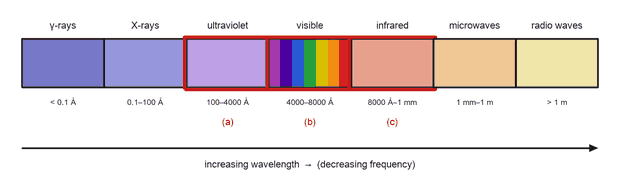
Therefore, (a) ultraviolet: 100–4000 Å; (b) visible: 4000–8000 Å; (c) infrared: 8000 Å to 1 mm.
- 542 marks
Question 54
Name two electromagnetic waves of wavelength smaller than that of violet light. State one use of each.
Solve with AIWritten solution
Solution:
Concept: Violet light has a wavelength of about 4000 Å. Ultraviolet rays, X-rays and gamma rays all have shorter wavelengths.
Step 1 — First wave and its use.
Ultraviolet rays kill germs, so they are used to sterilise water, air and surgical instruments.
Step 2 — Second wave and its use.
X-rays pass through flesh but not through bone, so they are used to detect fractures in bones.
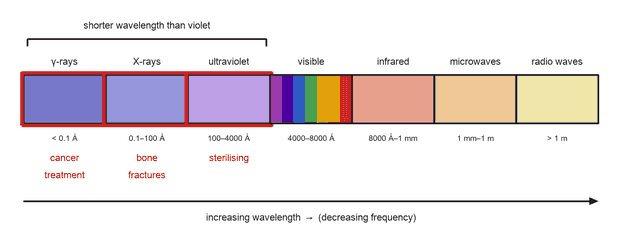
(Gamma rays are a third example; they are used to treat cancer.)
Therefore, two such waves are ultraviolet rays (used to sterilise) and X-rays (used to detect bone fractures).
- 552 marks
Question 55
Give one use each of (a) microwaves, (b) ultraviolet radiations, (c) infrared radiations, and (d) gamma rays.
Solve with AIWritten solution
Solution:
Concept: Each use of a radiation comes from one of its special properties.
Step 1 — Answer (a): microwaves.
Microwaves heat food quickly, so they are used for cooking in microwave ovens; they are also used for satellite communication and radar.
Step 2 — Answer (b): ultraviolet.
Ultraviolet radiations kill germs, so they are used to sterilise water and surgical instruments.
Step 3 — Answer (c): infrared.
Infrared radiations are invisible and are scattered little, so they are used in TV remote controls and for photography in fog.
Step 4 — Answer (d): gamma rays.
Gamma rays have very high energy and kill cancer cells, so they are used to treat cancer (radiotherapy).
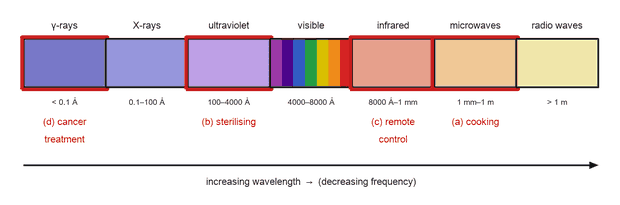
Therefore, (a) microwaves: cooking; (b) ultraviolet: sterilising; (c) infrared: remote controls; (d) gamma rays: treating cancer.
- 562 marks
Question 56
Name the waves (a) of lowest wavelength, (b) used for taking photographs in dark, (c) produced by changes in the nucleus of an atom, (d) of wavelength nearly 0·1 nm.
Solve with AIWritten solution
Solution:
Concept: The electromagnetic spectrum in order of increasing wavelength (book's ranges): gamma rays (below 0.1 Å), X-rays (0.1 Å to 100 Å), ultraviolet (100 Å to 4000 Å), visible light (4000 Å to 8000 Å), infrared (8000 Å to 1 mm), microwaves (1 mm to 1 m) and radio waves (above 1 m). All of them travel at 3 × 10⁸ m s⁻¹ in vacuum.
Step 1 — Answer (a): lowest wavelength.
Gamma rays have the shortest wavelength of all (less than 0.1 Å).
Step 2 — Answer (b): photographs in the dark.
Warm objects give out infrared rays, and a film sensitive to infrared records them even in the dark, so infrared rays are used.
Step 3 — Answer (c): changes in the nucleus.
Gamma rays are given out when the nucleus of a radioactive atom passes from an excited state to a lower energy state.
Step 4 — Answer (d): wavelength nearly 0.1 nm.
Change 0.1 nm into ångström: 0.1 nm = 1 Å, which lies in the X-ray range (0.1 Å to 100 Å).
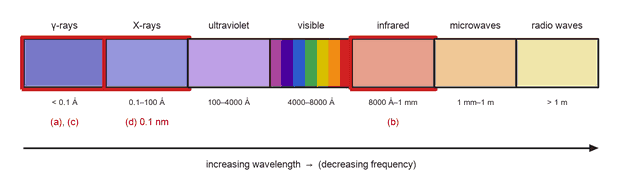
Therefore, (a) gamma rays; (b) infrared rays; (c) gamma rays; (d) X-rays.
- 572 marks
Question 57
Two waves A and B have wavelength 0·01 Å and 9000 Å respectively.
(a) Name the two waves.
(b) Compare the speeds of these waves when they travel in vacuum.
Solve with AIWritten solution
Solution:
Concept: The electromagnetic spectrum in order of increasing wavelength (book's ranges): gamma rays (below 0.1 Å), X-rays (0.1 Å to 100 Å), ultraviolet (100 Å to 4000 Å), visible light (4000 Å to 8000 Å), infrared (8000 Å to 1 mm), microwaves (1 mm to 1 m) and radio waves (above 1 m). All of them travel at 3 × 10⁸ m s⁻¹ in vacuum.
Step 1 — Answer (a): name wave A.
Wave A has a wavelength of 0.01 Å, below 0.1 Å, so it is a gamma ray.
Step 2 — Name wave B.
Wave B has a wavelength of 9000 Å, just beyond 8000 Å (the red end), so it is an infrared ray.
Step 3 — Answer (b): compare the speeds in vacuum.
All electromagnetic waves travel at the same speed in vacuum, c = 3 × 10⁸ m s⁻¹, so the ratio of their speeds is 1 : 1.
Step 4 — See what does differ.
Only their frequencies differ (f = c ÷ λ): wave A, with the much shorter wavelength, has the much higher frequency.
Watch out: Different wavelengths do NOT mean different speeds in vacuum.
Therefore, (a) A is a gamma ray and B is an infrared ray; (b) both travel at the same speed, 3 × 10⁸ m s⁻¹ (ratio 1 : 1).
- 582 marks
Question 58
Name two sources, each of infrared radiations and ultraviolet radiations.
Solve with AIWritten solution
Solution:
Concept: Every hot body gives out infrared radiation; very hot sources, such as the sun and electric arcs, also give out ultraviolet radiation.
Step 1 — Two sources of infrared.
The sun, and any hot body such as a room heater, an electric iron or a filament lamp, give out infrared radiation.
Step 2 — Two sources of ultraviolet.
The sun, an electric arc (such as a welding arc) and mercury-vapour lamps give out ultraviolet radiation.
Step 3 — Note about the sun.
The sun is a natural source of both, although the ozone layer absorbs most of its ultraviolet radiation.
Therefore, sources of infrared are the sun and hot bodies such as a heater; sources of ultraviolet are the sun and an electric arc.
- 594 marks
Question 59
Name two properties of ultraviolet radiations which are similar to visible light and two which differ from visible light.
Solve with AIWritten solution
Solution:
Concept: Ultraviolet rays are electromagnetic waves like light, so they share light's wave properties; their shorter wavelength gives them some different effects.
Step 1 — First similar property.
Like light, ultraviolet rays travel in straight lines at 3 × 10⁸ m s⁻¹ in vacuum.
Step 2 — Second similar property.
Like light, they obey the laws of reflection and refraction.
Step 3 — First different property.
Unlike light, they are invisible to our eyes, and too much exposure harms the body (sunburn, skin cancer, eye damage).
Step 4 — Second different property.
Unlike light, they are absorbed by ordinary glass (but pass through quartz), and they cause fluorescence and kill germs; visible light passes through glass and does neither.
Therefore, ultraviolet rays are like light in travelling at 3 × 10⁸ m s⁻¹ in straight lines and obeying the laws of reflection and refraction, and unlike light in being invisible and harmful, and in being absorbed by glass and causing fluorescence.
- 604 marks
Question 60
Mention two properties of infrared radiations which are similar to visible light and two which differ from visible light.
Solve with AIWritten solution
Solution:
Concept: Infrared rays are electromagnetic waves like light, so they share light's wave properties; their longer wavelength gives them some different effects.
Step 1 — First similar property.
Like light, infrared rays travel in straight lines at 3 × 10⁸ m s⁻¹ in vacuum.
Step 2 — Second similar property.
Like light, they obey the laws of reflection and refraction.
Step 3 — First different property.
Unlike light, they are invisible, and they produce a strong heating effect.
Step 4 — Second different property.
Unlike light, they are scattered much less by fog and dust, so they pass through fog; also, ordinary glass absorbs most infrared, while rock salt lets it pass.
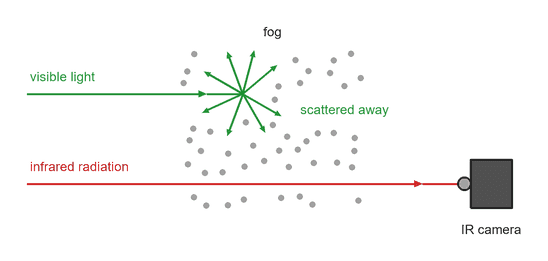
Therefore, infrared rays are like light in travelling at 3 × 10⁸ m s⁻¹ in straight lines and obeying the laws of reflection and refraction, and unlike light in being invisible with a strong heating effect, and in being scattered little by fog.
- 612 marks
Question 61
State one harmful effect each of the (a) ultraviolet and (b) infrared radiations.
Solve with AIWritten solution
Solution:
Concept: Both radiations are harmless in small amounts but harmful in large doses.
Step 1 — Answer (a): ultraviolet.
Over-exposure to ultraviolet causes sunburn and can lead to skin cancer; it can also damage the eyes. The ozone layer protects us by absorbing most of the sun's ultraviolet.
Step 2 — Answer (b): infrared.
A high dose of infrared heats the body strongly; it can burn the skin, and too much exposure can cause heat stroke.
Therefore, (a) ultraviolet can cause skin cancer (and sunburn); (b) infrared can burn the skin (and cause heat stroke).
- 626 marks
Question 62
Give reason for the following :
(i) Infrared radiations are used for photography in fog.
(ii) Infrared radiations are used for signals during war.
(iii) The photographic darkrooms are provided with infrared lamps.
(iv) A rock salt prism is used instead of a glass prism to obtain the infrared spectrum.
(v) A quartz prism is required for obtaining the spectrum of ultraviolet light.
(vi) Ultraviolet bulbs have a quartz envelope instead of glass.
Solve with AIWritten solution
Solution:
Concept: Each reason comes from one property: infrared is scattered little, is invisible and does not affect ordinary photographic film; glass absorbs ultraviolet and most infrared, while quartz passes ultraviolet and rock salt passes infrared.
Step 1 — Reason (i): photography in fog.
Infrared radiations have a long wavelength, so they are scattered very little by the fog droplets. They pass through the fog and give clear photographs.
Step 2 — Reason (ii): signals during war.
Infrared signals are invisible to the enemy, and they pass through fog and smoke with little scattering, so they reach far.
Step 3 — Reason (iii): infrared lamps in darkrooms.
Infrared light does not affect ordinary photographic film (it has no chemical action on it), yet it lets the worker see a little in the dark.
Step 4 — Reason (iv): rock-salt prism for the infrared spectrum.
Glass absorbs most infrared radiation, while rock salt lets it pass, so a rock-salt prism is needed to obtain the infrared spectrum.
Step 5 — Reason (v): quartz prism for the ultraviolet spectrum.
Glass absorbs ultraviolet radiation, while quartz transmits it, so a quartz prism is needed.
Step 6 — Reason (vi): quartz envelope for ultraviolet bulbs.
For the same reason, a glass envelope would absorb the ultraviolet rays, whereas a quartz envelope lets them pass out of the bulb.
Therefore, each use follows from little scattering and invisibility of infrared, its lack of effect on film, and the absorption of infrared and ultraviolet by glass (but not by rock salt and quartz).
- 632 marks
Question 63
Radiations from the sun fall on a prism and suffer dispersion. Three thermometers are kept on which the radiations after dispersion are made to fall as shown in the figure given alongside. Which thermometer would show a higher reading ? Give a reason for your answer.
 Solve with AI
Written solution
Solution:
Concept: The heating effect of sunlight's spectrum is small at the violet end and increases towards the red end; it is strongest just beyond the red, in the invisible infrared region.
Step 1 — Note where each thermometer is.
In the figure thermometer A is in the red region, B in the indigo region and C in the violet region.
Step 2 — Compare their heating.
Red light (and the infrared just beyond it) has the strongest heating effect, while indigo and violet have much weaker heating effects.
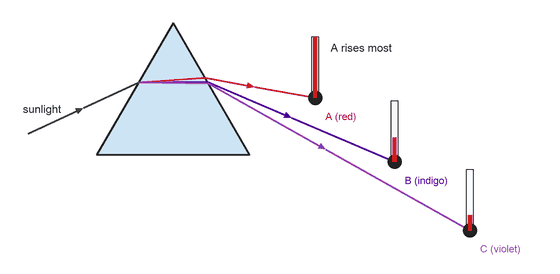
Step 3 — Choose the thermometer.
So thermometer A, in the red region, is heated the most and shows the highest reading.
Watch out: The heating effect is strongest towards the RED end, not the violet end.
Therefore, thermometer A (in the red region) shows the highest reading, because the heating effect is greatest towards the red end of the spectrum.
- 644 marks
Question 64
What are infrared radiations ? How are they detected ? State one use of these radiations.
Solve with AIWritten solution
Solution:
Concept: Infrared radiation is invisible, so it is detected by its effect, a strong heating effect.
Step 1 — Say what they are.
Infrared radiations are invisible electromagnetic waves of wavelength just longer than red light, from about 8000 Å (800 nm) to 1 mm. Hot bodies give them out, and because they heat whatever absorbs them they are also called heat radiation.
Step 2 — Say how they are detected.
A spectrum of sunlight is obtained with a rock-salt prism, and a thermopile (connected to a galvanometer) or a thermometer with a blackened bulb is placed just beyond the red end. The galvanometer shows a deflection, or the thermometer reading rises, where infrared falls on it.
Step 3 — Give one use.
Infrared radiations are used in the remote controls of TVs and other gadgets. (Other uses: photography in fog or darkness, physiotherapy, drying paint.)
Therefore, infrared radiations are invisible waves just longer than red (8000 Å to 1 mm); they are detected by their heating effect with a thermopile or a blackened-bulb thermometer; one use is in TV remote controls.
- 654 marks
Question 65
What are ultraviolet radiations ? How are they detected ? State one use of these radiations.
Solve with AIWritten solution
Solution:
Concept: Ultraviolet radiation is invisible, so it is detected by its effect, a strong chemical action.
Step 1 — Say what they are.
Ultraviolet radiations are invisible electromagnetic waves of wavelength just shorter than violet light, from about 100 Å to 4000 Å. The sun and electric arcs are their sources.
Step 2 — Say how they are detected.
A spectrum of sunlight is obtained with a quartz prism, and a paper soaked in silver chloride solution is placed just beyond the violet end. Where ultraviolet falls on it, the paper turns first violet and then dark brown. (Ultraviolet also makes some substances fluoresce.)
Step 3 — Give one use.
Ultraviolet radiations kill germs, so they are used to sterilise drinking water and surgical instruments. (Other uses: detecting forged documents and fingerprints, producing vitamin D in the skin.)
Therefore, ultraviolet radiations are invisible waves just shorter than violet (100–4000 Å); they are detected by their chemical action on silver chloride; one use is to sterilise water and instruments.
- 663 marks
Question 66
An electromagnetic wave has a frequency of 500 MHz and a wavelength of 60 cm.
(a) Calculate the speed of the wave.
(b) Name the medium through which it is travelling.
Solve with AIWritten solution
Solution:
Concept: For every wave, speed = frequency × wavelength, v = fλ. All electromagnetic waves travel at 3 × 10⁸ m s⁻¹ in vacuum (and very nearly so in air).
Given: f = 500 MHz, λ = 60 cm.
Step 1 — Change the data into S.I. units.
Write the frequency in hertz (1 MHz = 10⁶ Hz) and the wavelength in metre (1 cm = 10⁻² m).
Step 2 — Answer (a): calculate the speed.
Multiply the frequency by the wavelength.
Step 3 — Answer (b): name the medium.
This speed equals the speed of light in vacuum, so the wave is travelling through vacuum (or air). In glass or water its speed would be less.
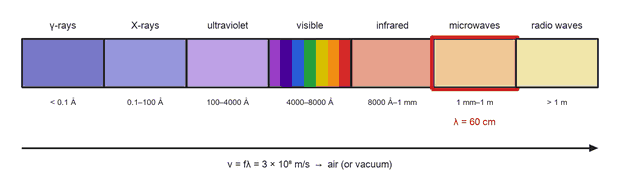
Watch out: Change MHz into Hz and cm into m before multiplying.
Therefore, (a) the speed of the wave is 3 × 10⁸ m s⁻¹; (b) it is travelling through vacuum (or air).
- 673 marks
Question 67
The wavelength of X-rays is 0·01 Å. Calculate its frequency. State the assumption made, if any.
Solve with AIWritten solution
Solution:
Concept: For an electromagnetic wave c = fλ, so the frequency is the speed of light divided by the wavelength. One ångström is 10⁻¹⁰ m.
Given: λ = 0.01 Å, c = 3 × 10⁸ m s⁻¹.
Step 1 — Change the wavelength into metre.
Multiply 0.01 by 10⁻¹⁰, since one ångström is 10⁻¹⁰ m.
Step 2 — Calculate the frequency.
Divide the speed of light by the wavelength.
Step 3 — State the assumption.
We have assumed that the X-rays travel in vacuum (or air) at the speed of light, 3 × 10⁸ m s⁻¹.
Watch out: Dividing by 10⁻¹² is the same as multiplying by 10¹², so the powers of ten add up to 10²⁰.
Note: by the book's own ranges a wavelength of 0.01 Å lies in the gamma-ray range (below 0.1 Å); the question calls it X-rays, and the calculation is the same either way.
Therefore, the frequency is 3 × 10²⁰ Hz, assuming the X-rays travel at 3 × 10⁸ m s⁻¹ (in vacuum).
- 681 mark
Question 68
For scattering of light, the necessary condition is that the size of air molecules should be ............ the wavelength of incident light.
Solve with AIAnswer
- Correct
(A) smaller than
(B) greater than
(C) equal to
(D) both (B) and (C)
Answer: (A) smaller than
Concept: Scattering of light is the absorption and re-emission of light in all directions by particles in its path. For particles much smaller than the wavelength (such as air molecules), the intensity of the scattered light is , so short wavelengths (violet, blue) are scattered far more than long ones (red).
Step 1 — Compare the sizes.
Air molecules are much smaller than the wavelength of visible light (4000 Å to 8000 Å).
Step 2 — See what such small particles do.
Particles much smaller than the wavelength absorb the light and re-emit it in all directions, and they scatter short wavelengths (blue, violet) far more than long ones (red). This is the scattering the question describes.
Step 3 — Compare with large particles.
Particles bigger than the wavelength (dust, water drops) behave differently: they scatter all colours to about the same extent, so their scattered light is white.
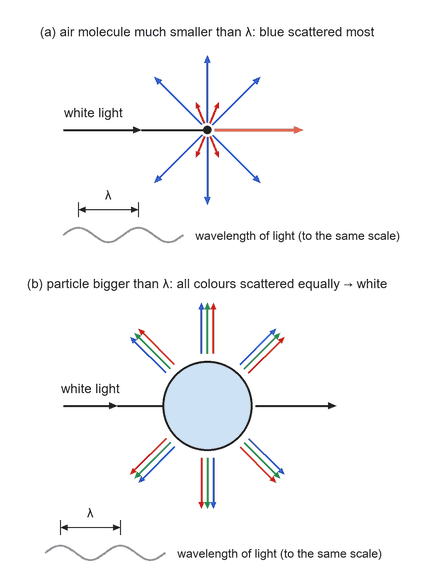
Why the other options are wrong:
- (B) greater than: particles bigger than the wavelength scatter all colours equally; that is not the scattering by air molecules meant here.
- (C) equal to: air molecules are far smaller than the wavelength of light, not equal to it.
- (D) both (B) and (C): both (B) and (C) are wrong, as explained above, so this option is wrong too.
Therefore, the size of the air molecules should be smaller than the wavelength of the incident light, option (A).
- 691 mark
Question 69
The intensity of scattered light is related to its wavelength as :
Solve with AIAnswer
(A)
(B)
- Correct
(C)
(D)
Answer: (C)
Concept: The intensity of scattered light is inversely proportional to the fourth power of its wavelength (Rayleigh's law), for particles much smaller than the wavelength.
Step 1 — Read the word "inversely".
Inversely proportional means that the shorter the wavelength, the more the light is scattered; so violet and blue are scattered much more than red.
Step 2 — Read the words "fourth power".
The fourth power makes the effect strong: halving the wavelength makes the scattering 2⁴ = 16 times greater.
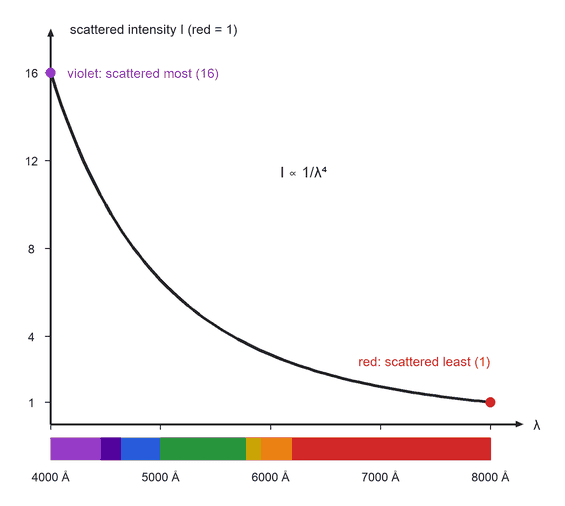
Watch out: The power is 4, not 2, and λ is in the denominator.
Why the other options are wrong:
- (A) : I ∝ λ⁴ would make red (the longest wavelength) the most scattered, but red is scattered the least.
- (B) : I ∝ λ² has the same fault: scattering would increase with wavelength.
- (D) : I ∝ 1/λ² has the right direction but the wrong power; the power is 4, not 2.
Therefore, the intensity of scattered light is related to its wavelength as I ∝ 1/λ⁴, option (C).
- 701 mark
Question 70
In the white light of the sun, the maximum scattering by the air molecules present in the earth's atmosphere is for :
Solve with AIAnswer
(A) red colour
(B) yellow colour
(C) green colour
- Correct
(D) blue colour
Answer: (D) blue colour
Concept: Scattering of light is the absorption and re-emission of light in all directions by particles in its path. For particles much smaller than the wavelength (such as air molecules), the intensity of the scattered light is , so short wavelengths (violet, blue) are scattered far more than long ones (red).
Step 1 — Order the four colours by wavelength.
Among red, yellow, green and blue, red has the longest wavelength and blue the shortest.
Step 2 — Apply the scattering law.
Since I ∝ 1/λ⁴, the colour with the shortest wavelength is scattered the most, so of these four, blue light is scattered the most. This scattered blue light, reaching us from all over the sky, makes the sky look blue.
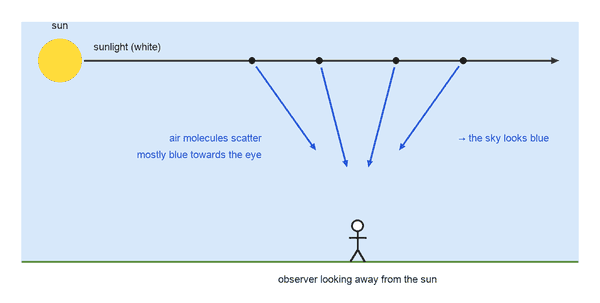
(Violet has an even shorter wavelength, but it is not one of the options; sunlight contains less violet and our eyes are less sensitive to it, so the sky looks blue rather than violet.)
Watch out: The LONGEST wavelength (red) is scattered the least, not the most.
Why the other options are wrong:
- (A) red colour: red has the longest wavelength, so it is scattered the least, not the most.
- (B) yellow colour: yellow has a longer wavelength than green and blue, so it is scattered less than both.
- (C) green colour: green has a longer wavelength than blue, so it is scattered less than blue.
Therefore, the maximum scattering by air molecules is for blue colour, option (D).
- 711 mark
Question 71
Violet light is scattered nearly ...... times more than the red light.
Solve with AIAnswer
(A) 4
(B) 8
- Correct
(C) 16
(D) 9
Answer: (C) 16
Concept: The intensity of scattered light is I ∝ 1/λ⁴, so the ratio of the scattering of two colours is the FOURTH power of the inverse ratio of their wavelengths.
Step 1 — Write the wavelengths.
Using the book's values, violet light has λ_V ≈ 4000 Å and red light has λ_R ≈ 8000 Å.
Step 2 — Write the ratio of the intensities.
Since I ∝ 1/λ⁴, the colour with the smaller λ is scattered more, by the fourth power of the wavelength ratio.
Step 3 — Read the graph.
The graph shows the same result: relative to red (1), violet is scattered 16 times as much.
Watch out: Raise the wavelength ratio to the FOURTH power, not the square.
Why the other options are wrong:
- (A) 4: 4 is 2²; it uses the square of the wavelength ratio instead of the fourth power.
- (B) 8: 8 is 2³; it uses the cube instead of the fourth power.
- (D) 9: 9 is 3²; it does not come from the wavelength ratio 2 at all.
Therefore, violet light is scattered nearly 16 times more than red light, option (C).
- 721 mark
Question 72
To an astronaut in a spaceship, the earth appears :
Solve with AIAnswer
(A) white
(B) red
- Correct
(C) blue
(D) black
Answer: (C) blue
Concept: Scattering of light is the absorption and re-emission of light in all directions by particles in its path. For particles much smaller than the wavelength (such as air molecules), the intensity of the scattered light is , so short wavelengths (violet, blue) are scattered far more than long ones (red).
Step 1 — See what the atmosphere does to sunlight.
Sunlight falling on the earth's atmosphere is scattered by the air molecules, and blue light is scattered the most, in all directions, including outwards into space.
Step 2 — See what reaches the astronaut.
Some of this scattered blue light reaches the astronaut above the atmosphere, so the earth appears blue. (The blue oceans add to this.)
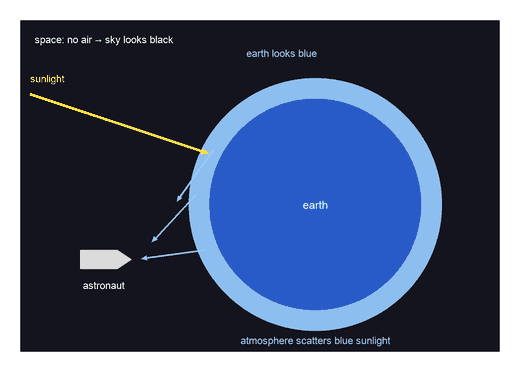
Step 3 — Compare with the sky around the spaceship.
Around the astronaut there is no air, so nothing scatters light there; the sky around the spaceship therefore looks black.
Watch out: Black is the colour of the SKY seen from space, not the colour of the earth.
Why the other options are wrong:
- (A) white: white would need all colours to be scattered equally, but air molecules scatter blue far more than the other colours.
- (B) red: red is the colour scattered the least by the atmosphere.
- (D) black: black is how the sky (empty space) looks to the astronaut, not how the earth looks.
Therefore, to an astronaut in a spaceship the earth appears blue, option (C).
- 731 mark
Question 73
The red colour of the sun at sunrise and sunset is due to which of the following phenomenon ?
Solve with AIAnswer
(A) deviation
(B) dispersion
(C) both deviation and dispersion
- Correct
(D) scattering
Answer: (D) scattering
Concept: Scattering of light is the absorption and re-emission of light in all directions by particles in its path. For particles much smaller than the wavelength (such as air molecules), the intensity of the scattered light is , so short wavelengths (violet, blue) are scattered far more than long ones (red).
Step 1 — Compare the path lengths.
At sunrise and sunset the sun is near the horizon, so its light travels a much longer path through the atmosphere before reaching us than it does at noon.
Step 2 — See what is lost on the way.
Along this long path the air molecules scatter away most of the short-wavelength light (violet, blue), because I ∝ 1/λ⁴.
Step 3 — See what is left.
The long-wavelength red light is scattered the least, so it is not much lost. Mainly red light reaches the observer, and the sun looks red.
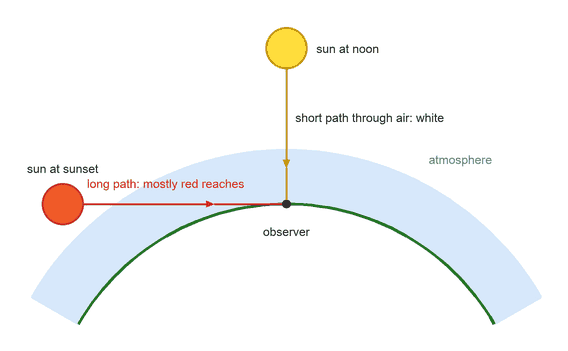
Why the other options are wrong:
- (A) deviation: deviation is the bending of light by refraction; it does not remove colours from sunlight.
- (B) dispersion: dispersion splits white light into all seven colours, as a prism does; it does not leave only red.
- (C) both deviation and dispersion: neither deviation nor dispersion is the cause, as explained above.
Therefore, the red colour of the sun at sunrise and sunset is due to scattering, option (D).
- 741 mark
Question 74
The sky in a direction other than that of the sun appears ............ to an observer on the moon.
Solve with AIAnswer
(A) red
(B) blue
(C) orange
- Correct
(D) black
Answer: (D) black
Concept: We see a coloured sky only because air scatters sunlight towards us from every direction. The moon has no atmosphere.
Step 1 — See what is missing on the moon.
With no air on the moon, there are no particles to scatter sunlight, so no scattered light reaches the observer's eye from the parts of the sky away from the sun.
Step 2 — Decide the colour of the sky.
Light reaches the eye only straight from the sun. In any other direction no light arrives, so the sky looks black, even in the daytime.

Why the other options are wrong:
- (A) red: a red sky needs a long path of sunlight through air (as at sunset), but the moon has no air at all.
- (B) blue: the sky looks blue on the earth because air scatters blue light; there is no air on the moon.
- (C) orange: an orange sky also needs scattering by air, which is absent on the moon.
Therefore, the sky away from the sun appears black to an observer on the moon, option (D).
- 751 mark
Question 75
The danger signal is red because its wavelength is the ................ and therefore it gets ................ the least .
Solve with AIAnswer
(A) least, deviated
- Correct
(B) longest, scattered
(C) longest, dispersed
(D) least, scattered
Answer: (B) longest, scattered
Concept: Scattering of light is the absorption and re-emission of light in all directions by particles in its path. For particles much smaller than the wavelength (such as air molecules), the intensity of the scattered light is , so short wavelengths (violet, blue) are scattered far more than long ones (red).
Step 1 — Fill the first blank.
In the visible spectrum, red light has the longest wavelength (up to about 8000 Å), so the first blank is "longest".
Step 2 — Fill the second blank.
Since I ∝ 1/λ⁴, red light is scattered the least by air molecules, dust and fog. It travels farthest without becoming weak, so a red danger signal can be seen from a long distance; the second blank is "scattered".
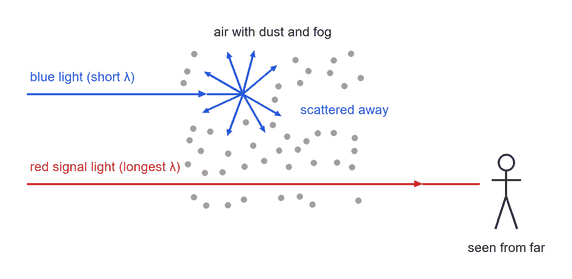
Watch out: The effect that matters for a signal is scattering, not deviation or dispersion.
Why the other options are wrong:
- (A) least, deviated: red has the longest wavelength, not the least; and the effect is scattering, not deviation.
- (C) longest, dispersed: "longest" is right, but dispersion (splitting of white light by a prism) has nothing to do with a signal being seen far away.
- (D) least, scattered: red does not have the least wavelength; violet does.
Therefore, the danger signal is red because its wavelength is the longest and therefore it gets scattered the least, option (B).
- 762 marks
Question 76
When sunlight enters the earth's atmosphere, state which colour of light is scattered (i) the most, and (ii) the least.
Solve with AIWritten solution
Solution:
Concept: Scattering of light is the absorption and re-emission of light in all directions by particles in its path. For particles much smaller than the wavelength (such as air molecules), the intensity of the scattered light is , so short wavelengths (violet, blue) are scattered far more than long ones (red).
Step 1 — Answer (i): scattered the most.
Violet light has the shortest wavelength in the visible spectrum (about 4000 Å), so it is scattered the most, with blue close behind.
Step 2 — Answer (ii): scattered the least.
Red light has the longest wavelength (about 8000 Å), so it is scattered the least.
Step 3 — Compare them.
The ratio of their scattering is the fourth power of the wavelength ratio.
Watch out: The sky looks blue rather than violet only because sunlight has less violet and our eyes are less sensitive to it; violet is still scattered the most.
Therefore, (i) violet light (and next to it blue) is scattered the most; (ii) red light is scattered the least.
- 772 marks
Question 77
A beam of blue, green and yellow light passes through the earth's atmosphere. Name the colour which is scattered (a) the least, (b) the most.
Solve with AIWritten solution
Solution:
Concept: Scattering of light is the absorption and re-emission of light in all directions by particles in its path. For particles much smaller than the wavelength (such as air molecules), the intensity of the scattered light is , so short wavelengths (violet, blue) are scattered far more than long ones (red).
Step 1 — Order the three colours by wavelength.
Blue has the shortest wavelength of the three, then green, and yellow the longest.
Step 2 — Answer (a): scattered the least.
The longest wavelength is scattered the least, so yellow is scattered the least.
Step 3 — Answer (b): scattered the most.
The shortest wavelength is scattered the most, so blue is scattered the most.
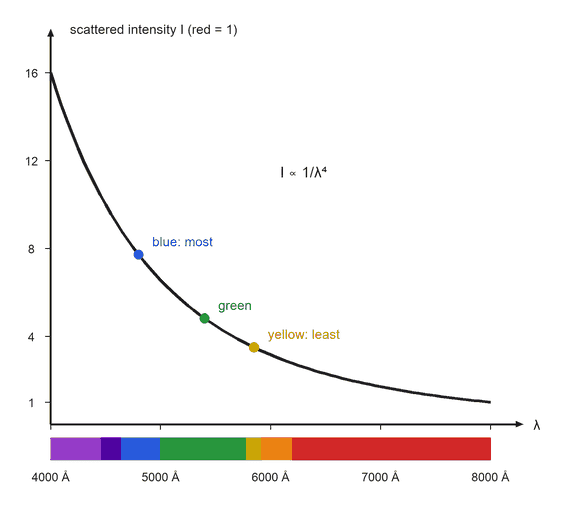
Therefore, (a) yellow light is scattered the least; (b) blue light is scattered the most.
- 782 marks
Question 78
What is meant by scattering of light ?
Solve with AIWritten solution
Solution:
Concept: Light falling on very small particles (dust, air molecules) is taken in by them and sent out again in all directions.
Step 1 — State the definition.
Scattering of light is the process of absorption and then re-emission of light energy by the dust particles and air molecules present in the atmosphere.
Step 2 — Describe what happens.
When light falls on a very small particle, such as an air molecule, the particle absorbs the light and sends it out again in all directions, without any change in its wavelength; the rest of the beam goes on.

Step 3 — Give an example.
A beam of sunlight entering a dark room through a small hole can be seen from the side, because the dust particles in its path scatter light towards our eyes.
Therefore, scattering of light is the absorption and re-emission of light in all directions by the dust particles and air molecules in its path.
- 792 marks
Question 79
How does the intensity of scattered light depend on the wavelength of incident light ? State the condition when this dependence hold.
Solve with AIWritten solution
Solution:
Concept: Scattering by very small particles depends strongly on the wavelength of the light.
Step 1 — State the dependence.
The intensity of scattered light is inversely proportional to the fourth power of the wavelength of the incident light.
Step 2 — Show what it means.
So the shorter the wavelength, the more the light is scattered. For example, violet (about 4000 Å) is scattered about 16 times as much as red (about 8000 Å).
Step 3 — State the condition.
This holds when the scattering particles are much smaller than the wavelength of the light, as air molecules are. Particles bigger than the wavelength (dust, water drops) scatter all colours to about the same extent.
Watch out: The λ⁴ rule does NOT apply to large particles such as cloud droplets.
Therefore, I ∝ 1/λ⁴, and this holds when the scattering particles are much smaller than the wavelength of the incident light.
- 802 marks
Question 80
Which colour of white light is scattered the least ? Give reason.
Solve with AIWritten solution
Solution:
Concept: Scattering of light is the absorption and re-emission of light in all directions by particles in its path. For particles much smaller than the wavelength (such as air molecules), the intensity of the scattered light is , so short wavelengths (violet, blue) are scattered far more than long ones (red).
Step 1 — Use the scattering law.
The intensity of scattered light is inversely proportional to the fourth power of the wavelength.
Step 2 — Find the longest wavelength.
Red light has the longest wavelength in the visible spectrum (about 8000 Å).
Step 3 — Draw the conclusion.
So red light is scattered the least; violet, with the shortest wavelength (about 4000 Å), is scattered about 16 times as much.
Therefore, red light is scattered the least, because it has the longest wavelength and I ∝ 1/λ⁴.
- 812 marks
Question 81
The danger signal is red. Why ?
Solve with AIWritten solution
Solution:
Concept: A danger signal must be seen clearly from a long distance, even in fog or dust. Scattering of light is the absorption and re-emission of light in all directions by particles in its path. For particles much smaller than the wavelength (such as air molecules), the intensity of the scattered light is , so short wavelengths (violet, blue) are scattered far more than long ones (red).
Step 1 — Find the colour with the longest wavelength.
In the visible spectrum, red light has the longest wavelength.
Step 2 — Apply the scattering law.
Since I ∝ 1/λ⁴, red light is scattered the least by air molecules, dust and fog, so less of it is lost from the beam on the way.
Step 3 — Draw the conclusion.
Compared with light of other colours of the same intensity, red light travels farther without becoming weak, so a red signal is seen from far away.
Therefore, danger signals are red because red light has the longest wavelength, is scattered the least and so can be seen from the greatest distance.
- 822 marks
Question 82
How would the sky appear when seen from the space (or moon) ? Give reason for your answer.
Solve with AIWritten solution
Solution:
Concept: We see a blue sky on the earth only because the air molecules scatter sunlight, mostly blue, towards our eyes from every direction.
Step 1 — See what is missing.
In space, and on the moon, there is no atmosphere, so there are no particles to scatter sunlight.
Step 2 — See what reaches the eye.
No scattered light reaches the eye from the parts of the sky away from the sun; light comes only straight from the sun.
Step 3 — Decide the colour of the sky.
So the rest of the sky looks black (dark), even in the daytime; stars can be seen, and they do not twinkle.
Therefore, the sky would appear black from space (or the moon), because there is no atmosphere to scatter sunlight.
- 831 mark
Question 83
What characteristic property of light is responsible for the blue colour of sky ?
Solve with AIWritten solution
Solution:
Concept: Scattering of light is the absorption and re-emission of light in all directions by particles in its path. For particles much smaller than the wavelength (such as air molecules), the intensity of the scattered light is , so short wavelengths (violet, blue) are scattered far more than long ones (red).
Step 1 — Name the property.
The blue colour of the sky is due to the scattering of light by the molecules of air.
Step 2 — Explain it briefly.
Air molecules scatter short wavelengths far more than long ones (I ∝ 1/λ⁴), so blue light is scattered much more than red, and this scattered blue light reaches us from all parts of the sky.
Therefore, the scattering of light (by air molecules) is responsible for the blue colour of the sky.
- 843 marks
Question 84
The colour of sky, in direction other than of the Sun, is blue. Explain.
Solve with AIWritten solution
Solution:
Concept: The blue colour of the sky is due to the scattering of sunlight by the molecules of air, which are much smaller than the wavelength of light.
Step 1 — Scattering in the air.
Light from the sun travels a long way through the atmosphere before reaching us, and on the way the air molecules scatter it in all directions.
Step 2 — Blue is scattered the most.
The intensity of scattered light varies as I ∝ 1/λ⁴, so blue (short wavelength) light is scattered much more than red (long wavelength) light.
Step 3 — What the eye receives.
The light reaching our eye directly from the sun still contains most of the colours. The light reaching our eye from all other directions is scattered light, which is mostly blue, so the sky, in directions other than that of the sun, looks blue.
(Violet is scattered even more than blue, but sunlight contains less violet and our eyes are less sensitive to it.)
Watch out: The sky looks blue because of SCATTERING, not because of reflection from the sea or dispersion.
Therefore, the sky away from the sun looks blue because the air molecules scatter mostly the blue part of sunlight towards our eyes from every direction.
- 853 marks
Question 85
Why does the Sun appear red at sunrise and sunset ?
Solve with AIWritten solution
Solution:
Concept: At sunrise and sunset the sun is near the horizon, so its light has to travel the longest distance through the atmosphere to reach us. Scattering of light is the absorption and re-emission of light in all directions by particles in its path. For particles much smaller than the wavelength (such as air molecules), the intensity of the scattered light is , so short wavelengths (violet, blue) are scattered far more than long ones (red).
Step 1 — Blue is scattered away.
Along this long path the air molecules scatter the short-wavelength blue and violet light much more, so most of it is lost from the beam before it reaches us.
Step 2 — Red gets through.
The long-wavelength red light is scattered only a little, so it is not much lost. The sunlight reaching the observer is therefore almost without blue, and mainly red reaches us.
Step 3 — Compare with noon.
At noon the path through air is short, so little of any colour is lost and the sun looks white.
Watch out: The sun does not change colour itself; the long path of air removes the blue from its light.
Therefore, the sun appears red at sunrise and sunset because its light crosses a long path of air, which scatters away the blue light and lets mainly the red light reach us.
- 862 marks
Question 86
The sky at noon appears white. Give reason.
Solve with AIWritten solution
Solution:
Concept: At noon the sun is overhead, so its light travels the shortest distance through the atmosphere to reach us.
Step 1 — Little light is scattered away.
Over such a short path, very little light of any colour is scattered out of the beam.
Step 2 — All colours reach us.
Light of all colours reaches us in almost the same proportion as in sunlight, so the sunlight and the sky around the sun look white.
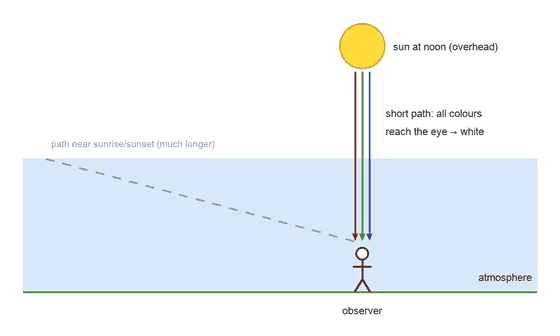
Step 3 — Compare with sunrise and sunset.
At sunrise and sunset the path is much longer, most of the blue is scattered away, and the sun looks red.
Therefore, the sky (near the sun) at noon appears white because the light crosses only a short path of air, so all colours reach us almost equally.
- 872 marks
Question 87
The clouds are seen white. Explain.
Solve with AIWritten solution
Solution:
Concept: Particles larger than the wavelength of light (dust, water drops, smoke) scatter all colours to about the same extent, so the light they scatter is white; the rule holds only for particles much smaller than the wavelength.
Step 1 — Compare the size of the particles.
Clouds contain dust particles and drops of water whose size is much bigger than the wavelength of visible light.
Step 2 — See how they scatter.
Such large particles scatter all the colours of white sunlight about equally; the I ∝ 1/λ⁴ rule does not apply to them.
Step 3 — Decide the colour.
The scattered light reaching our eyes therefore has all the colours in the same proportion as sunlight, so the clouds look white.

Therefore, clouds look white because their water drops and dust particles are bigger than the wavelength of light and scatter all colours equally.
- 882 marks
Question 88
Give reason why the smoke from a fire looks white.
Solve with AIWritten solution
Solution:
Concept: Particles larger than the wavelength of light (dust, water drops, smoke) scatter all colours to about the same extent, so the light they scatter is white; the rule holds only for particles much smaller than the wavelength.
Step 1 — Compare the size of the particles.
The particles of smoke (tiny specks of soot and ash) are bigger than the wavelength of light.
Step 2 — See how they scatter.
They scatter light of all colours about equally, so the scattered light reaching our eyes contains all colours in the same proportion as white light.

Step 3 — Compare with tiny particles.
If the particles were much smaller than the wavelength, like air molecules, they would scatter mostly blue light and the smoke would look bluish.
Therefore, smoke from a fire looks white because its particles are bigger than the wavelength of light and scatter all colours equally.
What Class 10 Physics Ch 6 covers
The sections of the chapter, in the order the book takes them. Every question above comes from one of these.
- 01Deviation Produced by a Triangular Prism
- 02Colours in White Light with Their Wavelength
- 03Dispersion of White Light Through a Prism
- 04Electromagnetic Spectrum
- 05Properties and Uses of Different Radiations
- 06Scattering of Light
More ways to study this chapter
The same chapter asked three other ways. Practise it, revise it, and see what the board has set on Ch 6 before.
- Competency-Based Questions (CBQ)Case study questions: a situation, and the part of the chapter that answers it.40questionsOpen
- Previous Year QuestionsQuestions that have actually appeared in board papers, each tagged with its year.20questionsOpen
- Practice QuestionsExtra questions per chapter, for when one attempt at a method is not enough.41questionsOpen
Ch 6 in past ICSE papers
The same chapter as the board has actually asked it. These are worded differently from the textbook exercise, which is the point of reading them.
- 12 marks
Board paper question 1
State the dependence of angle of deviation :
(i) On the refractive index of the material of the prism.
(ii) On the wavelength of light.
Solve with AIWritten solution
Solution:
Concept: A prism deviates (bends) light because light slows down in glass. The angle of deviation depends on how much the light slows down, that is, on the refractive index of the prism for that light.
Step 1 — Part (i): what the refractive index does.
A ray bends at a surface because light changes speed there. A material of higher refractive index slows the light more, so the ray bends more at each face of the prism and the total deviation is larger.
Step 2 — Part (i): an example.
In the figure, yellow light falls at the same angle of incidence (50°) on two 60° prisms. Tracing the ray with Snell's law gives a deviation of about 37° for μ = 1.5 and about 59° for μ = 1.7. So the greater the refractive index, the greater the angle of deviation.

Step 3 — Part (ii): what the wavelength does.
The refractive index of glass is not the same for all colours: it is greater for shorter wavelengths. Violet (shortest wavelength in the visible spectrum) has the greatest refractive index, red (longest) the least.
Step 4 — Part (ii): the result.
Since a greater refractive index means a greater deviation, the deviation increases as the wavelength decreases. Violet is deviated the most and red the least, which is why a prism splits white light into a spectrum.
Watch out: The dependence on wavelength is the opposite way round: a LONGER wavelength gives a SMALLER deviation.
Therefore, (i) the greater the refractive index of the material, the greater the angle of deviation; (ii) the angle of deviation increases as the wavelength decreases (violet is deviated most, red least).
- 24 marks
Board paper question 2
What do you understand by the term 'Scattering of light'? Which colour of white light is scattered the least and why?
Solve with AIWritten solution
Solution:
Concept: Scattering of light is the process in which very small particles of a medium (molecules of air, fine dust) absorb the light falling on them and send it out again in all directions. For particles much smaller than the wavelength, the intensity of scattered light varies as : the shorter the wavelength, the more the light is scattered.
Step 1 — Define scattering.
When light falls on very small particles such as the molecules of air or fine dust, each particle absorbs the light and re-emits it in all directions. This sending out of light in different directions by tiny particles is called scattering of light.
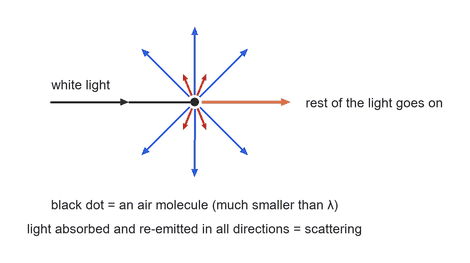
In the figure, a tiny air molecule sends out blue light strongly in every direction and red light only weakly.
Step 2 — State the rule for the amount of scattering.
For particles much smaller than the wavelength, the intensity of the scattered light is inversely proportional to the fourth power of the wavelength:
Step 3 — Pick the colour scattered least.
Red light has the longest wavelength in the visible spectrum, so is largest for red and its scattered intensity is the smallest. Red light is therefore scattered the least.
Step 4 — See how big the difference is.
Taking red as about 8000 Å and violet as about 4000 Å, we compare the scattered intensities:
So violet light is scattered about 16 times as much as red light.
Watch out: The fourth power matters: doubling the wavelength cuts the scattering to one-sixteenth, not to one-half.
Therefore, scattering is the re-emission of light in all directions by tiny particles; red light is scattered the least, because it has the longest wavelength and .
- 34 marks
Board paper question 3
(i) Name the radiations which are absorbed by greenhouse gases in the earth’s atmosphere.
(ii) A radiation X is focused by a particular device on the bulb of a thermometer and mercury in the thermometer shows a rapid increase. Name the radiation X.
(iii) Name two factors on which the heat energy liberated by a body depends.
Solve with AIWritten solution
Solution:
Concept: Infrared radiation is the 'heat radiation' of the spectrum: it has a strong heating effect and is given out by every warm body, including the earth.
Step 1 — Part (i): what the warm earth gives out.
Sunlight passes through the atmosphere and warms the earth's surface. The warm earth then gives out long-wavelength infrared radiation.
Step 2 — Part (i): what the greenhouse gases do.
Greenhouse gases such as carbon dioxide, water vapour and methane absorb this infrared radiation and send part of it back towards the earth. This keeps the earth warm (the greenhouse effect). So the radiations absorbed are infrared radiations.

Step 3 — Part (ii): identify X.
The mercury rises rapidly, so X must have a strong heating effect. Infrared rays are the 'heat radiation' of the spectrum: when a lens focuses them on the thermometer bulb, the bulb absorbs them and warms up quickly. So X is infrared radiation.
Step 4 — Part (iii): write the rule for heat given out.
When a body of mass m and specific heat capacity c cools through a temperature fall Δt, the heat it gives out is:
Step 5 — Part (iii): read off the factors.
So the heat liberated depends on the mass (m) of the body and on the fall in its temperature (Δt). It also depends on the material of the body, through its specific heat capacity (c). Any two of these three are accepted. (Part (iii) belongs to the Calorimetry chapter.)
Watch out: Ultraviolet is not the heat radiation; it is known for its chemical action (it darkens silver chloride, kills germs).
Therefore, (i) infrared radiations; (ii) X is infrared radiation; (iii) the mass of the body and the fall in its temperature (also its specific heat capacity).
- 42 marks
Board paper question 4
(i) Why is the ratio of the velocities of light of wavelengths 4000 Å and 8000 Å in vacuum 1 : 1 ?
(ii) Which of the above wavelengths has a higher frequency?
Solve with AIWritten solution
Solution:
Concept: Light of every colour is an electromagnetic wave. All electromagnetic waves travel with the same speed c in vacuum, and speed, frequency and wavelength are linked by .
Step 1 — Part (i): the speed in vacuum.
Light of every wavelength is an electromagnetic wave, and all electromagnetic waves travel with the same speed in vacuum, m s⁻¹. This speed does not depend on the wavelength.
Step 2 — Part (i): the ratio.
Both lights therefore travel at c in vacuum, so the ratio of their speeds is:
That is 1 : 1. (The speeds differ only inside a material medium such as glass.)
Step 3 — Part (ii): link frequency and wavelength.
Speed, frequency and wavelength are linked by , so the frequency is:
For the same c, the shorter the wavelength, the higher the frequency. We change Å to metres using 1 Å = m.
Step 4 — Part (ii): frequency of the 4000 Å light.
We put m:
Step 5 — Part (ii): frequency of the 8000 Å light.
We put m:
So the 4000 Å light (violet) has twice the frequency of the 8000 Å light (red).
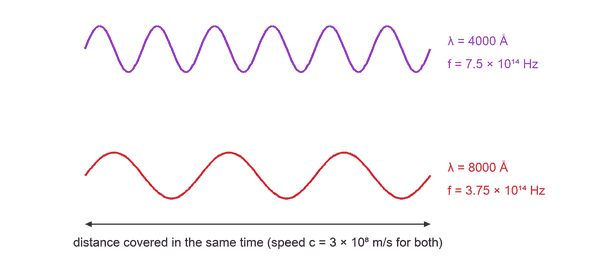
Both waves cover the same distance in the same time; the shorter wave fits twice as many waves into it, so twice as many pass a point each second.
Watch out: In vacuum every colour (every electromagnetic wave) has the same speed; the speeds differ only inside a medium.
Therefore, (i) all wavelengths travel with the same speed c = m s⁻¹ in vacuum, so the ratio is 1 : 1; (ii) the 4000 Å light has the higher frequency ( Hz, twice that of 8000 Å).
- 52 marks
Board paper question 5
(i) Define scattering.
(ii) The smoke from a fire looks white.
Which of the following statements is true?
(a) Molecules of the smoke are bigger than the wavelength of light.
(b) Molecules of the smoke are smaller than the wavelength of light.
Solve with AIWritten solution
Solution:
Concept: Scattering of light is the process in which very small particles of a medium (molecules of air, fine dust) absorb the light falling on them and send it out again in all directions. For particles much smaller than the wavelength, the intensity of scattered light varies as : the shorter the wavelength, the more the light is scattered. Particles bigger than the wavelength scatter all colours almost equally.
Step 1 — Part (i): define scattering.
Scattering of light is the process in which very small particles of a medium absorb the light falling on them and re-emit it in all directions.
Step 2 — Part (ii): how particle size changes scattering.
Particles much smaller than the wavelength (air molecules) scatter short wavelengths far more, so their scattered light is bluish. Particles bigger than the wavelength scatter all colours almost equally, so their scattered light has all the colours in the same proportion as sunlight and looks white.
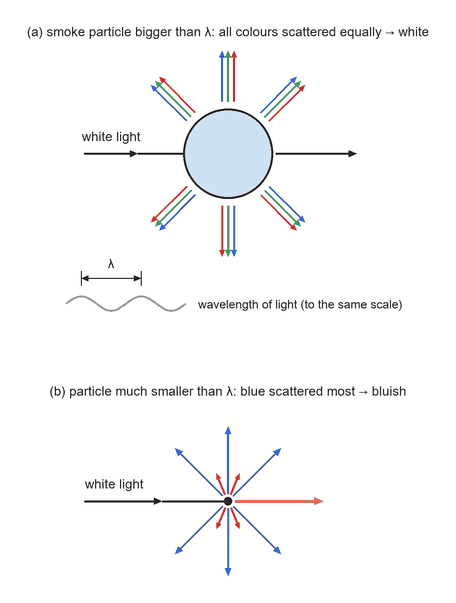
Step 3 — Part (ii): apply it to smoke.
The smoke looks white, so it must scatter all colours equally. Its particles must therefore be bigger than the wavelength of light, and statement (a) is true.
Step 4 — Part (ii): check the other statement.
If the smoke particles were smaller than the wavelength, as statement (b) says, they would scatter mostly blue light and the smoke would look bluish. So statement (b) is false.
Watch out: The paper calls them 'molecules'; strictly, each smoke particle is a tiny speck of soot or ash made of very many molecules, which is why it is bigger than the wavelength.
Therefore, (i) scattering is the absorption and re-emission of light in all directions by tiny particles; (ii) statement (a) is true: the smoke particles are bigger than the wavelength of light.
- 62 marks
Board paper question 6
An electromagnetic radiation is used for photography in fog.
(i) Identify the radiation.
(ii) Why is this radiation mentioned by you, ideal for this purpose?
Solve with AIWritten solution
Solution:
Concept: Fog scatters light. Radiation of longer wavelength is scattered much less, so it passes through the fog.
Step 1 — Part (i): identify the radiation.
Fog is made of tiny water droplets that scatter visible light, so a fog hides objects from an ordinary camera. The radiation used for photography in fog is infrared radiation.
Step 2 — Part (ii): why it gets through.
Infrared has a longer wavelength than visible light. Scattering falls sharply as the wavelength increases, so infrared is scattered very little by the fog and passes through it to the camera, giving a clear photograph.

Step 3 — Part (ii): a further advantage.
Every warm object gives out infrared radiation, so an infrared camera can photograph objects even when they cannot be seen.
Watch out: Ultraviolet is NOT suitable: its wavelength is shorter than that of visible light, so fog scatters it even more.
Therefore, (i) infrared radiation; (ii) its long wavelength makes it scatter very little in fog, so it passes through the fog to the camera.
All 20 board paper questions for this chapter, solved the same way.
Class 10 Physics Ch 6 questions students ask
How many questions are there in Class 10 Physics Ch 6?
88 questions. Every one is solved step by step on this page.
Are these Class 10 Physics solutions free?
Yes. Every question and its full working is free to read, with no account needed.
Can I download the Class 10 Physics Ch 6 solutions as a PDF?
There is no PDF to download. Every solution is on this page instead, which means it is searchable, always the current syllabus, and readable on a phone. Use your browser's print option if you want it on paper.