
Question 101 markEasy
How does the speed of light in glass change on increasing the wavelength of light ?
Confirming your payment
Sign up now and get 250 free tokens.
Spectrum · Question 10 of 88
How does the speed of light in glass change on increasing the wavelength of light ?
Solution:
Concept: In vacuum every colour travels at the same speed, 3 × 10⁸ m s⁻¹. Inside glass the speed is the speed in vacuum divided by the refractive index (v = c ÷ μ), and the refractive index μ of glass is smallest for red and largest for violet, so red travels fastest in glass and violet slowest.
Step 1 — Link wavelength with refractive index.
For glass, the refractive index μ is larger for shorter wavelengths (violet) and smaller for longer wavelengths (red).
Step 2 — Link refractive index with speed.
The speed of light in glass is v = c ÷ μ, so a smaller μ means a higher speed.
Step 3 — Combine the two.
As the wavelength increases, μ decreases, so the speed in glass increases. Red light therefore travels fastest in glass and violet light slowest.
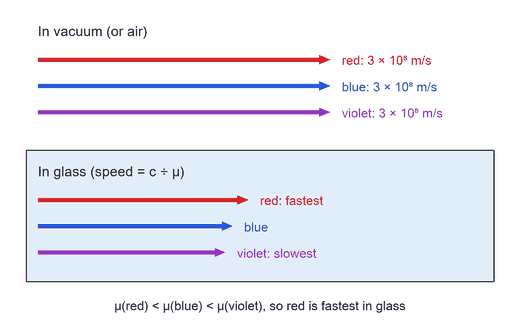
Watch out: This is true only inside a medium; in vacuum every wavelength travels at the same speed.
Therefore, the speed of light in glass increases as the wavelength of light increases.