
Question 91 markMCQMedium
Assertion (A) : A beam of white light gives a spectrum on passing through a hollow prism.
Reason (R) : The speed of light outside the prism is same as the speed of light inside the prism.
Confirming your payment
Sign up now and get 250 free tokens.
Spectrum · Question 9 of 88
Assertion (A) : A beam of white light gives a spectrum on passing through a hollow prism.
Reason (R) : The speed of light outside the prism is same as the speed of light inside the prism.
(A) both A and R are true and R is the correct explaination of A
(B) both A and R are True and R is not the correct explanation of A
(C) assertion is false but reason is true
(D) assertion is true but reason is false
Answer: (C) assertion is false but reason is true
Concept: In an assertion–reason item, judge the assertion (A) and the reason (R) separately as true or false, and then decide whether R correctly explains A.
Step 1 — Judge the assertion.
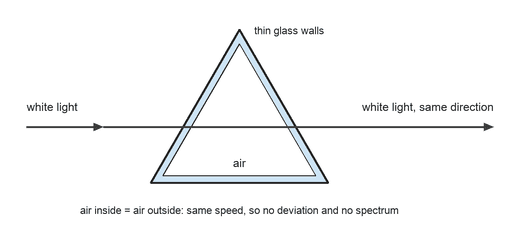
A hollow prism is filled with air, the same medium as outside. Light does not change speed on entering it, so it is not bent and its colours are not separated. Its thin glass walls are parallel-sided, so they act like thin slabs and do not change the direction of the light either. No spectrum is formed, so the assertion is false.
Step 2 — Judge the reason.
Inside and outside the hollow prism the light travels through air, so its speed is the same in both. The reason is true.
Step 3 — Link them.
The assertion is false and the reason is true; in fact the reason is exactly why the assertion fails.
Watch out: A prism disperses light only when its material has a refractive index different from the surrounding medium.
Why the other options are wrong:
Therefore, the assertion is false but the reason is true, option (C).