Answer: (B) both A and R are True and R is not the correct explanation of A
Concept: In an assertion–reason item, judge the assertion (A) and the reason (R) separately as true or false, and then decide whether R correctly explains A.
Step 1 — Judge the assertion.
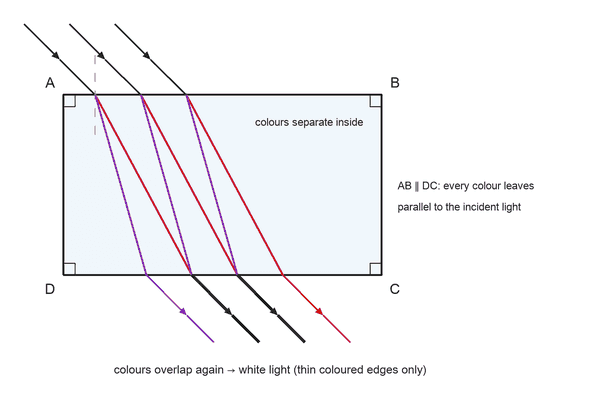
In a rectangular glass slab the two refracting faces are parallel. The colours do separate a little inside the slab, but at the second face each colour bends back by the same amount and leaves parallel to the incident ray. Colours from neighbouring parts of the beam overlap again, so white light comes out and no spectrum is seen. So the assertion is true (there is no net dispersion).
Step 2 — Judge the reason.
Dispersion is indeed the splitting of white light into its constituent colours. So the reason is a true statement.
Step 3 — Decide whether R explains A.
The reason only defines dispersion; it does not say why a slab produces none. The real explanation is that the slab's faces are parallel, so the second face undoes the separation made by the first. So R does not explain A.
Watch out: A correct definition is not automatically the explanation; ask whether R gives the CAUSE of A.
Why the other options are wrong:
- (A) both A and R are true and R is the correct explaination of A: R is true, but it is only the definition of dispersion; it does not explain why a slab gives no spectrum.
- (C) assertion is false but reason is true: the assertion is true: no spectrum comes out of a rectangular slab.
- (D) assertion is true but reason is false: the reason is true: it is the correct definition of dispersion.
Therefore, both A and R are true, but R is not the correct explanation of A, option (B).
