
Question 21 markMCQEasy
When a ray of white light falls on a prism, which of the following statements are correct ?
Confirming your payment
Sign up now and get 250 free tokens.
Spectrum · Question 2 of 88
When a ray of white light falls on a prism, which of the following statements are correct ?
(A) The dispersion of white light occurs at the first surface of the prism.
(B) The deviation of light rays occurs at both the surfaces of the prism.
(C) The prism does not produce colours, but it only splits the various colours present in the white light.
(D) All of the above.
Answer: (D) All of the above.
Concept: Follow the light face by face: what happens where it enters the prism, what happens where it leaves, and where the colours come from.
Step 1 — Check statement (A).
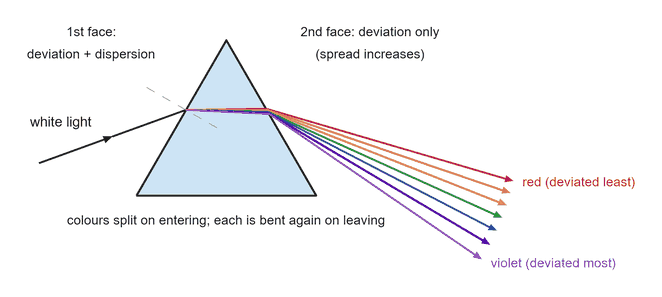
On entering the first face, each colour bends by a different amount because the refractive index of glass differs from colour to colour. So the colours separate at the first surface: statement (A) is true.
Step 2 — Check statement (B).
The light bends towards the normal at the first face and away from the normal at the second face. Both bends turn it towards the base and add up to the total deviation: statement (B) is true.
Step 3 — Check statement (C).
White light already contains all the colours. The prism does not make new colours; it only separates the ones that are present: statement (C) is true.
Step 4 — Choose the option.
All three statements are correct, so the complete answer is the option that includes all of them.
Watch out: A single true statement is not the full answer when the question asks which statements are correct.
Why the other options are wrong:
Therefore, all the statements are correct, option (D).