
Question 11 markMCQEasy
When a white light ray falls on a prism, the ray at its first surface suffers :
Confirming your payment
Sign up now and get 250 free tokens.
Spectrum · Question 1 of 88
When a white light ray falls on a prism, the ray at its first surface suffers :
(A) no refraction
(B) only dispersion
(C) only deviation
(D) both deviation and dispersion.
Answer: (D) both deviation and dispersion.
Concept: Dispersion is the splitting of white light into its colours. It happens because the refractive index (μ) of glass is slightly different for each colour: it is least for red light and greatest for violet light, so each colour bends by a different amount.
Step 1 — See what happens to the direction.
At the first surface the white ray passes from air into glass at an angle, so it slows down and bends towards the normal. This change of direction is deviation.
Step 2 — See what happens to the colours.
Glass has a different refractive index for each colour, so each colour bends by a slightly different amount on entering. The colours therefore begin to separate inside the prism; this is dispersion.
Step 3 — Put the two together.
Both changes happen at the same first surface, so the ray suffers deviation and dispersion together.
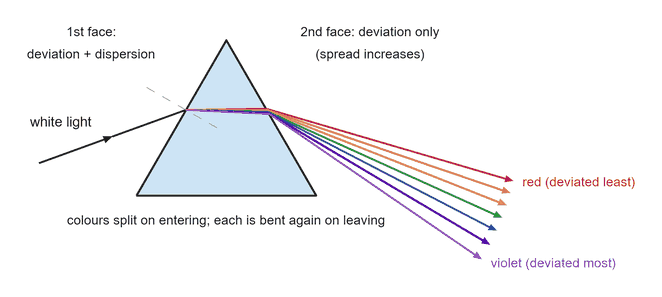
Watch out: The colours cannot separate unless the light bends, so dispersion never happens without deviation.
Why the other options are wrong:
Therefore, at the first surface the white ray suffers both deviation and dispersion, option (D).