
Question 24 marksAsked 2016Easy
What do you understand by the term 'Scattering of light'? Which colour of white light is scattered the least and why?
Confirming your payment
Sign up now and get 250 free tokens.
Previous Year Questions · Question 2 of 20
What do you understand by the term 'Scattering of light'? Which colour of white light is scattered the least and why?
Solution:
Concept: Scattering of light is the process in which very small particles of a medium (molecules of air, fine dust) absorb the light falling on them and send it out again in all directions. For particles much smaller than the wavelength, the intensity of scattered light varies as : the shorter the wavelength, the more the light is scattered.
Step 1 — Define scattering.
When light falls on very small particles such as the molecules of air or fine dust, each particle absorbs the light and re-emits it in all directions. This sending out of light in different directions by tiny particles is called scattering of light.
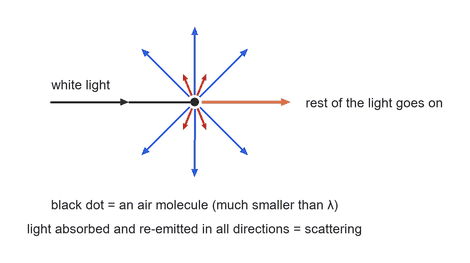
In the figure, a tiny air molecule sends out blue light strongly in every direction and red light only weakly.
Step 2 — State the rule for the amount of scattering.
For particles much smaller than the wavelength, the intensity of the scattered light is inversely proportional to the fourth power of the wavelength:
Step 3 — Pick the colour scattered least.
Red light has the longest wavelength in the visible spectrum, so is largest for red and its scattered intensity is the smallest. Red light is therefore scattered the least.
Step 4 — See how big the difference is.
Taking red as about 8000 Å and violet as about 4000 Å, we compare the scattered intensities:
So violet light is scattered about 16 times as much as red light.
Watch out: The fourth power matters: doubling the wavelength cuts the scattering to one-sixteenth, not to one-half.
Therefore, scattering is the re-emission of light in all directions by tiny particles; red light is scattered the least, because it has the longest wavelength and .