
Opening your dashboard
Class 10 Physics Chapter 6 Spectrum: Previous Year Questions
20 questions on Chapter 6, each solved step by step. Class 10 Physics, ICSE 2026-27.
20 questions with solutions
1–4 marks · Mixed difficulty
- 12 marks
Question 1
State the dependence of angle of deviation :
(i) On the refractive index of the material of the prism.
(ii) On the wavelength of light.
Solve with AIWritten solution
Solution:
Concept: A prism deviates (bends) light because light slows down in glass. The angle of deviation depends on how much the light slows down, that is, on the refractive index of the prism for that light.
Step 1 — Part (i): what the refractive index does.
A ray bends at a surface because light changes speed there. A material of higher refractive index slows the light more, so the ray bends more at each face of the prism and the total deviation is larger.
Step 2 — Part (i): an example.
In the figure, yellow light falls at the same angle of incidence (50°) on two 60° prisms. Tracing the ray with Snell's law gives a deviation of about 37° for μ = 1.5 and about 59° for μ = 1.7. So the greater the refractive index, the greater the angle of deviation.

Step 3 — Part (ii): what the wavelength does.
The refractive index of glass is not the same for all colours: it is greater for shorter wavelengths. Violet (shortest wavelength in the visible spectrum) has the greatest refractive index, red (longest) the least.
Step 4 — Part (ii): the result.
Since a greater refractive index means a greater deviation, the deviation increases as the wavelength decreases. Violet is deviated the most and red the least, which is why a prism splits white light into a spectrum.
Watch out: The dependence on wavelength is the opposite way round: a LONGER wavelength gives a SMALLER deviation.
Therefore, (i) the greater the refractive index of the material, the greater the angle of deviation; (ii) the angle of deviation increases as the wavelength decreases (violet is deviated most, red least).
- 24 marks
Question 2
What do you understand by the term 'Scattering of light'? Which colour of white light is scattered the least and why?
Solve with AIWritten solution
Solution:
Concept: Scattering of light is the process in which very small particles of a medium (molecules of air, fine dust) absorb the light falling on them and send it out again in all directions. For particles much smaller than the wavelength, the intensity of scattered light varies as : the shorter the wavelength, the more the light is scattered.
Step 1 — Define scattering.
When light falls on very small particles such as the molecules of air or fine dust, each particle absorbs the light and re-emits it in all directions. This sending out of light in different directions by tiny particles is called scattering of light.
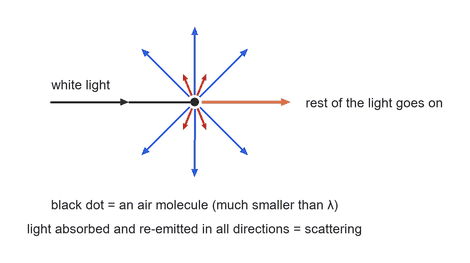
In the figure, a tiny air molecule sends out blue light strongly in every direction and red light only weakly.
Step 2 — State the rule for the amount of scattering.
For particles much smaller than the wavelength, the intensity of the scattered light is inversely proportional to the fourth power of the wavelength:
Step 3 — Pick the colour scattered least.
Red light has the longest wavelength in the visible spectrum, so is largest for red and its scattered intensity is the smallest. Red light is therefore scattered the least.
Step 4 — See how big the difference is.
Taking red as about 8000 Å and violet as about 4000 Å, we compare the scattered intensities:
So violet light is scattered about 16 times as much as red light.
Watch out: The fourth power matters: doubling the wavelength cuts the scattering to one-sixteenth, not to one-half.
Therefore, scattering is the re-emission of light in all directions by tiny particles; red light is scattered the least, because it has the longest wavelength and .
- 34 marks
Question 3
(i) Name the radiations which are absorbed by greenhouse gases in the earth’s atmosphere.
(ii) A radiation X is focused by a particular device on the bulb of a thermometer and mercury in the thermometer shows a rapid increase. Name the radiation X.
(iii) Name two factors on which the heat energy liberated by a body depends.
Solve with AIWritten solution
Solution:
Concept: Infrared radiation is the 'heat radiation' of the spectrum: it has a strong heating effect and is given out by every warm body, including the earth.
Step 1 — Part (i): what the warm earth gives out.
Sunlight passes through the atmosphere and warms the earth's surface. The warm earth then gives out long-wavelength infrared radiation.
Step 2 — Part (i): what the greenhouse gases do.
Greenhouse gases such as carbon dioxide, water vapour and methane absorb this infrared radiation and send part of it back towards the earth. This keeps the earth warm (the greenhouse effect). So the radiations absorbed are infrared radiations.

Step 3 — Part (ii): identify X.
The mercury rises rapidly, so X must have a strong heating effect. Infrared rays are the 'heat radiation' of the spectrum: when a lens focuses them on the thermometer bulb, the bulb absorbs them and warms up quickly. So X is infrared radiation.
Step 4 — Part (iii): write the rule for heat given out.
When a body of mass m and specific heat capacity c cools through a temperature fall Δt, the heat it gives out is:
Step 5 — Part (iii): read off the factors.
So the heat liberated depends on the mass (m) of the body and on the fall in its temperature (Δt). It also depends on the material of the body, through its specific heat capacity (c). Any two of these three are accepted. (Part (iii) belongs to the Calorimetry chapter.)
Watch out: Ultraviolet is not the heat radiation; it is known for its chemical action (it darkens silver chloride, kills germs).
Therefore, (i) infrared radiations; (ii) X is infrared radiation; (iii) the mass of the body and the fall in its temperature (also its specific heat capacity).
- 42 marks
Question 4
(i) Why is the ratio of the velocities of light of wavelengths 4000 Å and 8000 Å in vacuum 1 : 1 ?
(ii) Which of the above wavelengths has a higher frequency?
Solve with AIWritten solution
Solution:
Concept: Light of every colour is an electromagnetic wave. All electromagnetic waves travel with the same speed c in vacuum, and speed, frequency and wavelength are linked by .
Step 1 — Part (i): the speed in vacuum.
Light of every wavelength is an electromagnetic wave, and all electromagnetic waves travel with the same speed in vacuum, m s⁻¹. This speed does not depend on the wavelength.
Step 2 — Part (i): the ratio.
Both lights therefore travel at c in vacuum, so the ratio of their speeds is:
That is 1 : 1. (The speeds differ only inside a material medium such as glass.)
Step 3 — Part (ii): link frequency and wavelength.
Speed, frequency and wavelength are linked by , so the frequency is:
For the same c, the shorter the wavelength, the higher the frequency. We change Å to metres using 1 Å = m.
Step 4 — Part (ii): frequency of the 4000 Å light.
We put m:
Step 5 — Part (ii): frequency of the 8000 Å light.
We put m:
So the 4000 Å light (violet) has twice the frequency of the 8000 Å light (red).
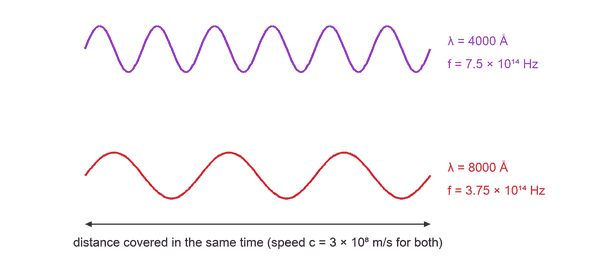
Both waves cover the same distance in the same time; the shorter wave fits twice as many waves into it, so twice as many pass a point each second.
Watch out: In vacuum every colour (every electromagnetic wave) has the same speed; the speeds differ only inside a medium.
Therefore, (i) all wavelengths travel with the same speed c = m s⁻¹ in vacuum, so the ratio is 1 : 1; (ii) the 4000 Å light has the higher frequency ( Hz, twice that of 8000 Å).
- 52 marks
Question 5
(i) Define scattering.
(ii) The smoke from a fire looks white.
Which of the following statements is true?
(a) Molecules of the smoke are bigger than the wavelength of light.
(b) Molecules of the smoke are smaller than the wavelength of light.
Solve with AIWritten solution
Solution:
Concept: Scattering of light is the process in which very small particles of a medium (molecules of air, fine dust) absorb the light falling on them and send it out again in all directions. For particles much smaller than the wavelength, the intensity of scattered light varies as : the shorter the wavelength, the more the light is scattered. Particles bigger than the wavelength scatter all colours almost equally.
Step 1 — Part (i): define scattering.
Scattering of light is the process in which very small particles of a medium absorb the light falling on them and re-emit it in all directions.
Step 2 — Part (ii): how particle size changes scattering.
Particles much smaller than the wavelength (air molecules) scatter short wavelengths far more, so their scattered light is bluish. Particles bigger than the wavelength scatter all colours almost equally, so their scattered light has all the colours in the same proportion as sunlight and looks white.
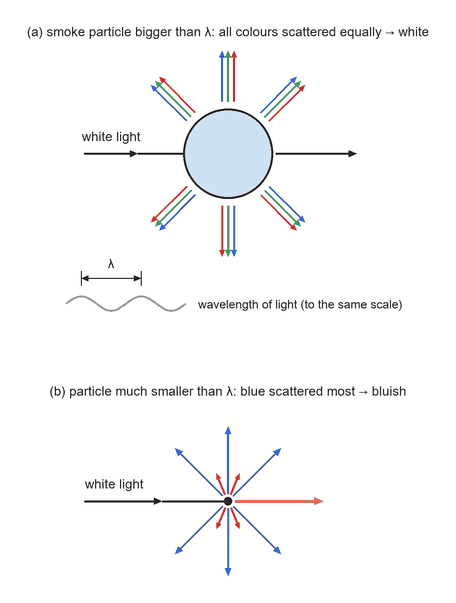
Step 3 — Part (ii): apply it to smoke.
The smoke looks white, so it must scatter all colours equally. Its particles must therefore be bigger than the wavelength of light, and statement (a) is true.
Step 4 — Part (ii): check the other statement.
If the smoke particles were smaller than the wavelength, as statement (b) says, they would scatter mostly blue light and the smoke would look bluish. So statement (b) is false.
Watch out: The paper calls them 'molecules'; strictly, each smoke particle is a tiny speck of soot or ash made of very many molecules, which is why it is bigger than the wavelength.
Therefore, (i) scattering is the absorption and re-emission of light in all directions by tiny particles; (ii) statement (a) is true: the smoke particles are bigger than the wavelength of light.
- 62 marks
Question 6
An electromagnetic radiation is used for photography in fog.
(i) Identify the radiation.
(ii) Why is this radiation mentioned by you, ideal for this purpose?
Solve with AIWritten solution
Solution:
Concept: Fog scatters light. Radiation of longer wavelength is scattered much less, so it passes through the fog.
Step 1 — Part (i): identify the radiation.
Fog is made of tiny water droplets that scatter visible light, so a fog hides objects from an ordinary camera. The radiation used for photography in fog is infrared radiation.
Step 2 — Part (ii): why it gets through.
Infrared has a longer wavelength than visible light. Scattering falls sharply as the wavelength increases, so infrared is scattered very little by the fog and passes through it to the camera, giving a clear photograph.

Step 3 — Part (ii): a further advantage.
Every warm object gives out infrared radiation, so an infrared camera can photograph objects even when they cannot be seen.
Watch out: Ultraviolet is NOT suitable: its wavelength is shorter than that of visible light, so fog scatters it even more.
Therefore, (i) infrared radiation; (ii) its long wavelength makes it scatter very little in fog, so it passes through the fog to the camera.
- 72 marks
Question 7
The wave lengths for the light of red and blue colours are nearly m and m respectively.
(i) Which colour has the greater speed in a vacuum?
(ii) Which colour has a greater speed in glass?
Solve with AIWritten solution
Solution:
Concept: In vacuum every colour travels at the same speed. In glass the speed depends on the wavelength: the longer the wavelength, the smaller the refractive index of glass for it, and the faster it travels ().
Step 1 — Part (i): speed in vacuum.
In vacuum every colour travels with the same speed, m s⁻¹, whatever its wavelength. So neither colour is faster: red and blue have equal speeds in vacuum.
Step 2 — Part (ii): compare the refractive indices.
In glass the refractive index depends on the wavelength: the longer the wavelength, the smaller the refractive index. Red ( m) has the longer wavelength, so glass has a smaller refractive index for red than for blue.
Step 3 — Part (ii): compare the speeds.
The speed in glass is the speed in vacuum divided by the refractive index:
A smaller μ gives a larger v, so red travels faster in glass. For example, with typical crown-glass values and :
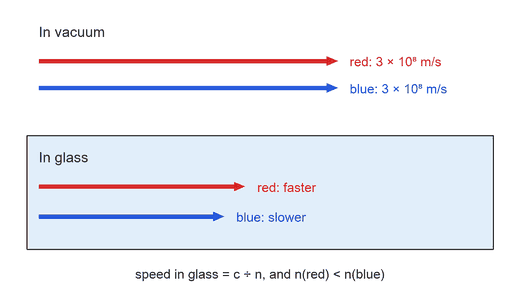
This is also why a prism bends red less than blue.
Watch out: In vacuum every colour (every electromagnetic wave) has the same speed; the speeds differ only inside a medium.
Therefore, (i) neither: both travel at m s⁻¹ in vacuum; (ii) red light has the greater speed in glass.
- 83 marks
Question 8
Give reasons for the following:
During the day:
(i) Clouds appear white.
(ii) Sky appears blue.
Solve with AIWritten solution
Solution:
Concept: How a particle scatters sunlight depends on its size. Particles bigger than the wavelength of light scatter all colours equally; particles much smaller than the wavelength (air molecules) scatter short wavelengths far more, as .
Step 1 — Part (i): size of the particles in a cloud.
Clouds are made of water droplets that are much larger than the wavelength of light.
Step 2 — Part (i): why the cloud looks white.
Such large particles scatter all colours of sunlight almost equally. The light scattered from a cloud therefore has all the colours in the same proportion as sunlight, so the cloud looks white.
Step 3 — Part (ii): size of the particles in clear air.
Sunlight passing through the atmosphere is scattered by the molecules of air, which are much smaller than the wavelength of light. For them the scattered intensity follows:
Step 4 — Part (ii): why the sky looks blue.
So blue light (short wavelength) is scattered much more than red light (long wavelength). When we look at the sky away from the sun, the light reaching our eyes is this scattered light, rich in blue, so the sky looks blue.
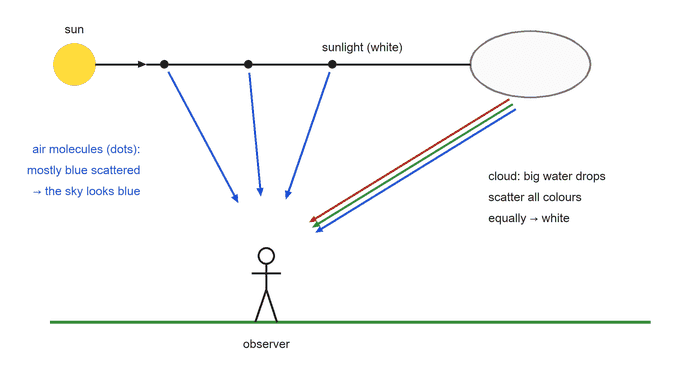
Watch out: Violet is scattered even more than blue, but sunlight has less violet and our eyes are less sensitive to it, so the sky looks blue, not violet.
Therefore, (i) clouds look white because their large water droplets scatter all colours equally; (ii) the sky looks blue because the tiny air molecules scatter blue light much more than red ().
- 91 mark
Question 9
Speed of blue light in water is:
Solve with AIAnswer
(A) more than green light
(B) more than orange light
- Correct
(C) more than violet light
(D) more than red light
Answer: (C) more than violet light
Concept: In a medium such as water or glass, the speed of light increases with its wavelength, because the refractive index is smaller for longer wavelengths.
Step 1 — Order the colours by wavelength.
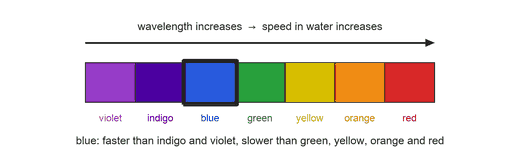
From shortest to longest wavelength the colours are: violet, indigo, blue, green, yellow, orange, red.
Step 2 — Order the speeds in water.
In water, the longer the wavelength, the smaller the refractive index and so the greater the speed (). The speeds follow the same order: violet is the slowest and red the fastest.
Step 3 — Compare blue with each option.
Blue has a longer wavelength than violet only, so blue is faster than violet and slower than green, orange and red.
Watch out: In vacuum (and nearly in air) all colours have the same speed; the order of speeds applies inside a medium.
Why the other options are wrong:
- (A) more than green light: green has a longer wavelength than blue, so green is faster than blue in water.
- (B) more than orange light: orange has a much longer wavelength than blue, so orange is faster.
- (D) more than red light: red has the longest wavelength and is the fastest colour in water.
Therefore, blue light in water is faster than violet light, option (C).
- 104 marks
Question 10
(a) Infrared radiations are used in warfare. Explain with reason, why.
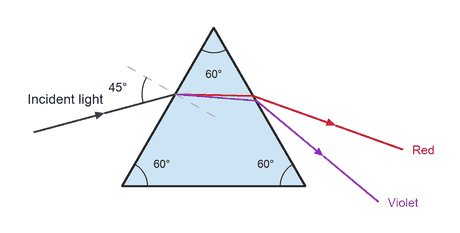
(b) A ray of light is incident at 45° on an equilateral prism in the diagram below.
-
Name the phenomenon exhibited by the ray of light when it enters and emerges out of the prism.
-
State the cause of the above phenomenon mentioned by you.
Solve with AIWritten solution
Solution:
Concept: Infrared rays are invisible and pass through fog and smoke with little scattering. Dispersion is the splitting of white light into its colours. Glass has a different refractive index for each colour (least for red, greatest for violet), so in glass each colour has a different speed and bends by a different amount.
Step 1 — Part (a): infrared from warm bodies.
Every warm body (a soldier, a running engine, a vehicle) gives out infrared radiation. Infrared cameras and night-vision devices detect this radiation, so targets can be seen and photographed in the dark.
Step 2 — Part (a): why infrared gets through.
Infrared has a long wavelength, so it is scattered very little by fog, mist and smoke and passes through them. It is also invisible to the eye, so it can be used without the enemy noticing.
Step 3 — Part (b) 1: name the phenomenon.
The white light splits into its colours, red to violet, as it passes through the prism. This is dispersion of light. (Each colour is also refracted, that is deviated, at both faces.)
Step 4 — Part (b) 2: the cause at the first face.
The speed of light in glass is different for different colours, so the refractive index of glass is different for each colour: least for red, greatest for violet. At the first face each colour therefore bends by a different amount. For example, at 45° incidence with and , Snell's law gives:
Violet is bent more towards the normal, so the colours separate.
Step 5 — Part (b) 2: the second face.
The second face is inclined to the first, so on leaving the colours bend again in the same sense and spread further apart: red is deviated the least and violet the most.
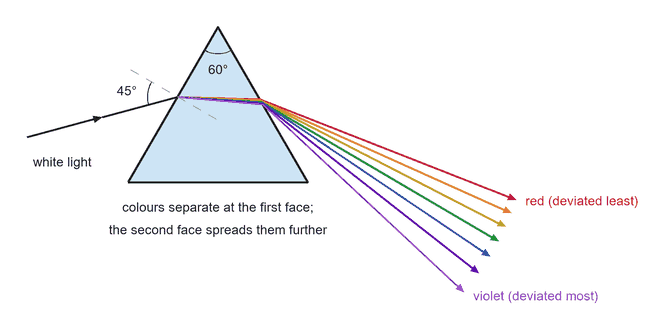
Watch out: The cause of dispersion is the different SPEED (refractive index) of each colour in glass; the prism does not 'add' colours to white light, it only separates those already there.
Therefore, (a) warm targets give out infrared, which night-vision devices detect in the dark and through fog and smoke; (b) 1. dispersion of light; 2. the speed, and so the refractive index, of glass is different for different colours, so each colour is deviated by a different amount.
-
- 111 mark
Question 11
Assertion (A) : Ultraviolet radiations are scattered more as compared to the microwave radiations.
Reason (R) : Wavelength of ultraviolet radiation is more than the wavelength of microwave radiation.
Solve with AIAnswer
(A) Both A and R are true.
- Correct
(B) A is true but R is false.
(C) A is false but R is true.
(D) Both A and R are false.
Answer: (B) A is true but R is false.
Concept: Scattering is stronger for shorter wavelengths (). To judge both statements, place ultraviolet and microwaves on the electromagnetic spectrum.
Step 1 — Place the two radiations.
Ultraviolet lies between X-rays and visible light (about 100 Å to 4000 Å). Microwaves lie beyond infrared (about 1 mm to 1 m). So ultraviolet has a much shorter wavelength than microwaves.
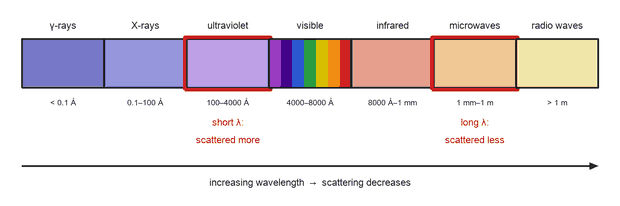
Step 2 — Judge the Assertion.
The shorter the wavelength, the more the scattering, so ultraviolet is scattered more than microwaves. The Assertion is true.
Step 3 — Judge the Reason.
The Reason says the wavelength of ultraviolet is MORE than that of microwaves, which is the opposite of the truth. The Reason is false.
Watch out: A true Assertion with a false Reason is still 'A true, R false'; do not let the false Reason make you doubt A.
Why the other options are wrong:
- (A) Both A and R are true: R reverses the order of the wavelengths, so it is false.
- (C) A is false but R is true: A is true: ultraviolet, with its shorter wavelength, is scattered more.
- (D) Both A and R are false: A is true, so 'both false' cannot be right.
Therefore, the Assertion is true and the Reason is false, option (B).
- 123 marks
Question 12
Below is an incomplete table showing the arrangement of electromagnetic spectrum in the increasing order of their wavelength. Complete the table.
Gamma ray X – ray U V rays Visible rays Infrared A Radio waves (a) Identify the radiation A.
(b) Name the radiation used to detect fracture in bones.
(c) Name one property common to both A and Radio waves.
Solve with AIWritten solution
Solution:
Concept: The electromagnetic spectrum in order of increasing wavelength (Selina's ranges) is: gamma rays (below 0.1 Å), X-rays (0.1 Å to 100 Å), ultraviolet (100 Å to 4000 Å), visible light (4000 Å to 8000 Å), infrared (8000 Å to 1 mm), microwaves (1 mm to 1 m) and radio waves (above 1 m). All of them travel at m s⁻¹ in vacuum.
Step 1 — Complete the table.
In order of increasing wavelength the spectrum runs gamma rays, X-rays, ultraviolet, visible, infrared, then microwaves, then radio waves. So the gap between infrared and radio waves is filled by microwaves:
Gamma ray X – ray U V rays Visible rays Infrared Microwaves Radio waves Step 2 — Part (a): identify A.
A is microwaves: their wavelengths (about 1 mm to 1 m) lie between those of infrared (up to about 1 mm) and radio waves (above 1 m).
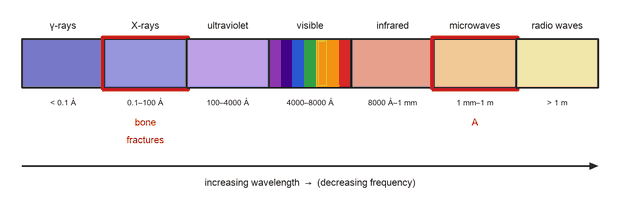
Step 3 — Part (b): detecting fractures.
The radiation used is X-rays. They pass through flesh but are stopped by bone, so a fracture shows up clearly on an X-ray photograph.
Step 4 — Part (c): a common property.
Microwaves and radio waves are both electromagnetic waves, so both travel with the speed of light, m s⁻¹, in vacuum and need no material medium. (Both are also used for communication: microwaves for radar and satellite links, radio waves for broadcasting.)
Watch out: The table is in INCREASING wavelength, so the long-wavelength end (radio waves) is on the right and A must have a longer wavelength than infrared.
Therefore, (a) A = microwaves; (b) X-rays; (c) both travel with the speed of light ( m s⁻¹) in vacuum.
- 131 mark
Question 13
Which one of the following combinations is the correct ascending order of electromagnetic waves in terms of wavelength?
Solve with AIAnswer
- Correct
(A) Gamma-rays, visible light, microwaves
(B) Microwaves, visible light, gamma-rays
(C) Gamma-rays, microwaves, visible light
(D) Microwaves, gamma-rays, visible light
Answer: (A) Gamma-rays, visible light, microwaves
Concept: The electromagnetic spectrum in order of increasing wavelength (Selina's ranges) is: gamma rays (below 0.1 Å), X-rays (0.1 Å to 100 Å), ultraviolet (100 Å to 4000 Å), visible light (4000 Å to 8000 Å), infrared (8000 Å to 1 mm), microwaves (1 mm to 1 m) and radio waves (above 1 m). All of them travel at m s⁻¹ in vacuum.
Step 1 — Understand 'ascending order of wavelength'.
Ascending order of wavelength means from the shortest wavelength to the longest.
Step 2 — Recall the full order.
From shortest to longest wavelength: gamma rays, X-rays, ultraviolet, visible light, infrared, microwaves, radio waves.
Step 3 — Pick out the three given.
Gamma rays (below 0.1 Å) come first, visible light (4000 Å to 8000 Å) next, and microwaves (1 mm to 1 m) last.
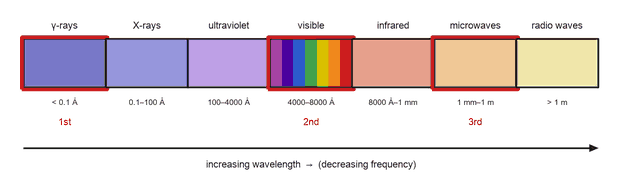
Watch out: The order 'ascending wavelength' is the same as DEScending frequency; do not mix the two orders up.
Why the other options are wrong:
- (B) Microwaves, visible light, gamma-rays: this is the descending order, with the longest wavelength first.
- (C) Gamma-rays, microwaves, visible light: microwaves have a longer wavelength than visible light, so they cannot come before it.
- (D) Microwaves, gamma-rays, visible light: microwaves have the longest wavelength of the three and must come last, not first.
Therefore, the ascending order is gamma rays, visible light, microwaves, option (A).
- 144 marks
Question 14
(a) Name the radiations :
(1) for which a quartz prism is used to study the spectrum.
(2) which are used in remote sensing devices.
(3) which are used in traffic signals in India.
(b) Name one property common to all electromagnetic radiations.
Solve with AIWritten solution
Solution:
Concept: The electromagnetic spectrum in order of increasing wavelength (Selina's ranges) is: gamma rays (below 0.1 Å), X-rays (0.1 Å to 100 Å), ultraviolet (100 Å to 4000 Å), visible light (4000 Å to 8000 Å), infrared (8000 Å to 1 mm), microwaves (1 mm to 1 m) and radio waves (above 1 m). All of them travel at m s⁻¹ in vacuum. Ordinary glass absorbs ultraviolet (so quartz is used for it); infrared is given out by every warm body.
Step 1 — Part (a)(1): the quartz prism.
Ordinary glass absorbs ultraviolet rays, but quartz lets them pass. So a quartz prism is used to study the spectrum of ultraviolet radiations.
Step 2 — Part (a)(2): remote sensing.
The radiation used is infrared. Warm objects on the ground give them out, and their long wavelength lets them pass through haze with little scattering, so satellites and remote-sensing devices use them.
Step 3 — Part (a)(3): traffic signals.
A traffic signal must be seen by the eye, so it uses visible light: red, amber (yellow) and green lights.
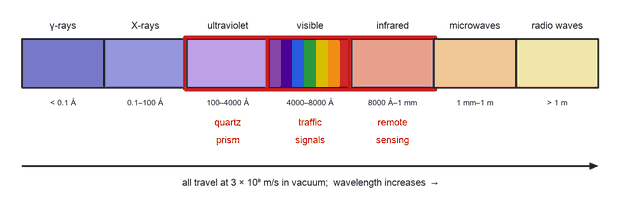
Step 4 — Part (b): a common property.
All electromagnetic radiations travel with the same speed, m s⁻¹, in vacuum. (They also need no material medium, and they are transverse waves.)
Watch out: A quartz prism is for ultraviolet; for infrared a rock-salt prism is used. Do not swap the two.
Therefore, (a) (1) ultraviolet; (2) infrared; (3) visible light (red, amber and green); (b) all travel at m s⁻¹ in vacuum.
- 151 mark
Question 15
Assertion (A) : Quartz prism is used to study ultraviolet spectrum.
Reason (R) : Quartz does not absorb ultraviolet radiations.
Solve with AIAnswer
- Correct
(A) Both (A) and (R) are true and (R) is the correct explanation of (A).
(B) Both (A) and (R) are true and (R) is not the correct explanation of (A).
(C) (A) is true but (R) is false.
(D) (A) is false and (R) is true.
Answer: (A) Both (A) and (R) are true and (R) is the correct explanation of (A).
Concept: To study a spectrum, the radiation must pass through the prism. Ordinary glass absorbs ultraviolet; quartz does not.
Step 1 — Judge the Assertion.
The ultraviolet spectrum is obtained with a quartz prism, not with a glass prism. The Assertion is true.
Step 2 — Judge the Reason.
Quartz is transparent to ultraviolet: it does not absorb it. The Reason is true.
Step 3 — Decide whether the Reason explains the Assertion.
A glass prism would absorb the ultraviolet rays and no ultraviolet spectrum would form. Quartz is chosen precisely because it does not absorb them, so the Reason explains the Assertion.
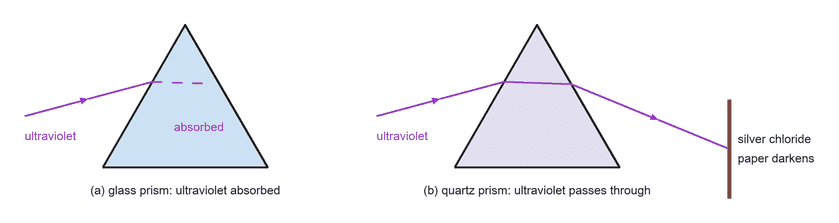
Watch out: Both statements being true is not enough; ask whether R is the reason FOR A. Here it is.
Why the other options are wrong:
- (B) Both (A) and (R) are true and (R) is not the correct explanation of (A): R is the actual reason for using quartz, so it does explain A.
- (C) (A) is true but (R) is false: R is true: quartz transmits ultraviolet rays, which is also why ultraviolet lamps have quartz envelopes.
- (D) (A) is false and (R) is true: A is true: a quartz prism is the standard choice for the ultraviolet spectrum.
Therefore, both statements are true and the Reason correctly explains the Assertion, option (A).
- 164 marks
Question 16
(a) Name the electromagnetic radiations which are used for sterilising water in a water purifier.
(b) State any one property of the radiations mentioned by you in part (a).
(c) Why are the danger signals red in colour?
Solve with AIWritten solution
Solution:
Concept: Ultraviolet rays kill germs. Scattering of light is the process in which very small particles of a medium (molecules of air, fine dust) absorb the light falling on them and send it out again in all directions. For particles much smaller than the wavelength, the intensity of scattered light varies as : the shorter the wavelength, the more the light is scattered.
Step 1 — Part (a): the sterilising radiation.
The radiation used is ultraviolet. In a water purifier the water flows past an ultraviolet lamp, and the ultraviolet rays kill the germs (bacteria) in it.
Step 2 — Part (b): one property of ultraviolet.
Ultraviolet rays kill germs (bacteria and other micro-organisms). Any one of these is also correct: they are absorbed by ordinary glass but pass through quartz; they cause fluorescence; they darken silver chloride and affect a photographic plate; they travel at m s⁻¹ in vacuum.
Step 3 — Part (c): the wavelength of red.
Red light has the longest wavelength in the visible spectrum. The intensity of scattered light varies as:
So red light is scattered the least by air molecules, dust and fog.
Step 4 — Part (c): why that suits a danger signal.
Being scattered the least, red light travels the farthest through air, dust and fog without being weakened. A red signal can therefore be seen clearly from a long distance, which is what a danger signal needs.
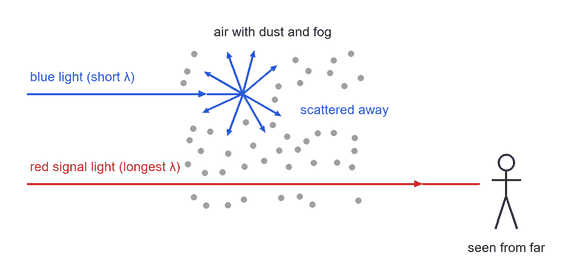
Watch out: Red is chosen because it is scattered LEAST (longest wavelength), not because it is the brightest colour.
Therefore, (a) ultraviolet radiations; (b) they kill germs (bacteria); (c) red light has the longest wavelength, so it is scattered least and can be seen from far, even in fog.
- 171 mark
Question 17
When a blackened bulb thermometer is moved beyond the red region of the visible spectrum, there is a rapid rise in the temperature. This is due to the presence of :
Solve with AIAnswer
- Correct
(A) Infrared radiations
(B) Ultraviolet radiations
(C) X-rays
(D) Radio waves
Answer: (A) Infrared radiations
Concept: Just beyond the red end of the visible spectrum lie infrared radiations, which are invisible but have a strong heating effect.
Step 1 — Locate the thermometer.
The thermometer is beyond the red end of the visible spectrum, where the eye sees nothing.
Step 2 — Name what lies there.
The radiation next to red, on the longer-wavelength side, is infrared. Infrared is deviated even less than red, so it falls just beyond the red end of the spectrum.
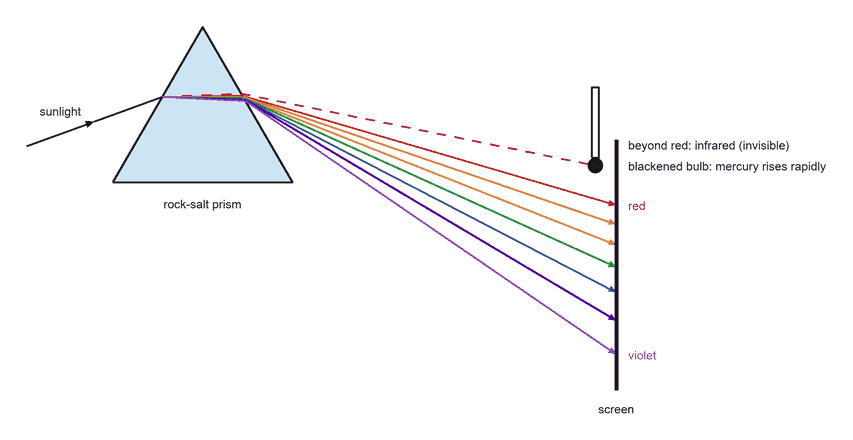
Step 3 — Explain the rise in temperature.
The blackened bulb absorbs the infrared radiation well, and infrared has a strong heating effect, so the mercury rises rapidly. This is how infrared radiation is detected.
Watch out: Beyond RED is infrared; beyond VIOLET is ultraviolet. Do not mix the two ends up.
Why the other options are wrong:
- (B) Ultraviolet radiations: ultraviolet lies beyond the violet end, not the red end, and it is detected by its chemical action, not by heating.
- (C) X-rays: X-rays lie far beyond the violet end, even beyond ultraviolet, so they cannot be found beyond red.
- (D) Radio waves: radio waves lie beyond microwaves, far from the red end; the radiation just beyond red is infrared.
Therefore, the rapid rise is due to infrared radiations, option (A).
- 181 mark
Question 18
Assertion (A) : Tiny air molecules scatter blue light more than red light.
Reason (R) : The refractive index of a medium is greater for blue light than red light.
Solve with AIAnswer
(A) (A) is true but (R) is false.
(B) (A) is false but (R) is true.
(C) Both (A) and (R) are true and (R) is correct explanation of (A).
- Correct
(D) Both (A) and (R) are true and (R) is not the correct explanation of (A).
Answer: (D) Both (A) and (R) are true and (R) is not the correct explanation of (A).
Concept: Scattering and refraction are two different effects. Scattering by tiny particles depends on the wavelength (); bending by a medium depends on its refractive index.
Step 1 — Judge the Assertion.
Air molecules are much smaller than the wavelength of light, and blue has a shorter wavelength than red. Since , blue is scattered more. The Assertion is true.
Step 2 — Judge the Reason.
The refractive index of glass, water and other media is greater for blue light than for red light; that is why a prism bends blue more than red. The Reason is true.
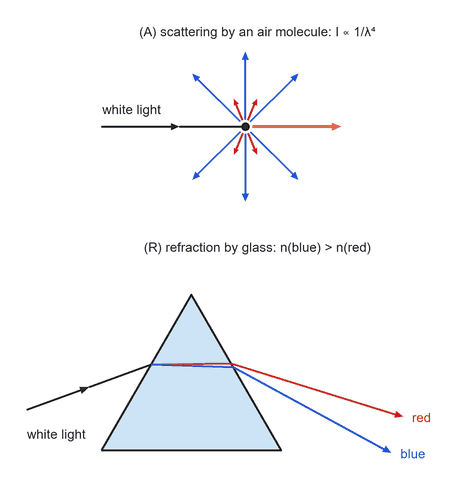
Step 3 — Decide whether the Reason explains the Assertion.
The scattering of blue light by air molecules is explained by its shorter wavelength, not by the refractive index. So the Reason, though true, does not explain the Assertion.
Watch out: Two true statements about the same colours are not automatically cause and effect.
Why the other options are wrong:
- (A) (A) is true but (R) is false: R is true: every medium such as glass has a greater refractive index for blue than for red.
- (B) (A) is false but (R) is true: A is true: blue light is scattered more by air molecules, which is why the sky is blue.
- (C) Both (A) and (R) are true and (R) is correct explanation of (A): R is true but explains refraction (bending), not scattering; scattering depends on the wavelength.
Therefore, both statements are true but the Reason does not explain the Assertion, option (D).
- 191 mark
Question 19
Identify the radiation that scatters the least.
Solve with AIAnswer
- Correct
(A) Radio waves
(B) Microwaves
(C) X-rays
(D) Gamma rays
Answer: (A) Radio waves
Concept: Scattering decreases rapidly as the wavelength increases (), so the radiation with the longest wavelength scatters the least.
Step 1 — Order the four by wavelength.
From shortest to longest: gamma rays, X-rays, microwaves, radio waves.
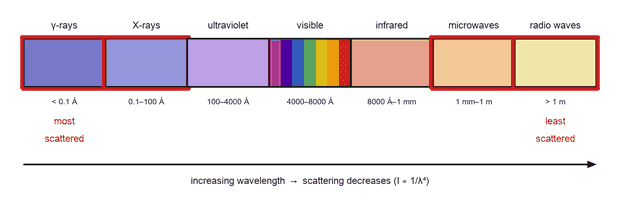
Step 2 — Find the longest wavelength.
Radio waves (above 1 m) have the longest wavelength of the four.
Step 3 — Apply the scattering rule.
Scattering falls rapidly as the wavelength increases, so the radiation with the longest wavelength, radio waves, is scattered the least.
Watch out: The phrase 'scatters the least' means the LONGEST wavelength, not the shortest.
Why the other options are wrong:
- (B) Microwaves: microwaves (1 mm to 1 m) have a shorter wavelength than radio waves, so they scatter more.
- (C) X-rays: X-rays have a very short wavelength, so by this rule they scatter much more.
- (D) Gamma rays: gamma rays have the shortest wavelength of all, so by this rule they scatter the most of the four.
Therefore, radio waves scatter the least, option (A).
- 203 marks
Question 20
The diagram given below shows refraction of white light through a rectangular glass block.
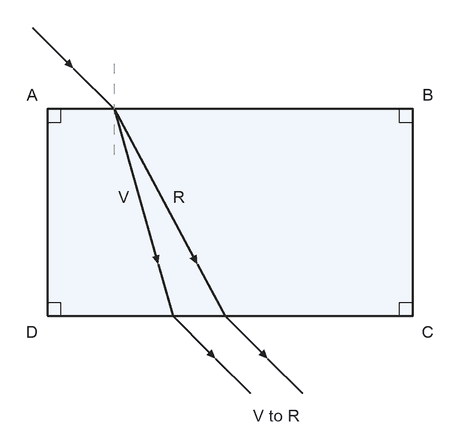
(a) Name the two phenomena taking place at the surface AB.
(b) With a reason state whether one can see these colours when seen from the side DC.
Solve with AIWritten solution
Solution:
Concept: At AB white light bends and splits into colours. But the face DC is parallel to AB, so each colour bends back by the same amount on leaving and comes out parallel to the incident light.
Step 1 — Part (a): the bending at AB.
As the white light enters the denser glass at AB it slows down and bends towards the normal. This is refraction.
Step 2 — Part (a): the splitting at AB.
Glass has a different refractive index for each colour, so the colours bend by different amounts and separate: violet (V) bends the most and red (R) the least. This is dispersion.
Step 3 — Part (b): what happens at DC.
The face DC is parallel to AB. At DC each colour is refracted back by exactly as much as it was bent at AB, so every colour comes out parallel to the incident white light.
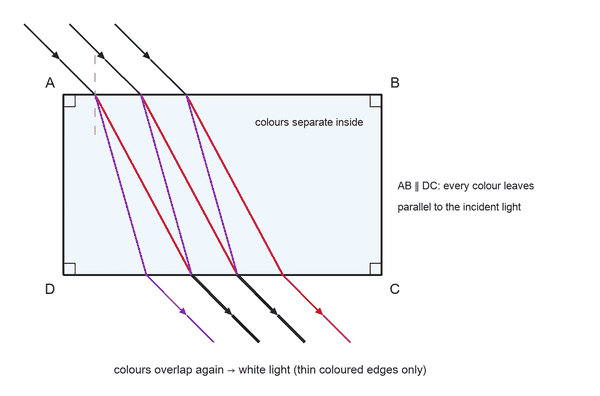
Step 4 — Part (b): why no colours are seen.
All the emergent colours travel in the same direction. In a beam of white light the colours from neighbouring rays overlap and recombine into white light, so the light seen from DC looks white. At most, the very edges of the beam show a faint tinge of colour.
Watch out: A prism forms a spectrum only because its two faces are INCLINED to each other; in a parallel-sided block the second face undoes the first.
Therefore, (a) refraction and dispersion; (b) no: the faces are parallel, so all colours emerge parallel to the incident light and recombine into white light.