Solution:
Concept: Infrared rays are invisible and pass through fog and smoke with little scattering. Dispersion is the splitting of white light into its colours. Glass has a different refractive index for each colour (least for red, greatest for violet), so in glass each colour has a different speed and bends by a different amount.
Step 1 — Part (a): infrared from warm bodies.
Every warm body (a soldier, a running engine, a vehicle) gives out infrared radiation. Infrared cameras and night-vision devices detect this radiation, so targets can be seen and photographed in the dark.
Step 2 — Part (a): why infrared gets through.
Infrared has a long wavelength, so it is scattered very little by fog, mist and smoke and passes through them. It is also invisible to the eye, so it can be used without the enemy noticing.
Step 3 — Part (b) 1: name the phenomenon.
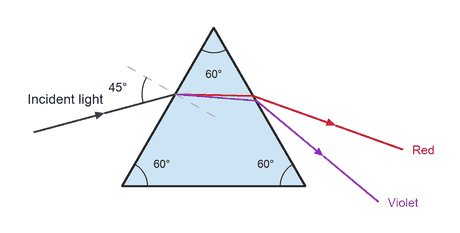
The white light splits into its colours, red to violet, as it passes through the prism. This is dispersion of light. (Each colour is also refracted, that is deviated, at both faces.)
Step 4 — Part (b) 2: the cause at the first face.
The speed of light in glass is different for different colours, so the refractive index of glass is different for each colour: least for red, greatest for violet. At the first face each colour therefore bends by a different amount. For example, at 45° incidence with μred≈1.514 and μviolet≈1.532, Snell's law sinr=μsini gives:
rred≈27.8∘
rviolet≈27.5∘
Violet is bent more towards the normal, so the colours separate.
Step 5 — Part (b) 2: the second face.
The second face is inclined to the first, so on leaving the colours bend again in the same sense and spread further apart: red is deviated the least and violet the most.
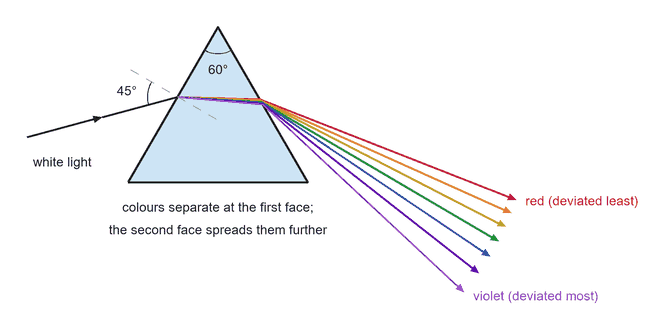
Watch out: The cause of dispersion is the different SPEED (refractive index) of each colour in glass; the prism does not 'add' colours to white light, it only separates those already there.
Therefore, (a) warm targets give out infrared, which night-vision devices detect in the dark and through fog and smoke; (b) 1. dispersion of light; 2. the speed, and so the refractive index, of glass is different for different colours, so each colour is deviated by a different amount.