
Question 83 marksAsked 2020Easy
Give reasons for the following:
During the day:
(i) Clouds appear white.
(ii) Sky appears blue.
Confirming your payment
Sign up now and get 250 free tokens.
Previous Year Questions · Question 8 of 20
Give reasons for the following:
During the day:
(i) Clouds appear white.
(ii) Sky appears blue.
Solution:
Concept: How a particle scatters sunlight depends on its size. Particles bigger than the wavelength of light scatter all colours equally; particles much smaller than the wavelength (air molecules) scatter short wavelengths far more, as .
Step 1 — Part (i): size of the particles in a cloud.
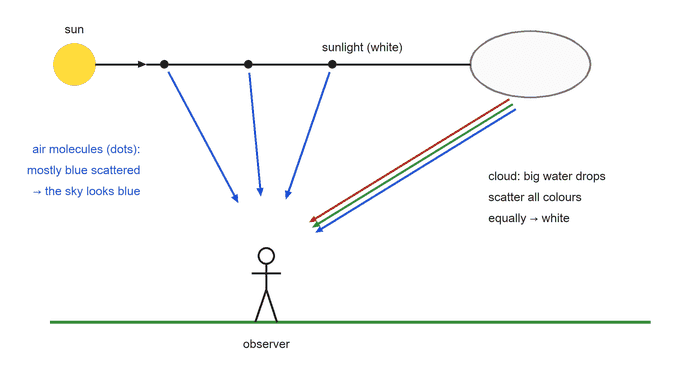
Clouds are made of water droplets that are much larger than the wavelength of light.
Step 2 — Part (i): why the cloud looks white.
Such large particles scatter all colours of sunlight almost equally. The light scattered from a cloud therefore has all the colours in the same proportion as sunlight, so the cloud looks white.
Step 3 — Part (ii): size of the particles in clear air.
Sunlight passing through the atmosphere is scattered by the molecules of air, which are much smaller than the wavelength of light. For them the scattered intensity follows:
Step 4 — Part (ii): why the sky looks blue.
So blue light (short wavelength) is scattered much more than red light (long wavelength). When we look at the sky away from the sun, the light reaching our eyes is this scattered light, rich in blue, so the sky looks blue.
Watch out: Violet is scattered even more than blue, but sunlight has less violet and our eyes are less sensitive to it, so the sky looks blue, not violet.
Therefore, (i) clouds look white because their large water droplets scatter all colours equally; (ii) the sky looks blue because the tiny air molecules scatter blue light much more than red ().