
Question 72 marksAsked 2020Easy
The wave lengths for the light of red and blue colours are nearly m and m respectively.
(i) Which colour has the greater speed in a vacuum?
(ii) Which colour has a greater speed in glass?
Confirming your payment
Sign up now and get 250 free tokens.
Previous Year Questions · Question 7 of 20
The wave lengths for the light of red and blue colours are nearly m and m respectively.
(i) Which colour has the greater speed in a vacuum?
(ii) Which colour has a greater speed in glass?
Solution:
Concept: In vacuum every colour travels at the same speed. In glass the speed depends on the wavelength: the longer the wavelength, the smaller the refractive index of glass for it, and the faster it travels ().
Step 1 — Part (i): speed in vacuum.
In vacuum every colour travels with the same speed, m s⁻¹, whatever its wavelength. So neither colour is faster: red and blue have equal speeds in vacuum.
Step 2 — Part (ii): compare the refractive indices.
In glass the refractive index depends on the wavelength: the longer the wavelength, the smaller the refractive index. Red ( m) has the longer wavelength, so glass has a smaller refractive index for red than for blue.
Step 3 — Part (ii): compare the speeds.
The speed in glass is the speed in vacuum divided by the refractive index:
A smaller μ gives a larger v, so red travels faster in glass. For example, with typical crown-glass values and :
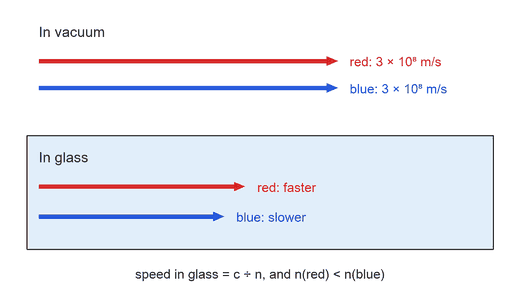
This is also why a prism bends red less than blue.
Watch out: In vacuum every colour (every electromagnetic wave) has the same speed; the speeds differ only inside a medium.
Therefore, (i) neither: both travel at m s⁻¹ in vacuum; (ii) red light has the greater speed in glass.