Solution:
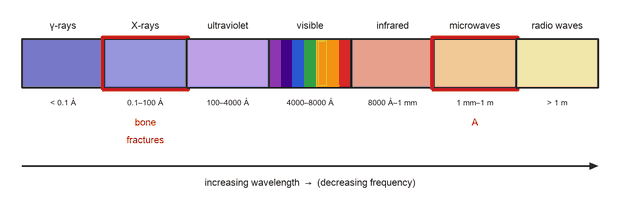
Concept: The electromagnetic spectrum in order of increasing wavelength (Selina's ranges) is: gamma rays (below 0.1 Å), X-rays (0.1 Å to 100 Å), ultraviolet (100 Å to 4000 Å), visible light (4000 Å to 8000 Å), infrared (8000 Å to 1 mm), microwaves (1 mm to 1 m) and radio waves (above 1 m). All of them travel at 3×10⁸ m s⁻¹ in vacuum.
Step 1 — Complete the table.
In order of increasing wavelength the spectrum runs gamma rays, X-rays, ultraviolet, visible, infrared, then microwaves, then radio waves. So the gap between infrared and radio waves is filled by microwaves:
| Gamma ray | X – ray | U V rays | Visible rays | Infrared | Microwaves | Radio waves |
|---|
Step 2 — Part (a): identify A.
A is microwaves: their wavelengths (about 1 mm to 1 m) lie between those of infrared (up to about 1 mm) and radio waves (above 1 m).
Step 3 — Part (b): detecting fractures.
The radiation used is X-rays. They pass through flesh but are stopped by bone, so a fracture shows up clearly on an X-ray photograph.
Step 4 — Part (c): a common property.
Microwaves and radio waves are both electromagnetic waves, so both travel with the speed of light, 3×10⁸ m s⁻¹, in vacuum and need no material medium. (Both are also used for communication: microwaves for radar and satellite links, radio waves for broadcasting.)
Watch out: The table is in INCREASING wavelength, so the long-wavelength end (radio waves) is on the right and A must have a longer wavelength than infrared.
Therefore, (a) A = microwaves; (b) X-rays; (c) both travel with the speed of light (3×10⁸ m s⁻¹) in vacuum.
