Solution:
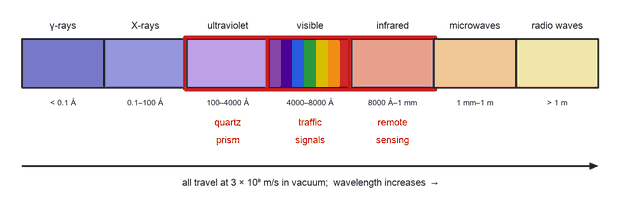
Concept: The electromagnetic spectrum in order of increasing wavelength (Selina's ranges) is: gamma rays (below 0.1 Å), X-rays (0.1 Å to 100 Å), ultraviolet (100 Å to 4000 Å), visible light (4000 Å to 8000 Å), infrared (8000 Å to 1 mm), microwaves (1 mm to 1 m) and radio waves (above 1 m). All of them travel at 3×10⁸ m s⁻¹ in vacuum. Ordinary glass absorbs ultraviolet (so quartz is used for it); infrared is given out by every warm body.
Step 1 — Part (a)(1): the quartz prism.
Ordinary glass absorbs ultraviolet rays, but quartz lets them pass. So a quartz prism is used to study the spectrum of ultraviolet radiations.
Step 2 — Part (a)(2): remote sensing.
The radiation used is infrared. Warm objects on the ground give them out, and their long wavelength lets them pass through haze with little scattering, so satellites and remote-sensing devices use them.
Step 3 — Part (a)(3): traffic signals.
A traffic signal must be seen by the eye, so it uses visible light: red, amber (yellow) and green lights.
Step 4 — Part (b): a common property.
All electromagnetic radiations travel with the same speed, 3×10⁸ m s⁻¹, in vacuum. (They also need no material medium, and they are transverse waves.)
Watch out: A quartz prism is for ultraviolet; for infrared a rock-salt prism is used. Do not swap the two.
Therefore, (a) (1) ultraviolet; (2) infrared; (3) visible light (red, amber and green); (b) all travel at 3×10⁸ m s⁻¹ in vacuum.
