
Question 181 markMCQAsked 2026Medium
Assertion (A) : Tiny air molecules scatter blue light more than red light.
Reason (R) : The refractive index of a medium is greater for blue light than red light.
Confirming your payment
Sign up now and get 250 free tokens.
Previous Year Questions · Question 18 of 20
Assertion (A) : Tiny air molecules scatter blue light more than red light.
Reason (R) : The refractive index of a medium is greater for blue light than red light.
(A) (A) is true but (R) is false.
(B) (A) is false but (R) is true.
(C) Both (A) and (R) are true and (R) is correct explanation of (A).
(D) Both (A) and (R) are true and (R) is not the correct explanation of (A).
Answer: (D) Both (A) and (R) are true and (R) is not the correct explanation of (A).
Concept: Scattering and refraction are two different effects. Scattering by tiny particles depends on the wavelength (); bending by a medium depends on its refractive index.
Step 1 — Judge the Assertion.
Air molecules are much smaller than the wavelength of light, and blue has a shorter wavelength than red. Since , blue is scattered more. The Assertion is true.
Step 2 — Judge the Reason.
The refractive index of glass, water and other media is greater for blue light than for red light; that is why a prism bends blue more than red. The Reason is true.
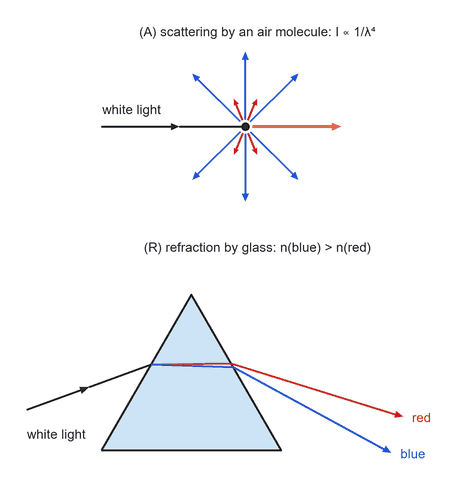
Step 3 — Decide whether the Reason explains the Assertion.
The scattering of blue light by air molecules is explained by its shorter wavelength, not by the refractive index. So the Reason, though true, does not explain the Assertion.
Watch out: Two true statements about the same colours are not automatically cause and effect.
Why the other options are wrong:
Therefore, both statements are true but the Reason does not explain the Assertion, option (D).