
Question 171 markMCQAsked 2026Easy
When a blackened bulb thermometer is moved beyond the red region of the visible spectrum, there is a rapid rise in the temperature. This is due to the presence of :
Confirming your payment
Sign up now and get 250 free tokens.
Previous Year Questions · Question 17 of 20
When a blackened bulb thermometer is moved beyond the red region of the visible spectrum, there is a rapid rise in the temperature. This is due to the presence of :
(A) Infrared radiations
(B) Ultraviolet radiations
(C) X-rays
(D) Radio waves
Answer: (A) Infrared radiations
Concept: Just beyond the red end of the visible spectrum lie infrared radiations, which are invisible but have a strong heating effect.
Step 1 — Locate the thermometer.
The thermometer is beyond the red end of the visible spectrum, where the eye sees nothing.
Step 2 — Name what lies there.
The radiation next to red, on the longer-wavelength side, is infrared. Infrared is deviated even less than red, so it falls just beyond the red end of the spectrum.
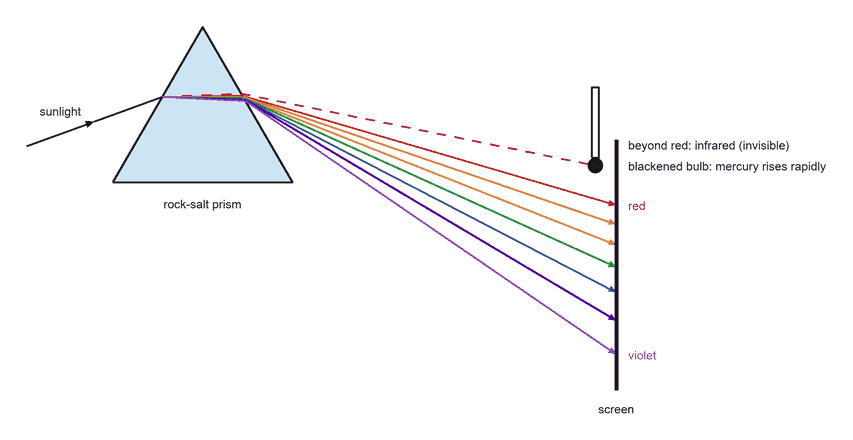
Step 3 — Explain the rise in temperature.
The blackened bulb absorbs the infrared radiation well, and infrared has a strong heating effect, so the mercury rises rapidly. This is how infrared radiation is detected.
Watch out: Beyond RED is infrared; beyond VIOLET is ultraviolet. Do not mix the two ends up.
Why the other options are wrong:
Therefore, the rapid rise is due to infrared radiations, option (A).