Solution:
Concept: Ultraviolet rays kill germs. Scattering of light is the process in which very small particles of a medium (molecules of air, fine dust) absorb the light falling on them and send it out again in all directions. For particles much smaller than the wavelength, the intensity of scattered light varies as I∝λ41: the shorter the wavelength, the more the light is scattered.
Step 1 — Part (a): the sterilising radiation.
The radiation used is ultraviolet. In a water purifier the water flows past an ultraviolet lamp, and the ultraviolet rays kill the germs (bacteria) in it.
Step 2 — Part (b): one property of ultraviolet.
Ultraviolet rays kill germs (bacteria and other micro-organisms). Any one of these is also correct: they are absorbed by ordinary glass but pass through quartz; they cause fluorescence; they darken silver chloride and affect a photographic plate; they travel at 3×10⁸ m s⁻¹ in vacuum.
Step 3 — Part (c): the wavelength of red.
Red light has the longest wavelength in the visible spectrum. The intensity of scattered light varies as:
I∝λ41
So red light is scattered the least by air molecules, dust and fog.
Step 4 — Part (c): why that suits a danger signal.
Being scattered the least, red light travels the farthest through air, dust and fog without being weakened. A red signal can therefore be seen clearly from a long distance, which is what a danger signal needs.
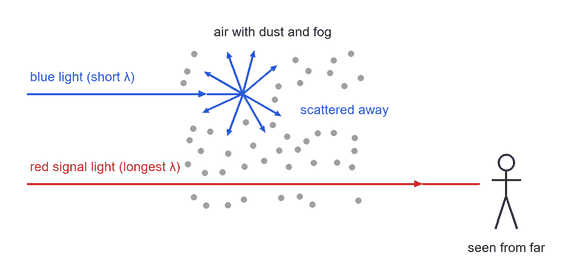
Watch out: Red is chosen because it is scattered LEAST (longest wavelength), not because it is the brightest colour.
Therefore, (a) ultraviolet radiations; (b) they kill germs (bacteria); (c) red light has the longest wavelength, so it is scattered least and can be seen from far, even in fog.
