
Question 42 marksAsked 2018Easy
(i) Why is the ratio of the velocities of light of wavelengths 4000 Å and 8000 Å in vacuum 1 : 1 ?
(ii) Which of the above wavelengths has a higher frequency?
Confirming your payment
Sign up now and get 250 free tokens.
Previous Year Questions · Question 4 of 20
(i) Why is the ratio of the velocities of light of wavelengths 4000 Å and 8000 Å in vacuum 1 : 1 ?
(ii) Which of the above wavelengths has a higher frequency?
Solution:
Concept: Light of every colour is an electromagnetic wave. All electromagnetic waves travel with the same speed c in vacuum, and speed, frequency and wavelength are linked by .
Step 1 — Part (i): the speed in vacuum.
Light of every wavelength is an electromagnetic wave, and all electromagnetic waves travel with the same speed in vacuum, m s⁻¹. This speed does not depend on the wavelength.
Step 2 — Part (i): the ratio.
Both lights therefore travel at c in vacuum, so the ratio of their speeds is:
That is 1 : 1. (The speeds differ only inside a material medium such as glass.)
Step 3 — Part (ii): link frequency and wavelength.
Speed, frequency and wavelength are linked by , so the frequency is:
For the same c, the shorter the wavelength, the higher the frequency. We change Å to metres using 1 Å = m.
Step 4 — Part (ii): frequency of the 4000 Å light.
We put m:
Step 5 — Part (ii): frequency of the 8000 Å light.
We put m:
So the 4000 Å light (violet) has twice the frequency of the 8000 Å light (red).
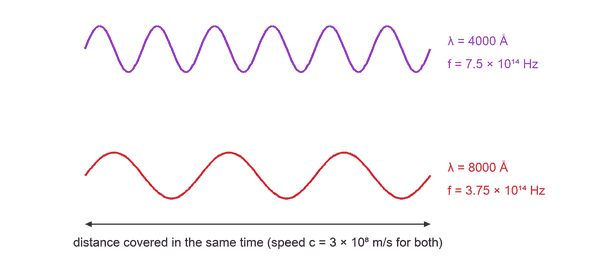
Both waves cover the same distance in the same time; the shorter wave fits twice as many waves into it, so twice as many pass a point each second.
Watch out: In vacuum every colour (every electromagnetic wave) has the same speed; the speeds differ only inside a medium.
Therefore, (i) all wavelengths travel with the same speed c = m s⁻¹ in vacuum, so the ratio is 1 : 1; (ii) the 4000 Å light has the higher frequency ( Hz, twice that of 8000 Å).