Solution:
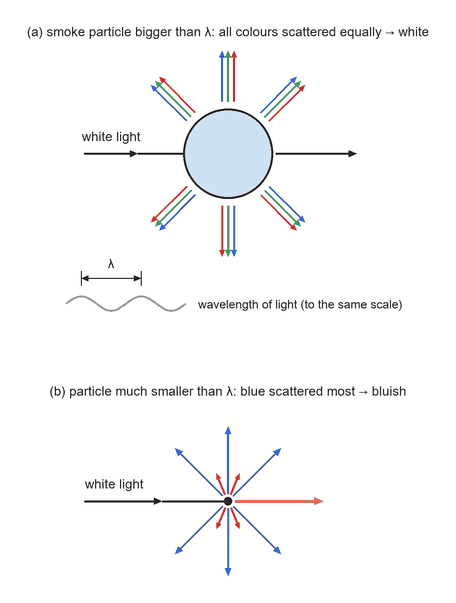
Concept: Scattering of light is the process in which very small particles of a medium (molecules of air, fine dust) absorb the light falling on them and send it out again in all directions. For particles much smaller than the wavelength, the intensity of scattered light varies as I∝λ41: the shorter the wavelength, the more the light is scattered. Particles bigger than the wavelength scatter all colours almost equally.
Step 1 — Part (i): define scattering.
Scattering of light is the process in which very small particles of a medium absorb the light falling on them and re-emit it in all directions.
Step 2 — Part (ii): how particle size changes scattering.
Particles much smaller than the wavelength (air molecules) scatter short wavelengths far more, so their scattered light is bluish. Particles bigger than the wavelength scatter all colours almost equally, so their scattered light has all the colours in the same proportion as sunlight and looks white.
Step 3 — Part (ii): apply it to smoke.
The smoke looks white, so it must scatter all colours equally. Its particles must therefore be bigger than the wavelength of light, and statement (a) is true.
Step 4 — Part (ii): check the other statement.
If the smoke particles were smaller than the wavelength, as statement (b) says, they would scatter mostly blue light and the smoke would look bluish. So statement (b) is false.
Watch out: The paper calls them 'molecules'; strictly, each smoke particle is a tiny speck of soot or ash made of very many molecules, which is why it is bigger than the wavelength.
Therefore, (i) scattering is the absorption and re-emission of light in all directions by tiny particles; (ii) statement (a) is true: the smoke particles are bigger than the wavelength of light.
