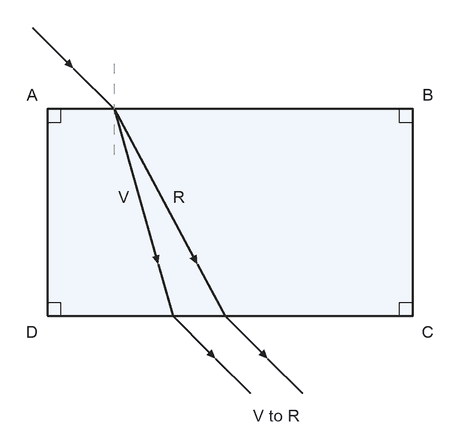
Solution:
Concept: At AB white light bends and splits into colours. But the face DC is parallel to AB, so each colour bends back by the same amount on leaving and comes out parallel to the incident light.
Step 1 — Part (a): the bending at AB.
As the white light enters the denser glass at AB it slows down and bends towards the normal. This is refraction.
Step 2 — Part (a): the splitting at AB.
Glass has a different refractive index for each colour, so the colours bend by different amounts and separate: violet (V) bends the most and red (R) the least. This is dispersion.
Step 3 — Part (b): what happens at DC.
The face DC is parallel to AB. At DC each colour is refracted back by exactly as much as it was bent at AB, so every colour comes out parallel to the incident white light.
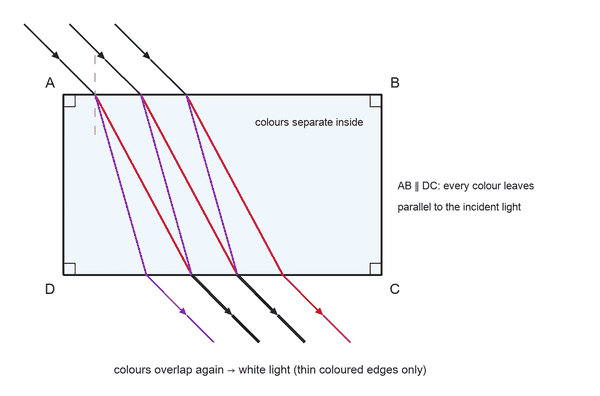
Step 4 — Part (b): why no colours are seen.
All the emergent colours travel in the same direction. In a beam of white light the colours from neighbouring rays overlap and recombine into white light, so the light seen from DC looks white. At most, the very edges of the beam show a faint tinge of colour.
Watch out: A prism forms a spectrum only because its two faces are INCLINED to each other; in a parallel-sided block the second face undoes the first.
Therefore, (a) refraction and dispersion; (b) no: the faces are parallel, so all colours emerge parallel to the incident light and recombine into white light.