
Question 163 marksMedium
Name three factors on which the deviation produced by a prism depends and state how does it depend on the factors stated by you.
Confirming your payment
Sign up now and get 250 free tokens.
Spectrum · Question 16 of 88
Name three factors on which the deviation produced by a prism depends and state how does it depend on the factors stated by you.
Solution:
Concept: A prism deviates light towards its base. How much it deviates depends on how the light meets the prism, what the prism is made of and its shape, and the light itself.
Step 1 — Factor 1: the angle of incidence.
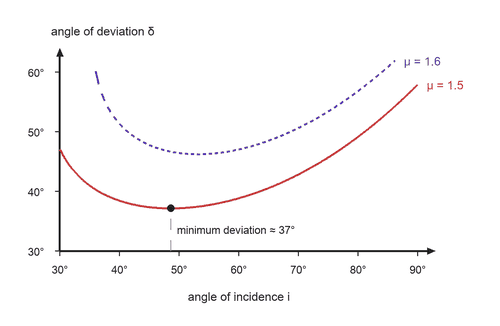
As the angle of incidence increases, the deviation first decreases, reaches a minimum value (minimum deviation), and then increases again.
Step 2 — Factor 2: the material (refractive index) of the prism.
The higher the refractive index of the material, the greater the deviation; for example, a flint-glass prism deviates light more than a crown-glass prism.
Step 3 — Factor 3: the colour (wavelength) of light.
The shorter the wavelength, the larger the refractive index and so the greater the deviation: violet is deviated the most and red the least.
Step 4 — Read the graph.
The graph shows factor 1 for a 60° prism of refractive index 1.5: the deviation falls to a minimum of about 37° and then rises. The upper curve (μ = 1.6) shows factors 2 and 3: a material of higher refractive index, or light of shorter wavelength, gives more deviation at every angle.
(The deviation also increases with the angle of the prism, which is a fourth factor.)
Watch out: The deviation does not keep increasing with the angle of incidence; it passes through a minimum first.
Therefore, the deviation depends on (1) the angle of incidence (it first decreases to a minimum, then increases), (2) the material of the prism (greater for a higher refractive index) and (3) the wavelength of light (greater for a shorter wavelength).