
Question 751 markMCQEasy
The danger signal is red because its wavelength is the ................ and therefore it gets ................ the least .
Confirming your payment
Sign up now and get 250 free tokens.
Spectrum · Question 75 of 88
The danger signal is red because its wavelength is the ................ and therefore it gets ................ the least .
(A) least, deviated
(B) longest, scattered
(C) longest, dispersed
(D) least, scattered
Answer: (B) longest, scattered
Concept: Scattering of light is the absorption and re-emission of light in all directions by particles in its path. For particles much smaller than the wavelength (such as air molecules), the intensity of the scattered light is , so short wavelengths (violet, blue) are scattered far more than long ones (red).
Step 1 — Fill the first blank.
In the visible spectrum, red light has the longest wavelength (up to about 8000 Å), so the first blank is "longest".
Step 2 — Fill the second blank.
Since I ∝ 1/λ⁴, red light is scattered the least by air molecules, dust and fog. It travels farthest without becoming weak, so a red danger signal can be seen from a long distance; the second blank is "scattered".
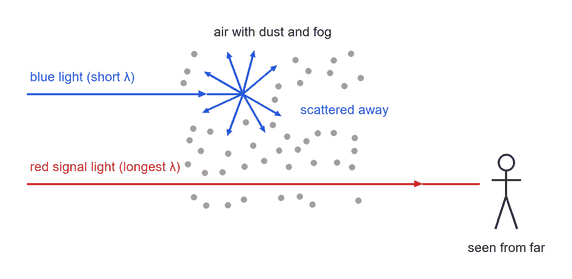
Watch out: The effect that matters for a signal is scattering, not deviation or dispersion.
Why the other options are wrong:
Therefore, the danger signal is red because its wavelength is the longest and therefore it gets scattered the least, option (B).