
Question 762 marksEasy
When sunlight enters the earth's atmosphere, state which colour of light is scattered (i) the most, and (ii) the least.
Confirming your payment
Sign up now and get 250 free tokens.
Spectrum · Question 76 of 88
When sunlight enters the earth's atmosphere, state which colour of light is scattered (i) the most, and (ii) the least.
Solution:
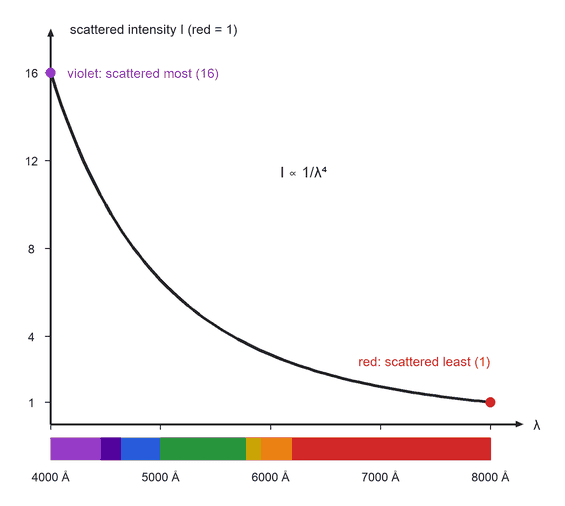
Concept: Scattering of light is the absorption and re-emission of light in all directions by particles in its path. For particles much smaller than the wavelength (such as air molecules), the intensity of the scattered light is , so short wavelengths (violet, blue) are scattered far more than long ones (red).
Step 1 — Answer (i): scattered the most.
Violet light has the shortest wavelength in the visible spectrum (about 4000 Å), so it is scattered the most, with blue close behind.
Step 2 — Answer (ii): scattered the least.
Red light has the longest wavelength (about 8000 Å), so it is scattered the least.
Step 3 — Compare them.
The ratio of their scattering is the fourth power of the wavelength ratio.
Watch out: The sky looks blue rather than violet only because sunlight has less violet and our eyes are less sensitive to it; violet is still scattered the most.
Therefore, (i) violet light (and next to it blue) is scattered the most; (ii) red light is scattered the least.