Solution:
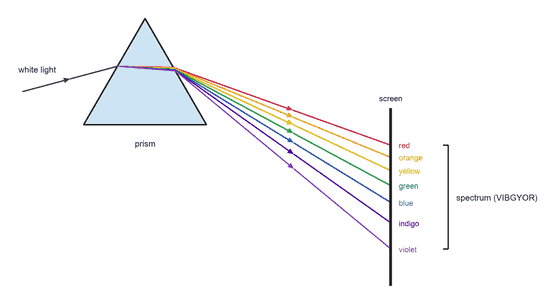
Concept: A prism deviates (turns) light towards its base. The larger the refractive index of the prism for a colour, the more that colour is bent, so violet (largest μ) is deviated the most and red (smallest μ) the least.
Step 1 — Answer (a): the order of colours.
From the base side upwards on the screen the colours are violet, indigo, blue, green, yellow, orange and red (VIBGYOR): violet, deviated most, is nearest the base and red, deviated least, is nearest the apex.
Step 2 — Answer (b): the widths.
No, the colours do not have the same width. Each colour covers a different range of wavelengths (in the book's table red spans 6200–8000 Å, that is 1800 Å, but yellow only 5780–5920 Å, that is 140 Å), and a glass prism spreads the violet–blue end out more than the red end.
Step 3 — Answer (c)(i): most deviated.
Violet is deviated the most, because glass has the largest refractive index for violet light.
Step 4 — Answer (c)(ii): least deviated.
Red is deviated the least, because glass has the smallest refractive index for red light.
Watch out: The colour nearest the BASE of the prism is violet, the most deviated one.
Therefore, (a) VIBGYOR from the base side up; (b) no, the colours have different widths; (c) (i) violet deviates the most, (ii) red the least.
