
Question 264 marksMedium
Explain the cause of dispersion of white light through a prism.
Confirming your payment
Sign up now and get 250 free tokens.
Spectrum · Question 26 of 88
Explain the cause of dispersion of white light through a prism.
Solution:
Concept: Dispersion is caused by the variation of the refractive index (and so of the speed of light) of the prism material with the wavelength (colour) of light.
Step 1 — White light is a mixture.
White light contains seven colours, each with its own wavelength, from violet (shortest) to red (longest).
Step 2 — Same speed in air, different speeds in glass.
In vacuum (or air) all the colours travel at the same speed. In glass the speed depends on the wavelength: red travels fastest and violet slowest.
Step 3 — So each colour has its own refractive index.
Since μ = c ÷ v, the refractive index of glass is least for red (fastest) and greatest for violet (slowest).
Step 4 — So each colour bends by a different amount.
When white light enters the prism, each colour is refracted by a different amount: violet bends the most and red the least, so the colours separate inside the prism. At the second face each colour bends again, the separation increases, and a spectrum is formed.
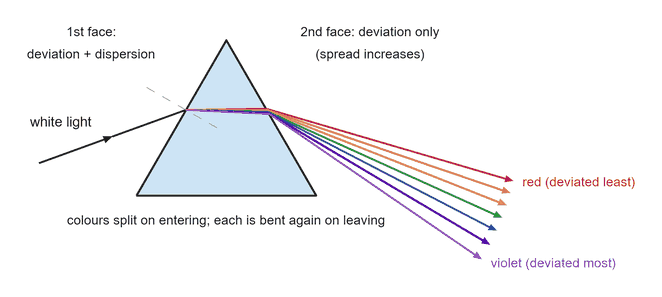
Watch out: The prism does not create the colours; it only separates colours already present in white light.
Therefore, the cause of dispersion is that the refractive index of glass (the speed of light in it) is different for different wavelengths, so each colour is deviated by a different amount.