Solution:
Concept: Dispersion is the splitting of white light into its colours. It happens because the refractive index (μ) of glass is slightly different for each colour: it is least for red light and greatest for violet light, so each colour bends by a different amount.
Step 1 — Set up the experiment.
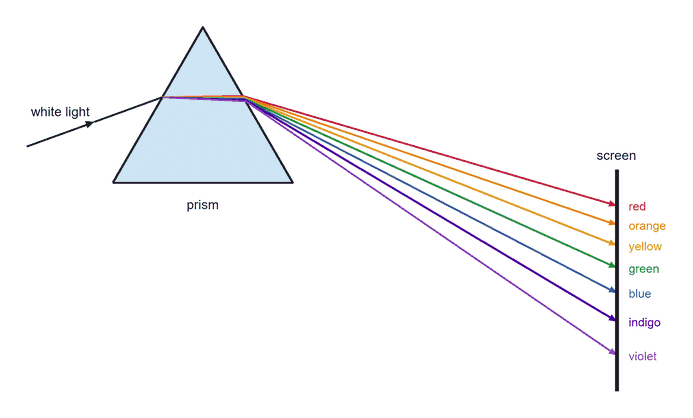
A narrow beam of white light falls on the first face of a glass prism, and a white screen is placed beyond the second face.
Step 2 — What happens at the first face.
On entering the glass, the colours are refracted by different amounts, because the refractive index differs for each colour. The colours therefore separate inside the prism (dispersion), and the whole beam bends towards the base (deviation).
Step 3 — What happens at the second face.
At the second face each colour is refracted again, away from the normal. The colours, already separated, are bent further towards the base, so their separation increases.
Step 4 — What is seen on the screen.
The screen shows a spectrum, VIBGYOR: violet, deviated most, nearest the base and red, deviated least, nearest the apex.
Step 5 — Name the surfaces.
At the first surface there is both dispersion and deviation. At the second surface there is only deviation: the colours separated at the first face are bent further, but no new splitting takes place.
Watch out: The colours split at the FIRST face; the second face only bends the colours that are already separate.
Therefore, white light is dispersed because each colour has a different refractive index in glass; there is both dispersion and deviation at the first surface and only deviation at the second surface.
