Solution:
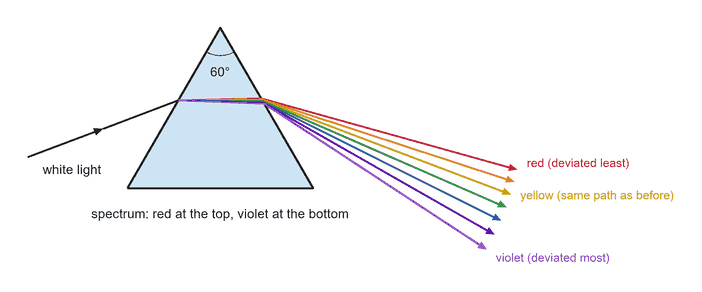
Concept: In Fig. 6.8 the yellow light passes through the equiangular prism parallel to its base, which is the position of minimum deviation. White light contains yellow along with colours of shorter and longer wavelength, which the prism bends by different amounts.
Step 1 — Yellow keeps its old path.
At the same angle of incidence, yellow light has the same refractive index as before, so it follows exactly the same path: parallel to the base inside the prism.
Step 2 — Shorter wavelengths bend more.
Green, blue, indigo and violet have shorter wavelengths, so glass has a larger refractive index for them; they are deviated more, towards the base.
Step 3 — Longer wavelengths bend less.
Orange and red have longer wavelengths, so they are deviated less than yellow.
Step 4 — Draw and label the result.
A spectrum fans out from the second face, with red at the top (deviated least) and violet at the bottom (deviated most).
Watch out: The colour that was at minimum deviation (yellow) still passes parallel to the base; the others do not.
Therefore, the prism disperses the white light into a spectrum: yellow follows its old path, red is deviated least (top) and violet most (bottom).

