
Question 562 marksEasy
Name the waves (a) of lowest wavelength, (b) used for taking photographs in dark, (c) produced by changes in the nucleus of an atom, (d) of wavelength nearly 0·1 nm.
Confirming your payment
Sign up now and get 250 free tokens.
Spectrum · Question 56 of 88
Name the waves (a) of lowest wavelength, (b) used for taking photographs in dark, (c) produced by changes in the nucleus of an atom, (d) of wavelength nearly 0·1 nm.
Solution:
Concept: The electromagnetic spectrum in order of increasing wavelength (book's ranges): gamma rays (below 0.1 Å), X-rays (0.1 Å to 100 Å), ultraviolet (100 Å to 4000 Å), visible light (4000 Å to 8000 Å), infrared (8000 Å to 1 mm), microwaves (1 mm to 1 m) and radio waves (above 1 m). All of them travel at 3 × 10⁸ m s⁻¹ in vacuum.
Step 1 — Answer (a): lowest wavelength.
Gamma rays have the shortest wavelength of all (less than 0.1 Å).
Step 2 — Answer (b): photographs in the dark.
Warm objects give out infrared rays, and a film sensitive to infrared records them even in the dark, so infrared rays are used.
Step 3 — Answer (c): changes in the nucleus.
Gamma rays are given out when the nucleus of a radioactive atom passes from an excited state to a lower energy state.
Step 4 — Answer (d): wavelength nearly 0.1 nm.
Change 0.1 nm into ångström: 0.1 nm = 1 Å, which lies in the X-ray range (0.1 Å to 100 Å).
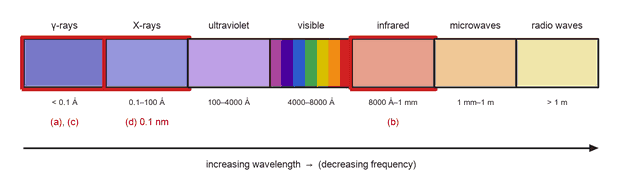
Therefore, (a) gamma rays; (b) infrared rays; (c) gamma rays; (d) X-rays.