
Opening your dashboard
Class 10 Physics Chapter 6 Spectrum: Competency-Based Questions (CBQ)
40 questions on Chapter 6, each worked through on its own page with the AI tutor. Class 10 Physics, ICSE 2026-27.
40 questions
1–5 marks · Mixed difficulty
- 11 mark
Question 1
Competency: Recall
________ of UV > ________ of microwaves
The quantity suitable for filling in both the blanks is:
- 21 mark
Question 2
Competency: Analysis
Assertion (A): Sometimes the sky appears reddish in the evening.
Reason (R): Red, being longer in wavelength, scatter more than the other colours.
- 31 mark
Question 3
Competency: Analysis
A ray of yellow light falls on one face of an equilateral glass prism at an angle of incidence of 35° and comes out of the second face at an angle of emergence of 66°.

The same ray is now made to fall on the first face at an angle of incidence of 66°. Its angle of emergence and its angle of deviation will now be:
- 41 mark
Question 4
Competency: Application
Four LEDs P, Q, R and S each give out light of a single frequency. The frequencies are listed below.
LED P Q R S Frequency (in Hz) 4.6 5.6 6.4 7.2 Taking the speed of light in air as m s, which LED gives out green light?
- 51 mark
Question 5
Competency: Analysis
Sana forms the spectrum of sunlight on a screen, first with a quartz prism and then with an ordinary glass prism of the same shape. Each time she holds a strip of paper soaked in silver chloride solution just beyond the violet end of the spectrum. With the quartz prism the strip darkens quickly. With the glass prism it hardly changes. Which conclusion do these observations support?
- 61 mark
Question 6
Competency: Understanding
Assertion (A): To an astronaut standing on the surface of the moon, the sky appears black even while the sun is shining.
Reason (R): The intensity of light scattered by air molecules is inversely proportional to the fourth power of the wavelength of the light.
- 72 marks
Question 7
Competency: Understanding & Application
A cut-glass pendant hanging at a sunny window throws small patches of rainbow colours on the opposite wall. The flat glass pane of the same window lets the same sunlight through, but the light it throws on the floor is white.
(a) Explain how the pendant produces the coloured patches.
(b) Explain why the flat pane does not produce them.
- 82 marks
Question 8
Competency: Application
A home Wi-Fi router sends its signals in two bands, one of frequency 2.4 GHz and the other of frequency 5 GHz (1 GHz = Hz). Take the speed of electromagnetic waves in air as m s.
(a) Calculate the wavelength of the waves in each band.
(b) Name the part of the electromagnetic spectrum to which these waves belong. Do the 5 GHz waves reach a phone kept 6 m away sooner than the 2.4 GHz waves ? Give a reason.
- 92 marks
Question 9
Competency: Analysis
Farah forms the spectrum of sunlight on a screen with a rock-salt prism in a dark room. She holds a thermometer with a blackened bulb at each of the four positions marked in the figure for two minutes, starting each time from the room temperature of 25.0 °C.
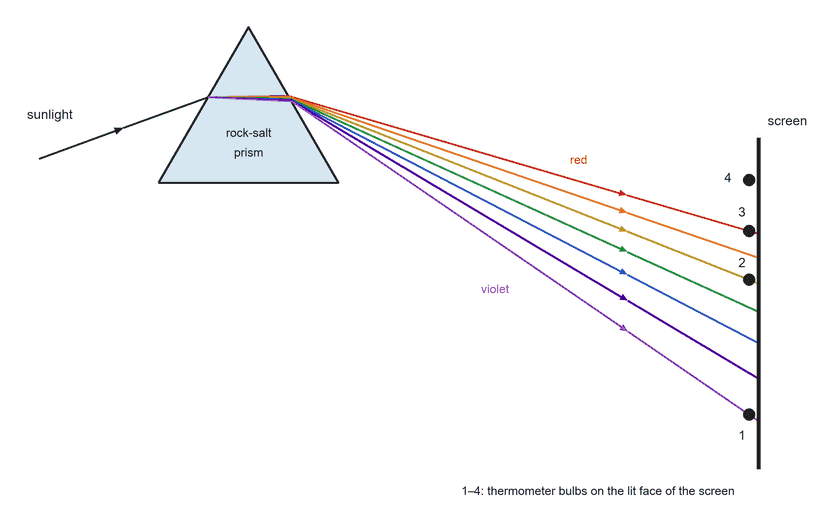
Her readings are given below.
Position 1 2 3 4 Final reading (in °C) 25.3 25.9 26.8 28.4 (a) No light is seen on the screen at position 4. What do the readings show about this position ? Name the radiation that falls there.
(b) Give a reason why the bulb of the thermometer is blackened, and why the prism is made of rock salt and not of glass.
- 102 marks
Question 10
Competency: Application & Analysis
The intensity of light scattered by air molecules is inversely proportional to the fourth power of its wavelength.
(a) Red light of wavelength 720 nm is scattered by the air with a certain intensity. Find the wavelength of the radiation that is scattered 16 times as strongly, and name the part of the electromagnetic spectrum in which it lies.
(b) Use your answer to explain why a person sitting in the shade of a beach umbrella, where no direct sunlight falls, can still get sunburnt on a clear day.
- 114 marks
Question 11
Competency: Analysis & Evaluation
Case study: In the school laboratory, Ishaan passes a narrow beam of yellow light through a glass prism. He changes the angle of incidence in steps, measures the angle of deviation each time and plots the graph shown below.

(a) Describe how the angle of deviation changes as the angle of incidence is increased from 35° to 70°. Read from the graph the least value of the angle of deviation and the angle of incidence at which it occurs.
(b) The deviation is 42° at two different angles of incidence. Read these two angles from the graph. Taking one of them as the angle of incidence and the other as the corresponding angle of emergence, calculate the angle of the prism.
(c) Ishaan says, "At the lowest point of the graph, the ray must be leaving the prism at the same angle at which it entered." Use your values from parts (a) and (b) to judge his statement.
- 124 marks
Question 12
Competency: Application & Evaluation
Case study: The streets of an old town are lit by sodium vapour lamps. A sodium lamp gives out light of practically a single wavelength, 589 nm in air. Before it reaches the street, the light passes through the thick glass cover of the lamp, in which the speed of light is m s. (Speed of light in air = m s)
(a) Calculate the frequency of the light, and name its colour.
(b) State the frequency of this light inside the glass cover, and calculate its wavelength there.
(c) Kabir says, "Inside the glass the wavelength is shorter than 400 nm. So while the light is in the glass it is ultraviolet radiation, and it turns into visible light again when it comes out." Judge his statement.
- 134 marks
Question 13
Competency: Analysis & Application
Case study: A testing laboratory has three sealed sources X, Y and Z. Each gives out one kind of invisible electromagnetic radiation: one infrared radiation, one ultraviolet radiation and one X-rays. The labels have come off. A technician tries three tests on the beam from each source and records what happens in the table below.
Test X Y Z Thermometer with a blackened bulb held in the beam reading rises quickly no noticeable rise no noticeable rise Zinc sulphide screen held in the beam no glow screen glows screen glows Hand held between the source and a photographic film film not affected anywhere film darkens, except behind the whole hand film darkens, except behind the bones (a) Identify the radiation from each of X, Y and Z, giving a reason for each.
(b) Arrange the three radiations in the order of increasing wavelength, and state which of them has the highest frequency.
(c) Which source should the laboratory use to check whether a gemstone is pure by the glow it gives, and which to look for a fracture in a bone ? Give a reason for each choice.
- 144 marks
Question 14
Competency: Analysis & Evaluation
Case study: A warning lamp is to be fixed on top of a tall tower near an airfield, so that pilots can see it from several kilometres away, even through hazy air. The engineers compare three lamps of equal brightness, listed in the table below.
Lamp Colour of light Wavelength L1 Blue 480 nm L2 Green 540 nm L3 Red 720 nm The air molecules and the fine particles of the haze are much smaller than these wavelengths, so the intensity of the scattered light is inversely proportional to the fourth power of the wavelength.
(a) Taking the scattering of the red light as 1, calculate the relative scattering of the green light and of the blue light.
(b) Which lamp should the engineers choose ? Give a reason based on your answer to part (a).
(c) A member of the team says, "The blue lamp is the best choice. Its light is scattered the most, so more of it spreads out and reaches the pilot." Judge this statement.
- 154 marks
Question 15
Competency: Analysis & Creation
Aman passes a narrow beam of white light through a glass prism and gets a band of colours on a screen. He says, "White light has no colours in it. The glass of the prism adds the colours to the light." Besides Aman's set-up, you are given a second identical prism, a second white screen and a card with a narrow slit cut in it.
(a) Design an experiment with these things to test Aman's idea. Describe the arrangement step by step.
(b) State what would be seen on the second screen if Aman were right, and what you expect will actually be seen.
(c) Write the conclusion that the expected observation leads to, and give two precautions that make the test reliable.
- 161 mark
Question 16
Competency: Application
The record sheet of a prism experiment lists the wavelength (in air) of the light from two single-colour torches A and B.
Torch A B Wavelength 7500 Å m (Hypothetical data.)
A narrow beam from each torch is sent, one after the other, through the same glass prism at the same angle of incidence. Which statement is correct?
- 171 mark
Question 17
Competency: Understanding
While studying the image of a heavenly body formed by a lens, Newton noticed that the image was coloured at its edges. He first thought that the lens was defective, so he repeated the experiment with a carefully polished lens. The image was coloured as before. What did he conclude?
- 181 mark
Question 18
Competency: Understanding
Assertion (A): A narrow beam of X-rays passes straight through the gap between two oppositely charged metal plates without bending.
Reason (R): X-rays are electromagnetic waves, and electromagnetic waves are not deflected by electric and magnetic fields.
- 191 mark
Question 19
Competency: Analysis
Assertion (A): A thermopile kept just beyond the violet end of the spectrum of sunlight shows a large deflection in the galvanometer joined to it.
Reason (R): Infrared radiations have a strong heating effect.
- 201 mark
Question 20
Competency: Understanding
In a dark kitchen, Rani sees a bright streak of sunlight coming through a small hole in the shutter. She is standing at the side of the beam and the light is not coming straight towards her eyes, yet she can see the streak clearly. Which statement explains this?
- 211 mark
Question 21
Competency: Analysis
A narrow beam of white light falls on a prism of flint glass. A student measures, for the red part and for the violet part of the beam, the deviation at the first surface and the deviation at the second surface. The total deviation is .
Colour Red 18.8° 29.0° Violet 19.3° 32.4° (Hypothetical data.)
What is the angle between the emergent red ray and the emergent violet ray?
- 221 mark
Question 22
Competency: Application
A solar flare sends out X-rays and radio waves together. Take the distance from the Sun to the Earth as m and the speed of electromagnetic waves in space as m s. Which statement about the arrival of the two kinds of waves at the Earth is correct?
- 231 mark
Question 23
Competency: Understanding
Neha is preparing a revision chart on ultraviolet, visible and infrared radiations. Only one of the statements she has written is correct. Which one is it?
- 241 mark
Question 24
Competency: Analysis
The axis below shows the wavelength of the radiation given out by four sources P, Q, R and S. Each tick on the axis stands for a wavelength 10 times the one before it. The coloured band marks the visible region. (Hypothetical data.)

Which two sources give out invisible radiation of wavelength longer than that of visible light?
- 251 mark
Question 25
Competency: Analysis
After a dust storm over a desert town, the sky looks pale and whitish instead of a deep blue. Which explanation is best?
- 262 marks
Question 26
Competency: Application
Zoya reads that the frequency of visible light runs from Hz (red) to Hz (violet). In the book's figure of the complete electromagnetic spectrum, the frequency scale is marked from Hz (below which lie radio waves) to Hz (above which lie gamma rays).
(a) By what factor is the frequency of violet light greater than that of red light?
(b) By what factor is the frequency Hz greater than Hz? Use the two factors to say how large a share of the whole scale the visible part is.
- 272 marks
Question 27
Competency: Understanding
A hospital's cancer unit directs a narrow beam of radiation from a sealed radioactive source at a tumour to destroy the cancer cells. The unit is run by trained staff, and the dose and time are strictly controlled.
(a) Name the radiation used and say where it comes from.
(b) Why must this radiation be used only in a controlled manner?
- 282 marks
Question 28
Competency: Understanding
In the X-ray tube of a hospital, a beam of fast electrons is stopped by a small plate of tungsten, a heavy metal. Only a small part of the energy of the electrons becomes radiation. The rest appears as heat, so the plate gets very hot while the tube is working.
(a) Name the radiation produced and state one use of it in medicine.
(b) Why must the target plate be made of a metal of high melting point?
- 292 marks
Question 29
Competency: Application
A room heater has a glowing element fixed in front of a curved, polished, bowl-shaped metal reflector. The reflector makes the heat from the element come out as a narrow parallel beam, which warms a person sitting some distance away.
(a) Where must the element be placed with respect to the reflector so that a parallel beam leaves it? Name the property of infrared radiation that the reflector uses.
(b) Name one harmful effect on the skin of staying too close to the heater for a long time.
- 302 marks
Question 30
Competency: Application & Analysis
A narrow beam holding only red light and violet light falls on a glass slab at an angle of incidence of 50°. The refractive index of the glass is 1.51 for red light and 1.53 for violet light. (Hypothetical data.) Take and the speed of light in air as m s.
(a) Find the angle of refraction for each colour and say which colour is deviated more at the first surface.
(b) Find the speed of each colour in the glass and say which is slower.
- 312 marks
Question 31
Competency: Evaluation
Ritu says, "X-rays and gamma rays are really the same radiation. Both are invisible, both make a zinc sulphide screen glow, and both can pass through human flesh."
(a) Is Ritu right? Give two ways in which gamma rays and X-rays differ.
(b) Which of the two is used to look for a fracture in a bone? Why would the other one not show the fracture?
- 323 marks
Question 32
Competency: Evaluation
Meena forms the spectrum of sunlight on a white screen with a glass prism in a dark room. The base of the prism is downwards. She plans three changes and writes in her notebook what she expects each change to do.
- Statement 1: "If I hold a red glass filter (a piece of glass that lets only red light pass) in the path of the sunlight before it reaches the prism, only a red band will be seen on the screen, at the same place where the red part of the spectrum was."
- Statement 2: "If I move the screen farther away from the prism, the spectrum on it will become wider, but the order of the colours will stay the same."
- Statement 3: "If I turn the prism upside down so that its base is upwards, violet will be at the top of the spectrum, because violet will now be deviated the least."
(a) Is statement 1 correct? Give a reason.
(b) Is statement 2 correct? Give a reason.
(c) Judge statement 3. If any part of it is wrong, correct it.
- 333 marks
Question 33
Competency: Analysis
Rahul sends a narrow beam of single-colour light through glass prisms and measures the angle of deviation. His readings are in the table. (Hypothetical data.)
Trial Colour Angle of the prism Angle of incidence Angle of deviation 1 Yellow 60° 50° 38.9° 2 Violet 60° 50° 39.8° 3 Red 60° 50° 38.1° 4 Yellow 50° 50° 30.9° 5 Yellow 60° 40° 40.6° (a) Which trials should be compared to find the effect of the colour of light alone? What do they show?
(b) Which two trials show the effect of the angle of the prism alone? What do they show?
(c) Which two trials show whether the angle of incidence matters? What do they show?
- 343 marks
Question 34
Competency: Analysis
The figure shows three electromagnetic waves P, Q and R drawn to the same scale. The dots mark the crests. One division on the horizontal axis stands for 100 nm. (Hypothetical data.)
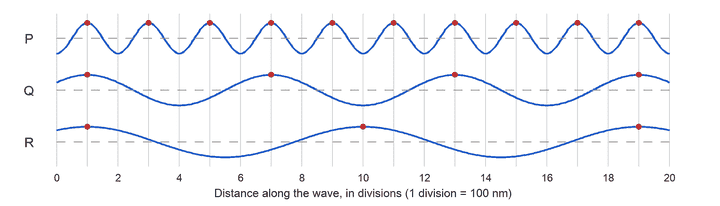
(a) Read the wavelength of each wave from the figure and name the part of the electromagnetic spectrum to which it belongs.
(b) Which of the three waves has the highest frequency? Give a reason.
(c) Calculate the frequency of wave Q. Take the speed of the wave as m s.
- 353 marks
Question 35
Competency: Evaluation & Application
A news reader says, "The ozone layer in the upper atmosphere protects us from the infrared radiations of the Sun. If the ozone layer gets thinner, more infrared radiation will reach us and this will cause skin cancer."
(a) Which part of the statement is wrong? Correct it.
(b) The ozone layer absorbs most of the Sun's radiation of wavelength from 200 nm to 300 nm. Use the book's wavelength ranges to show that all of this radiation is ultraviolet.
(c) Find the frequency of the radiation of wavelength 300 nm, taking the speed of light as m s, and check that it lies in the frequency range of ultraviolet radiations.
- 363 marks
Question 36
Competency: Creativity
A dental clinic wants a small closed cabinet in which instruments are kept under an ultraviolet lamp to sterilise them. You are asked to plan the cabinet.
(a) The cabinet door will have a window so that the staff can look inside. Should the window be made of ordinary glass or of quartz? Give a reason.
(b) Suggest a simple way for the staff to check, without looking at the lamp, that it is giving out ultraviolet radiation.
(c) A staff member suggests fitting an infrared lamp instead, "since infrared is also invisible, so it will do the same job". Judge this suggestion.
- 374 marks
Question 37
Competency: Analysis & Application
Case study: A physics club in Pune studies how strongly the air scatters sunlight of different wavelengths. Their measurements agree with the rule that the intensity of light scattered by air molecules is inversely proportional to the fourth power of its wavelength. They plot the graph below, taking the scattered intensity of light of wavelength 800 nm as 1. (Hypothetical data.)
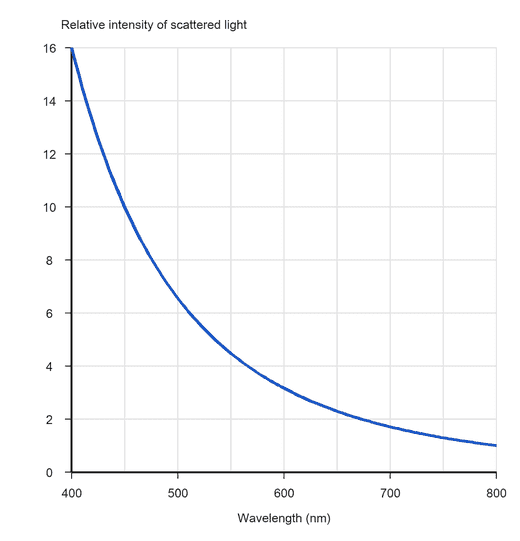
(a) Read from the graph the relative intensity of the scattered light of wavelength 400 nm. How many times more strongly is light of 400 nm scattered than light of 800 nm?
(b) Calculate how many times more strongly light of wavelength 500 nm is scattered than light of wavelength 700 nm. Check your answer roughly with the graph.
(c) The scattered intensity of light of one colour is 4 times that of the 800 nm light. Read its wavelength from the graph and name its colour.
- 385 marks
Question 38
Competency: Application & Analysis
Case study: During a live cricket telecast, the programme is sent from a van at the stadium up to a satellite and then down to a dish in a village. Microwaves carry the signal on both legs. The table gives the frequency used and the distance travelled on each leg. (Hypothetical data; the satellite is about 36 000 km above the equator.)
Leg Frequency Distance Up-link: stadium to satellite 6 GHz m Down-link: satellite to village dish 4 GHz m Take Hz and the speed of the signal as m s.
(a) Find the wavelength used on each leg. Show that both belong to the microwave region.
(b) Find the time the signal takes to travel from the stadium to the village dish. (Ignore any delay inside the satellite.)
(c) Suppose the same programme were sent on both legs with radio waves of frequency 100 MHz instead. Find the wavelength and say whether the total travel time would be more, less or the same.
- 394 marks
Question 39
Competency: Analysis & Application
Case study: Sana sends a narrow beam of white light through a glass prism of angle 60° at an angle of incidence of 50°. She measures the angle of deviation of each colour in the spectrum and notes the wavelength of the light. (Hypothetical data.)
Colour Wavelength (nm) Angle of deviation Red 680 38.4° Orange 600 38.6° Yellow 580 38.7° Green 530 38.9° Blue 480 39.2° Indigo 455 39.4° Violet 420 39.7° (a) Describe how the angle of deviation changes as the wavelength of the light decreases. Which colour travels fastest in the glass?
(b) Find the angle between the emergent red ray and the emergent violet ray.
(c) A diagram in a book shows the red and violet rays leaving the prism about 10° apart. Use your answer to part (b) to say how far this diagram is from the real situation, and why books draw it that way.
- 405 marks
Question 40
Competency: Evaluation & Application
Case study: A factory makes thick steel pipes for a city's water supply. Every welded joint is checked for hidden cracks. A beam of penetrating radiation is sent through the joint onto a photographic film, and a crack shows up as a darker line on the film. The factory has two sources, each kept behind a thick shield. (Hypothetical data.)
Source Radiation Thickest steel wall it can check K X-rays from an X-ray machine 5 cm L Radiation of wavelength 0.001 nm from a sealed radioactive capsule 15 cm Take the speed of electromagnetic waves as m s and m.
(a) Calculate the frequency of the radiation from L, and use its wavelength to name the radiation.
(b) A pipe has a steel wall 12 cm thick. Which source must be used to check its joints? Explain, using the table and a property of the radiation.
(c) A new worker says, "The radiation from L goes straight through 15 cm of steel, so it will pass through my body too without doing any harm. I need not stay behind the shield while it is in use." Judge this statement and state the safe practice.