Solution:
Concept: Each reason comes from one property: infrared is scattered little, is invisible and does not affect ordinary photographic film; glass absorbs ultraviolet and most infrared, while quartz passes ultraviolet and rock salt passes infrared.
Step 1 — Reason (i): photography in fog.
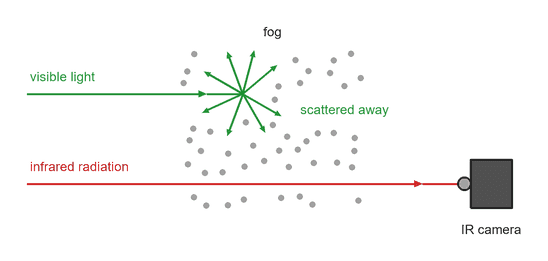
Infrared radiations have a long wavelength, so they are scattered very little by the fog droplets. They pass through the fog and give clear photographs.
Step 2 — Reason (ii): signals during war.
Infrared signals are invisible to the enemy, and they pass through fog and smoke with little scattering, so they reach far.
Step 3 — Reason (iii): infrared lamps in darkrooms.
Infrared light does not affect ordinary photographic film (it has no chemical action on it), yet it lets the worker see a little in the dark.
Step 4 — Reason (iv): rock-salt prism for the infrared spectrum.
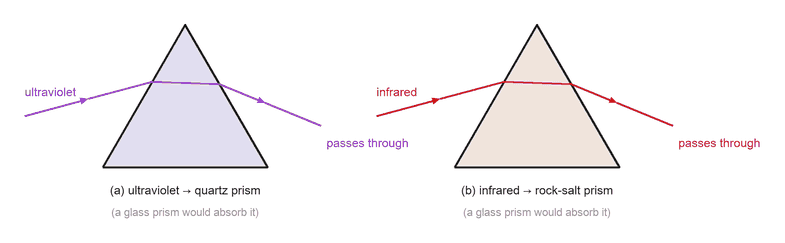
Glass absorbs most infrared radiation, while rock salt lets it pass, so a rock-salt prism is needed to obtain the infrared spectrum.
Step 5 — Reason (v): quartz prism for the ultraviolet spectrum.
Glass absorbs ultraviolet radiation, while quartz transmits it, so a quartz prism is needed.
Step 6 — Reason (vi): quartz envelope for ultraviolet bulbs.
For the same reason, a glass envelope would absorb the ultraviolet rays, whereas a quartz envelope lets them pass out of the bulb.
Therefore, each use follows from little scattering and invisibility of infrared, its lack of effect on film, and the absorption of infrared and ultraviolet by glass (but not by rock salt and quartz).
