
Question 212 marksEasy
The wavelengths for the light of red and blue colours are nearly m and m respectively.
(a) Which colour has greater speed in vacuum ?
(b) Which colour has greater speed in glass ?
Confirming your payment
Sign up now and get 250 free tokens.
Spectrum · Question 21 of 88
The wavelengths for the light of red and blue colours are nearly m and m respectively.
(a) Which colour has greater speed in vacuum ?
(b) Which colour has greater speed in glass ?
Solution:
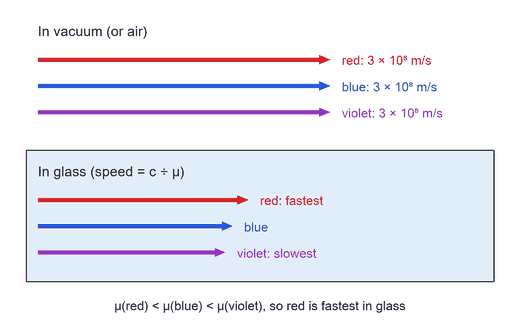
Concept: In vacuum every colour travels at the same speed, 3 × 10⁸ m s⁻¹. Inside glass the speed is the speed in vacuum divided by the refractive index (v = c ÷ μ), and the refractive index μ of glass is smallest for red and largest for violet, so red travels fastest in glass and violet slowest.
Step 1 — Answer (a): speed in vacuum.
In vacuum the speed of light does not depend on the wavelength. Both red (7.8 × 10⁻⁷ m) and blue (4.8 × 10⁻⁷ m) light travel at the same speed, c = 3 × 10⁸ m s⁻¹.
Step 2 — Answer (b): speed in glass.
Red light has the longer wavelength, so glass has a smaller refractive index for it. Since v = c ÷ μ, red light travels faster in glass than blue light.
Watch out: The wavelengths given are needed only for part (b); in vacuum all wavelengths travel at the same speed.
Therefore, (a) both colours have the same speed in vacuum, 3 × 10⁸ m s⁻¹; (b) red light has the greater speed in glass.