Solution:
Concept: At minimum deviation the path through an equiangular prism is symmetrical: the angle of incidence equals the angle of emergence, and the ray inside makes equal angles with the two faces.
Step 1 — Answer (a): the monochromatic beam.
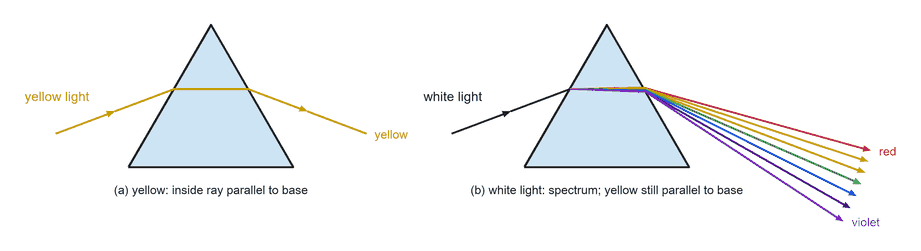
Because the path is symmetrical, the beam inside the prism makes equal angles with the two equal faces, so it passes parallel to the base.
Step 2 — Answer (b): white light used the same way.
The emergent beam is split into its constituent colours and a spectrum is formed. The colour for which the prism is at minimum deviation still passes parallel to the base; violet is deviated the most and red the least.
Step 3 — Answer (c): the conclusion.
Since the prism only separates the light, the colours must already be present in white light. So white light is polychromatic, a mixture of light of several colours (wavelengths).
Therefore, (a) the beam passes parallel to the base; (b) the emergent beam is dispersed into a spectrum; (c) white light is a mixture of several colours (polychromatic).
