
Question 681 markMCQEasy
For scattering of light, the necessary condition is that the size of air molecules should be ............ the wavelength of incident light.
Confirming your payment
Sign up now and get 250 free tokens.
Spectrum · Question 68 of 88
For scattering of light, the necessary condition is that the size of air molecules should be ............ the wavelength of incident light.
(A) smaller than
(B) greater than
(C) equal to
(D) both (B) and (C)
Answer: (A) smaller than
Concept: Scattering of light is the absorption and re-emission of light in all directions by particles in its path. For particles much smaller than the wavelength (such as air molecules), the intensity of the scattered light is , so short wavelengths (violet, blue) are scattered far more than long ones (red).
Step 1 — Compare the sizes.
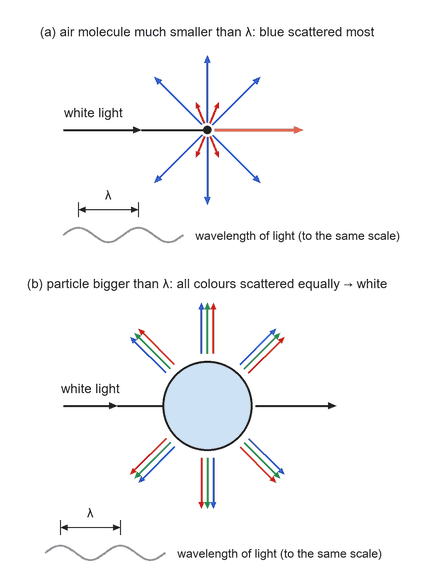
Air molecules are much smaller than the wavelength of visible light (4000 Å to 8000 Å).
Step 2 — See what such small particles do.
Particles much smaller than the wavelength absorb the light and re-emit it in all directions, and they scatter short wavelengths (blue, violet) far more than long ones (red). This is the scattering the question describes.
Step 3 — Compare with large particles.
Particles bigger than the wavelength (dust, water drops) behave differently: they scatter all colours to about the same extent, so their scattered light is white.
Why the other options are wrong:
Therefore, the size of the air molecules should be smaller than the wavelength of the incident light, option (A).