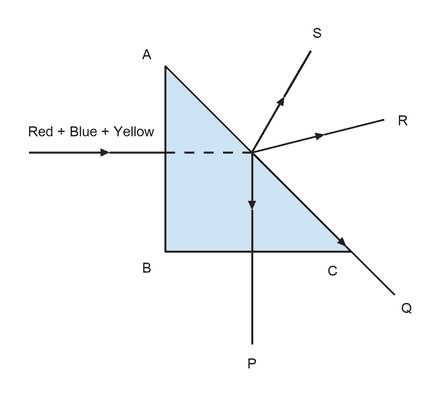
Answer: (B) Q
Concept: When light goes from glass to air, it is totally internally reflected if its angle of incidence is GREATER than the critical angle; at exactly the critical angle the refracted ray grazes along the surface (angle of refraction 90°); below the critical angle it refracts out. A colour with a larger refractive index has a smaller critical angle (sin C = 1/μ), and μ increases from red to yellow to blue.
Step 1 — Follow the beam into the prism.
The beam falls normally on face AB (angle of incidence 0°), so it goes straight in without bending.
Step 2 — Find the angle of incidence at face AC.
The prism is isosceles and right-angled at B, so the angle at A is 45°. The beam runs parallel to BC and meets face AC at an angle of incidence of 45°.
i=45∘
Step 3 — Decide what yellow light does.
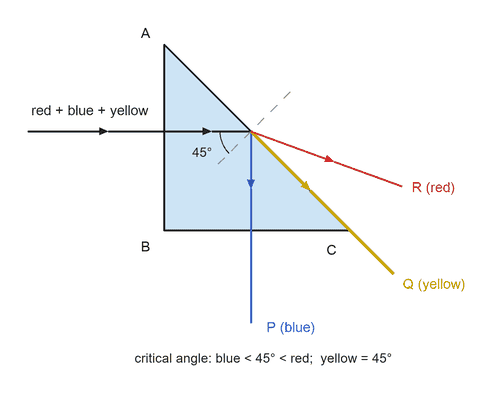
For yellow light the critical angle is exactly 45°, so i = C. At the critical angle the refracted ray makes 90° with the normal, so yellow light grazes along face AC. That is ray Q.
Step 4 — Check the other colours.
Blue has a larger refractive index than yellow, so its critical angle is less than 45°; since i = 45° is greater, blue is totally internally reflected and leaves through BC as ray P. Red has a smaller refractive index, so its critical angle is more than 45°; it refracts out of AC, bending away from the normal, as ray R.
Watch out: Total internal reflection needs i GREATER than C; at exactly i = C the ray grazes the surface.
Note: in the printed figure the rays R and S are only rough sketches. A real ray passing from glass into air at AC bends AWAY from the normal, so the red ray leaves below the horizontal, as drawn in the solution figure; the key (Q for yellow) is not affected.
Why the other options are wrong:
- (A) P: P is the ray that is totally internally reflected at AC and leaves through BC; that is blue light, whose critical angle is below 45°.
- (C) R: R stands for the ray refracted out of AC into air; that is red light, whose critical angle is above 45°.
- (D) S: S is not the path of any of the three colours: blue is totally reflected (P), yellow grazes along AC (Q) and red refracts out (R), and there is no fourth colour in the beam.
Therefore, the emergent ray for yellow light is Q, option (B).