
Opening your dashboard
Class 10 Physics Chapter 6 Spectrum: Practice Questions
41 questions on Chapter 6, each worked through on its own page with the AI tutor. Class 10 Physics, ICSE 2026-27.
41 questions
1–5 marks · Mixed difficulty
- 11 mark
Question 1
Bloom's level: Remember
In the spectrum of white light on a screen, which colour lies next to green on the side of shorter wavelength ?
- 21 mark
Question 2
Bloom's level: Remember
All electromagnetic waves, from gamma rays to radio waves, travel in vacuum with a speed of :
- 31 mark
Question 3
Bloom's level: Understand
White light splits into colours at the first surface of a glass prism because, on entering glass, light of different colours :
- 41 mark
Question 4
Bloom's level: Understand
Air molecules scatter blue light much more than red light. This happens because :
- 51 mark
Question 5
Bloom's level: Apply
A beam of light has a wavelength of 480 nm in air. Taking m s⁻¹, its frequency is :
- 61 mark
Question 6
Bloom's level: Apply
An electromagnetic wave has a frequency of Hz in vacuum. The wave is :
- 71 mark
Question 7
Bloom's level: Apply
A hospital wants to sterilise syringes that are already sealed inside plastic packets, without heating them. The most suitable radiation is :
- 81 mark
Question 8
Bloom's level: Analyse
Three narrow beams of light P, Q and R, each of a single colour, fall on the same face of the same glass prism at the same angle of incidence. Their angles of deviation are P : 41°, Q : 38° and R : 44°. The beams in increasing order of wavelength are :
- 91 mark
Question 9
Bloom's level: Evaluate
Kunal says, "The sky looks blue because the air contains a blue-coloured gas." Which is the best judgement of his statement ?
- 101 mark
Question 10
Bloom's level: Understand
Read the Assertion (A) and the Reason (R) and choose the correct option.
Assertion (A): Infrared radiations are used to take photographs of distant objects in fog.
Reason (R): Infrared radiations have a strong heating effect.
- 111 mark
Question 11
Bloom's level: Apply
Read the Assertion (A) and the Reason (R) and choose the correct option.
Assertion (A): Light of wavelength 400 nm is scattered by air molecules about 16 times more strongly than light of wavelength 800 nm.
Reason (R): For particles much smaller than the wavelength, the intensity of scattered light is inversely proportional to the fourth power of the wavelength.
- 121 mark
Question 12
Bloom's level: Understand
Read the Assertion (A) and the Reason (R) and choose the correct option.
Assertion (A): In vacuum, red light travels faster than violet light.
Reason (R): The wavelength of red light is longer than that of violet light.
- 131 mark
Question 13
Bloom's level: Remember
In the electromagnetic spectrum, which radiation lies between ultraviolet and infrared ? Give its range of wavelength in nanometres.
- 141 mark
Question 14
Bloom's level: Remember
Name the radiation used (a) by the remote control of a television, and (b) to heat food in the kind of oven that cooks without a flame or hot coil.
- 152 marks
Question 15
Bloom's level: Understand
Fog lamps on many vehicles give out yellow light rather than blue light. Explain why yellow light is the better choice in fog.
- 162 marks
Question 16
Bloom's level: Understand
A ray of light of a single colour passes through a glass prism. Explain why it bends towards the base of the prism at both of its refracting surfaces.
- 172 marks
Question 17
Bloom's level: Understand
X-rays and radio waves are both electromagnetic waves. State (a) two ways in which they are alike, and (b) two ways in which they differ.
- 182 marks
Question 18
Bloom's level: Apply
A laser pointer gives light of frequency Hz. Find its wavelength in nanometres and name its colour. ( m s⁻¹)
- 192 marks
Question 19
Bloom's level: Apply
An airport radar sends out microwaves of wavelength 3 cm. (a) Find their frequency. (b) A pulse reflected from an aircraft 30 km away returns to the radar. How long after it was sent does the echo pulse arrive ? ( m s⁻¹)
- 202 marks
Question 20
Bloom's level: Apply
Using the law of scattering by air molecules, find how many times more strongly blue light of wavelength 450 nm is scattered than red light of wavelength 675 nm.
- 212 marks
Question 21
Bloom's level: Analyse
In a greenhouse, sunlight passes easily through the glass roof and warms the plants and soil, but the heat given out by the warm soil does not escape through the glass, so the inside stays warm. Analyse this in terms of the wavelengths of the radiations involved.
- 222 marks
Question 22
Bloom's level: Analyse
Four radiations have these wavelengths in vacuum :
Radiation P Q R S Wavelength m m 100 m m (a) Name each radiation.
(b) Arrange them in the order of increasing frequency.
- 233 marks
Question 23
Bloom's level: Apply
A ray of yellow light falls on one face of an equilateral glass prism at an angle of incidence of 48° and leaves the other face at an angle of emergence of 49°.
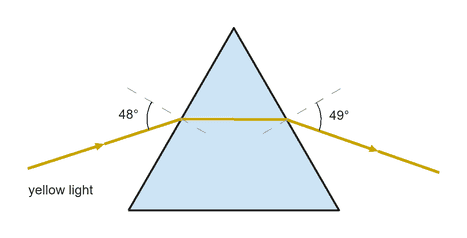
(a) Find the angle of deviation.
(b) If a ray of violet light falls at the same angle of incidence, will its angle of deviation be more or less ? Give a reason.
(c) Name two other changes that would increase the deviation of the yellow ray.
- 244 marks
Question 24
Bloom's level: Apply
Case study: For the school's annual day, a light show uses three lasers: red (650 nm), green (520 nm) and blue (450 nm). ( m s⁻¹)
(a) Which laser light has the highest frequency ? Give a reason.
(b) Calculate the frequency of the green light.
(c) The three beams are sent through a glass block. Compare their speeds in air and in glass, and say which beam bends the most on entering the glass.
- 254 marks
Question 25
Bloom's level: Analyse
Case study: Three devices are used in a city:
- a thermal camera used by firefighters, which detects radiation of wavelength about m given out by warm bodies;
- a germ-killing lamp in a water purifier, which gives out radiation of wavelength 254 nm;
- a baggage scanner at the airport, which uses radiation of wavelength about 0.5 Å.
(a) Identify the radiation used in each device from its wavelength.
(b) Why can the thermal camera 'see' people through smoke and in the dark ?
(c) The germ-killing lamp is enclosed so that nobody looks at it, and the scanner has lead-lined walls. Explain the danger each precaution guards against.
- 264 marks
Question 26
Bloom's level: Evaluate
Three students explain why the clear sky looks blue :
- Asha: "Sunlight is reflected from the blue sea into the sky."
- Bilal: "Air molecules are much smaller than the wavelength of light, so they scatter short wavelengths much more than long ones; the scattered light that reaches us from the sky is rich in blue."
- Chetan: "Dust and water droplets in the air are bigger than the wavelength of light, and they scatter blue the most."
(a) Judge each explanation as correct or incorrect, giving a reason.
(b) Violet is scattered even more than blue. Why does the sky not look violet ?
(c) Predict how the sky would look if the air contained only large particles and no tiny molecules.
- 274 marks
Question 27
Bloom's level: Evaluate
Ravi says, "A glass prism produces colours because the glass adds colour to white light." His friend Neha says, "The colours are already present in white light; the prism only separates them."
(a) Whose statement is correct ? Explain the cause of the spectrum.
(b) Describe how a second, identical prism can be used to support your judgement, and what is observed.
(c) What would be seen if a narrow beam of only red light were passed through a prism ? How does this support your judgement ?
- 284 marks
Question 28
Bloom's level: Analyse
A mountaineer notices that the sky above a high peak looks a much deeper blue, almost dark, than the sky seen from the plains. Passengers in a jet flying at 12 km see a dark blue to blackish sky above them. On the plains, the sun looks white at noon but reddish at sunset.
(a) Explain why the sky becomes darker as we go higher.
(b) Why is the sun white at noon but reddish at sunset when seen from the plains ?
(c) Would the setting sun look more red or less red to the mountaineer on the peak than to a person on the plains ? Give a reason.
- 295 marks
Question 29
Bloom's level: Create
Prepare a one-page chart on the electromagnetic spectrum for your class notice board. Construct a table with these columns: radiation, approximate wavelength range, one source, one way of detecting it, one use. Include all seven radiations from gamma rays to radio waves, arranged in increasing order of wavelength. Add one safety note for any two radiations.
- 304 marks
Question 30
Bloom's level: Create
Case study: Your class wants to show a model of the blue sky and the red sunset. You have a long, clear glass tank of water, a few drops of milk, a strong torch and a white card.
(a) Plan the set-up: where you will place the torch, the tank and the card, and what you will add to the water.
(b) Predict what will be seen when the tank is viewed from the side, and on the card placed at the far end of the tank.
(c) Explain how your model matches the real sky and sunset, and suggest how to make the 'sunset' look redder.
- 313 marks
Question 31
Name the radiations to which the greenhouse gases of the atmosphere are :
(i) transparent
(ii) opaque
- 321 mark
Question 32
Orange light has a wavelength of 6000 Å in air. If the speed of light in air is m s, the frequency of this light is :
- 331 mark
Question 33
Three electromagnetic radiations are used as follows :
- radiation 1 : to detect a fracture in a bone,
- radiation 2 : in medical science to kill cancer cells,
- radiation 3 : in the remote control of a television.
Radiations 1, 2 and 3 are, in that order :
- 341 mark
Question 34
Assertion (A): To an astronaut standing on the surface of the Moon, the sky appears black even in the day time.
Reason (R): On the Moon, sunlight of all colours is scattered equally in all directions.
- 352 marks
Question 35
A ray of yellow light passes through an equilateral glass prism and suffers a deviation of 40°. The angle of incidence is kept the same. State, with a reason, whether the deviation will be more than or less than 40° when
(i) the yellow light is replaced by red light,
(ii) the prism is replaced by a prism of the same shape and size made of a glass of higher refractive index.
- 362 marks
Question 36
A narrow beam of white light falls on one face of a glass prism kept with its base downwards, and a spectrum is obtained on a white screen placed behind the prism.

(i) Which colour is seen at the lower end of the spectrum (the end nearer the base of the prism) ? Give a reason.
(ii) At which surface of the prism does the dispersion of white light take place ? State what happens to the colours at the other surface.
- 372 marks
Question 37
A radio station broadcasts its programmes on a frequency of 1500 kHz. The speed of electromagnetic waves in air is m s.
(i) Calculate the wavelength of these radio waves.
(ii) In vacuum, will X-rays travel faster than, slower than or with the same speed as these radio waves ? Give a reason.
- 382 marks
Question 38
(i) State how the intensity of light scattered by the air molecules depends on the wavelength of the light.
(ii) Light of wavelength 4500 Å and light of wavelength 6750 Å, of equal intensity, pass through the same layer of air. Which of the two is scattered more, and about how many times more ?
- 394 marks
Question 39
The table gives information about three invisible electromagnetic radiations P, Q and R.
Radiation Information P Found just beyond the red end of the spectrum of sunlight ; a thermometer with a blackened bulb kept there shows a rapid rise in temperature. Q Found just beyond the violet end of the spectrum of sunlight ; silver chloride solution kept there turns violet and then dark brown. R Used for satellite communication and for cooking food in a special kind of oven. (i) Name the radiations P, Q and R.
(ii) Arrange P, Q and R in the increasing order of their frequency.
(iii) State one use and one harmful effect of the radiation Q.
- 403 marks
Question 40
In a certain glass, red light travels with a speed of m s and violet light with a speed of m s. The speed of light of every colour in vacuum is m s.
(i) Calculate the refractive index of this glass for red light and for violet light.
(ii) Which of the two colours is deviated more by a prism made of this glass ? Give a reason.
(iii) Use the data to explain why white light is dispersed by a glass prism although it does not split into colours while travelling in vacuum.
- 413 marks
Question 41
The diagram (not to scale) shows sunlight reaching an observer O on the surface of the Earth for two positions of the Sun.
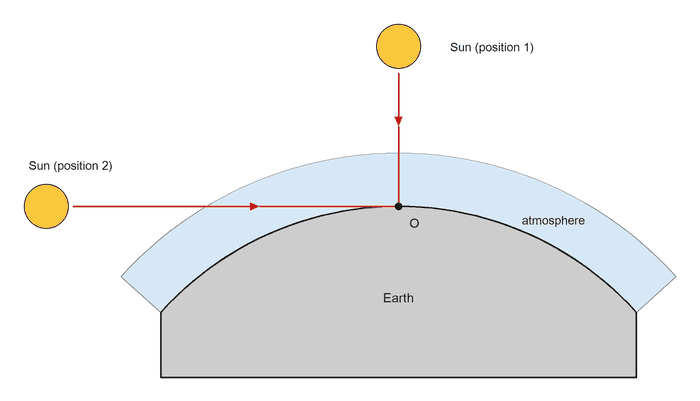
(i) Which position of the Sun, 1 or 2, corresponds to sunset ? State how the path of sunlight through the atmosphere in this position differs from that in the other position.
(ii) Explain why the Sun appears red to the observer at sunset.
(iii) Why does the Sun appear nearly white when it is in the other position ?