
Question 721 markMCQEasy
To an astronaut in a spaceship, the earth appears :
Confirming your payment
Sign up now and get 250 free tokens.
Spectrum · Question 72 of 88
To an astronaut in a spaceship, the earth appears :
(A) white
(B) red
(C) blue
(D) black
Answer: (C) blue
Concept: Scattering of light is the absorption and re-emission of light in all directions by particles in its path. For particles much smaller than the wavelength (such as air molecules), the intensity of the scattered light is , so short wavelengths (violet, blue) are scattered far more than long ones (red).
Step 1 — See what the atmosphere does to sunlight.
Sunlight falling on the earth's atmosphere is scattered by the air molecules, and blue light is scattered the most, in all directions, including outwards into space.
Step 2 — See what reaches the astronaut.
Some of this scattered blue light reaches the astronaut above the atmosphere, so the earth appears blue. (The blue oceans add to this.)
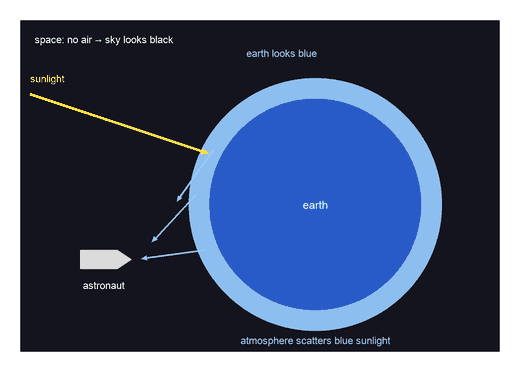
Step 3 — Compare with the sky around the spaceship.
Around the astronaut there is no air, so nothing scatters light there; the sky around the spaceship therefore looks black.
Watch out: Black is the colour of the SKY seen from space, not the colour of the earth.
Why the other options are wrong:
Therefore, to an astronaut in a spaceship the earth appears blue, option (C).