
Opening your dashboard
Class 10 Physics Chapter 7: Sound Solutions
137 textbook questions with step-by-step answers, free to read, for ICSE 2026-27.
Get talked through Ch 7, not just shown the answer
Reading a finished solution is not the same as being able to do it. The AI tutor takes one question at a time and works it with you, in your own words, until you can.
- Ask it out loud, in your own words
- It gives you the next step, not the answer
- Stuck on part (ii)? Start there
137 questions with solutions
1–5 marks · Mixed difficulty
- 11 mark
Question 1
With respect to sound waves, which of the following statements are correct ?
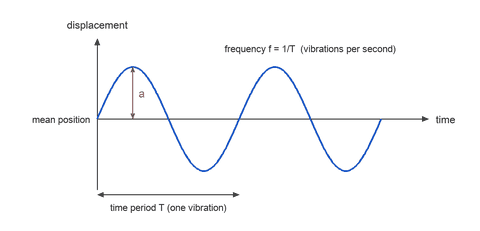
(1) The maximum displacement of a particle on either side of its mean position is called the amplitude of the wave.
(2) Time taken by the particle of a medium to complete one vibration is called the time period.
(3) The number of vibrations made by the particle of a medium in one second is called the frequency.
(4) The frequency of a wave is different than the frequency of the source producing it.
Solve with AIAnswer
(A) 1
(B) 1, 2
- Correct
(C) 1, 2, 3
(D) 1, 2, 3 and 4
Answer: (C) 1, 2, 3
Concept: A wave is described by the motion of ONE particle of the medium: its amplitude, time period and frequency. That particle is made to vibrate by the source, so it vibrates at the source's frequency.
Step 1 — Judge statement 1.
The amplitude is the maximum displacement of a particle on either side of its mean position. Statement 1 is the book's definition, so it is true.
Step 2 — Judge statement 2.
The time period T is the time a particle of the medium takes to complete one vibration. Statement 2 is true.
Step 3 — Judge statement 3.
The frequency f is the number of vibrations a particle makes in one second, so f = 1 ÷ T. Statement 3 is true.
Step 4 — Judge statement 4.
The particles of the medium are forced to vibrate by the source, so they vibrate at the same frequency as the source. The frequency of a wave is therefore EQUAL to the frequency of its source, and statement 4 is false.
Watch out: The frequency of a wave never differs from that of its source; it stays the same even when the wave enters a new medium.
Why the other options are wrong:
- (A) 1: it keeps only statement 1, but statements 2 and 3 are true as well.
- (B) 1, 2: it leaves out statement 3, which is also true.
- (D) 1, 2, 3 and 4: it includes statement 4, which is false: the wave has the same frequency as its source.
Therefore, the correct statements are 1, 2 and 3, option (C).
- 21 mark
Question 2
The speed V of a longitudinal wave is given by :
Solve with AIAnswer
(A)
(B)
(C)
- Correct
(D)
Answer: (D)
Concept: The speed of a wave is fixed by the medium, not by the source: V = √(E ÷ d), where E is the elasticity and d the density of the medium. For a gas the elasticity is γP (γ is the ratio of the two specific heats, P the pressure), so V = √(γP ÷ d).
Step 1 — Recognise the wave.
Sound in a gas is a longitudinal wave, so its speed is set by the elasticity and the density of the gas.
Step 2 — Put in the elasticity of a gas.
For a gas the elasticity is E = γP, so replace E by γP.
Step 3 — See what it tells us.
A gas of smaller density d carries sound faster, because d is in the denominator under the square root.
Watch out: The density goes INSIDE the square root, under γP; the speed varies as 1/√d, not as 1/d.
Why the other options are wrong:
- (A) : it puts the density outside the square root, so it would make V vary as 1/d instead of 1/√d.
- (B) : it leaves out the density altogether, but a denser gas does carry sound more slowly.
- (C) : √(T ÷ m) is the speed of a transverse wave on a stretched string (T tension, m mass per unit length).
Therefore, the speed of a longitudinal wave is V = √(γP ÷ d), option (D).
- 31 mark
Question 3
The speed V of a transverse wave is given by :
Solve with AIAnswer
- Correct
(A)
(B)
(C)
(D)
Answer: (A)
Concept: A transverse wave on a stretched string travels faster when the string is pulled tighter (greater tension T) and more slowly when the string is heavier (greater mass per unit length m).
Step 1 — Write the book's relation.
For a transverse wave on a string of tension T and mass per unit length m, the speed is given by
Step 2 — Check that it makes sense.
T is in the numerator, so a tighter string gives a faster wave; m is in the denominator, so a heavier string gives a slower wave. Both agree with experience.
Watch out: The mass per unit length must be in the DENOMINATOR; a heavier string carries the wave more slowly.
Why the other options are wrong:
- (B) : √(γP ÷ d) is the speed of a longitudinal wave (sound) in a gas, not of a transverse wave.
- (C) : √(Tm) would make a heavier string carry the wave faster, which is wrong.
- (D) : (1 ÷ d)√(γP) is a wrong form of the gas formula and has nothing to do with a string.
Therefore, the speed of a transverse wave on a string is V = √(T ÷ m), option (A).
- 41 mark
Question 4
Various types of mechanical waves are :
Solve with AIAnswer
(A) electromagnetic, longitudinal, transverse
(B) electromagnetic, transverse
- Correct
(C) longitudinal, transverse
(D) electromagnetic, transverse.
Answer: (C) longitudinal, transverse
Concept: Mechanical waves travel by the vibrations of the particles of a material medium (solid, liquid or gas), so they cannot travel through vacuum. They are of two kinds, named by the direction in which the particles vibrate.
Step 1 — Longitudinal waves.
In a longitudinal wave the particles vibrate ALONG the direction in which the wave travels, forming compressions and rarefactions. Sound in air is an example.
Step 2 — Transverse waves.
In a transverse wave the particles vibrate AT RIGHT ANGLES to the direction of travel, forming crests and troughs. Waves on a stretched string are an example.

Step 3 — Leave out electromagnetic waves.
Electromagnetic waves (light, radio waves) need no medium and travel through vacuum, so they are not mechanical waves.
Watch out: Electromagnetic waves are transverse too, but they are not MECHANICAL, because they need no medium.
Why the other options are wrong:
- (A) electromagnetic, longitudinal, transverse: it includes electromagnetic waves, which are not mechanical because they need no medium.
- (B) electromagnetic, transverse: it includes electromagnetic waves and leaves out longitudinal waves.
- (D) electromagnetic, transverse: it is printed the same as (B) (apart from the full stop), so it is wrong for the same reason; the book prints these two options alike.
Therefore, the mechanical waves are longitudinal and transverse, option (C).
- 51 mark
Question 5
Due to vibrations of medium particles, the energy transformation is from :
Solve with AIAnswer
(A) heat energy to kinetic energy and vice versa
- Correct
(B) kinetic energy to potential energy and vice versa
(C) heat energy to potential energy and vice versa
(D) potential energy to nuclear energy and vice versa
Answer: (B) kinetic energy to potential energy and vice versa
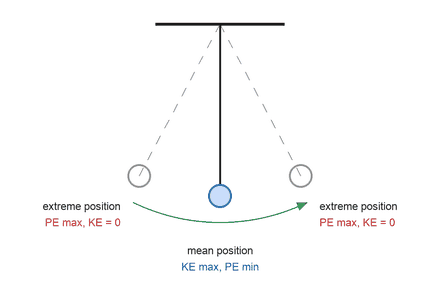
Concept: When a wave passes, each particle of the medium vibrates about its mean position, like a small pendulum. During each vibration its energy keeps changing form, and it passes the energy on to the next particle.
Step 1 — At the mean position.
The particle moves fastest at its mean position, so there its energy is all kinetic energy (its potential energy is least).
Step 2 — At an extreme position.
The particle stops for an instant at each extreme position, so there its kinetic energy is zero and its energy is all potential energy.
Step 3 — In between.
Between these positions kinetic energy changes into potential energy and back again, over and over, in every vibration.
Watch out: Heat is not part of this exchange; the wave passes through without warming the medium noticeably.
Why the other options are wrong:
- (A) heat energy to kinetic energy and vice versa: heat energy plays no part in the to-and-fro exchange of energy of a vibrating particle.
- (C) heat energy to potential energy and vice versa: heat energy plays no part here either; the exchange is between kinetic and potential energy.
- (D) potential energy to nuclear energy and vice versa: nuclear energy has nothing to do with the vibration of particles of a medium.
Therefore, the energy changes from kinetic energy to potential energy and back, option (B).
- 61 mark
Question 6
With the increase in temperature of a gas, the speed of sound:
Solve with AIAnswer
(A) decreases
- Correct
(B) increases
(C) remains the same
(D) cannot say
Answer: (B) increases
Concept: The speed of a wave is fixed by the medium, not by the source: V = √(E ÷ d), where E is the elasticity and d the density of the medium. For a gas the elasticity is γP (γ is the ratio of the two specific heats, P the pressure), so V = √(γP ÷ d).
Step 1 — See what heating does to the gas.
When a gas is heated at constant pressure it expands, so its density d decreases.
Step 2 — Use the formula.
In V = √(γP ÷ d) a smaller d gives a larger V, so the speed of sound increases with temperature.
Step 3 — Know the size of the effect.
In air the speed of sound rises by about 0.61 m s⁻¹ for each 1 °C rise in temperature.
Watch out: A change of pressure ALONE does not change the speed, because it changes the density in the same proportion; a change of temperature does.
Why the other options are wrong:
- (A) decreases: a decrease would need the density to rise on heating, but a heated gas expands and its density falls.
- (C) remains the same: the speed cannot stay the same, because the density changes when the temperature changes.
- (D) cannot say: the effect is definite and known: the speed increases by about 0.61 m s⁻¹ per °C in air.
Therefore, the speed of sound in a gas increases with temperature, option (B).
- 71 mark
Question 7
The condition for reflection of sound wave is :
Solve with AIAnswer
(A) surface must be smooth
(B) surface must be polished
- Correct
(C) reflecting surface must be bigger than the wavelength of the sound wave
(D) reflecting surface must be smaller than the wavelength of the sound wave
Answer: (C) reflecting surface must be bigger than the wavelength of the sound wave
Concept: Sound waves have long wavelengths: in air (V ≈ 340 m s⁻¹) the audible range 20 Hz to 20 000 Hz has wavelengths from about 17 m down to about 1.7 cm. A surface reflects a wave well only if it is larger than the wavelength; otherwise the wave simply bends round it.
Step 1 — Look at what reflects sound.
Sound is reflected by any large surface, rough or smooth, polished or not: a wall, a metal sheet, plywood, a cliff or a hillside.
Step 2 — Find the only requirement.
So the one condition for the reflection of sound is that the reflecting surface be bigger than the wavelength of the sound.
Watch out: Smooth and polished surfaces are needed for the regular reflection of LIGHT, whose wavelength is tiny; sound does not need them.
Why the other options are wrong:
- (A) surface must be smooth: sound is reflected well by rough surfaces too, such as a cliff or a brick wall.
- (B) surface must be polished: a polished surface is needed for the regular reflection of light, not of sound.
- (D) reflecting surface must be smaller than the wavelength of the sound wave: a surface smaller than the wavelength does not reflect the sound; the wave bends round it.
Therefore, the reflecting surface must be bigger than the wavelength of the sound, option (C).
- 81 mark
Question 8
For an echo, the reflected sound must reach the person at least .......... after the original sound is heard.
Solve with AIAnswer
(A) 1 s
(B) 10 s
- Correct
(C) 0·1 s
(D) 0·01 s
Answer: (C) 0·1 s
Concept: The sensation of a sound stays in our ear for about 0.1 s after the sound stops (persistence of hearing). An echo is heard as a separate sound only if the reflected sound arrives at least 0.1 s after the original. Sound goes to the reflector and back, a total distance 2d, so 2d = Vt, that is d = Vt ÷ 2.
Step 1 — Recall how long a sound stays in the ear.
The sensation of a sound persists in our ear for about 0.1 s after the sound has stopped.
Step 2 — Apply it to the reflected sound.
If the reflected sound arrives within 0.1 s, it merges with the original sound still 'in the ear' and is not heard separately. So it must arrive at least 0.1 s later.
Step 3 — See what distance this needs.
In air (V = 340 m s⁻¹) the reflector must then be at least
away.
Watch out: The 0.1 s is the time between hearing the original sound and hearing the reflected sound, not the time for the sound to reach the reflector.
Why the other options are wrong:
- (A) 1 s: 1 s is far more than needed; any delay of 0.1 s or more gives a distinct echo.
- (B) 10 s: 10 s is far more than needed; it would need a reflector about 1.7 km away.
- (D) 0·01 s: 0.01 s is too short; the reflected sound would merge with the original sound.
Therefore, the reflected sound must reach the person at least 0·1 s after the original sound, option (C).
- 91 mark
Question 9
Time taken to hear the echo if distance between the listener and the obstacle is given by :
Solve with AIAnswer
(A)
(B)
(C)
- Correct
(D)
Answer: (D)
Concept: Time = distance ÷ speed. For an echo, the sound travels TO the obstacle and then BACK to the listener, so it covers the distance d twice.
Step 1 — Find the total distance.
The sound goes a distance d to the obstacle and the same distance d back.
Step 2 — Divide by the speed.
Time is the total distance divided by the speed V of sound.

Watch out: Do not forget the return journey; t = d ÷ V is only the time to reach the obstacle.
Why the other options are wrong:
- (A) : the product d × V has the unit m² s⁻¹ (metre times metre per second), which is not a unit of time.
- (B) : 2d × V also multiplies distance by speed, so its unit m² s⁻¹ is not a time.
- (C) : V ÷ 2d is upside down: its unit is s⁻¹, the reciprocal of the time.
Therefore, the time to hear the echo is t = 2d ÷ V, option (D).
- 101 mark
Question 10
To detect obstacles in their path, bats produce :
Solve with AIAnswer
(A) infrasonic waves
- Correct
(B) ultrasonic waves
(C) electromagnetic waves
(D) radio waves.
Answer: (B) ultrasonic waves
Concept: Bats find obstacles by echolocation (sound ranging): they send out sound and listen for its echo. They use ultrasonic waves, of frequency above 20 kHz, which they can both produce and hear.
Step 1 — The bat sends out waves.
As it flies, the bat emits short pulses of ultrasonic waves.
Step 2 — The obstacle sends them back.
The waves are reflected by an obstacle in the bat's path, and the bat hears the echo.
Step 3 — The bat judges the position.
From how soon the echo returns and from which direction, the bat knows where the obstacle is, even in the dark, and turns away from it.
Watch out: Bats use SOUND (mechanical) waves; radio waves are used by RADAR, not by bats.
Why the other options are wrong:
- (A) infrasonic waves: infrasonic waves (below 20 Hz) have very long wavelengths, so small obstacles do not reflect them sharply; bats do not use them.
- (C) electromagnetic waves: electromagnetic waves are not produced by bats; they produce sound waves.
- (D) radio waves: radio waves are electromagnetic waves used by RADAR; bats do not produce them.
Therefore, bats produce ultrasonic waves to detect obstacles, option (B).
- 111 mark
Question 11
With respect to ultrasonic waves, which of the following statements is correct ?
Solve with AIAnswer
(A) they travel undeviated through a long distance
(B) they have a speed greater than the speed of sound in a medium
(C) they are not easily absorbed in a medium
- Correct
(D) they can be confined to a narrow beam
Answer: (D) they can be confined to a narrow beam
Concept: Ultrasonic waves have frequencies above 20 kHz, so their wavelength is very short. Because of this they travel undeviated through long distances, can be confined to a narrow beam and are not easily absorbed in the medium. Their speed in a medium is the same as that of audible sound in it.
Step 1 — Judge each statement as printed.
Statements (A), (C) and (D) are the three properties the book lists for ultrasonic waves, so each of them is true.
Step 2 — Find the false statement.
The speed of a sound wave depends only on the medium, not on its frequency. So ultrasonic waves travel at the SAME speed as audible sound in that medium, and statement (B) is false.
Step 3 — Choose the key.
Option (D), the narrow beam, is the property that lets SONAR aim a pulse straight at the sea bed or a shoal of fish, and it is the key kept here.
Note: As printed ('which … is correct'), three options are true: (A), (C) and (D). The book's key prints (B), which is the only FALSE statement, so the book most likely meant 'which statement is incorrect?', whose answer is (B). The stored key (D) is a correct statement and is kept.
Watch out: A higher frequency does not mean a higher speed; V = fλ, so a higher f simply gives a shorter λ.
About the other options:
- (A) they travel undeviated through a long distance: this is also true (the book's first property); it is not the key kept here.
- (B) they have a speed greater than the speed of sound in a medium: this is false; their speed equals that of audible sound in the same medium.
- (C) they are not easily absorbed in a medium: this is also true (the book's third property); it is not the key kept here.
Therefore, ultrasonic waves can be confined to a narrow beam, option (D).
- 121 mark
Question 12
Infrasonic sound waves have a frequency :
Solve with AIAnswer
(A) between 20 Hz to 10,000 Hz
- Correct
(B) below 20 Hz
(C) above 20,000 Hz
(D) between 20 Hz to 20,000 Hz
Answer: (B) below 20 Hz
Concept: The human ear hears only sounds of frequency 20 Hz to 20 000 Hz, the audible range. Sound outside this range is named by the side it falls on.
Step 1 — Below the range.
Sound of frequency below 20 Hz is infrasonic (infra = below).
Step 2 — Above the range.
Sound of frequency above 20 000 Hz is ultrasonic (ultra = beyond). We cannot hear either kind.

Watch out: 'infra' means below and 'ultra' means beyond; do not swap them.
Why the other options are wrong:
- (A) between 20 Hz to 10,000 Hz: 20 Hz to 10 000 Hz lies inside the audible range, so we can hear it.
- (C) above 20,000 Hz: above 20 000 Hz is the ultrasonic range.
- (D) between 20 Hz to 20,000 Hz: 20 Hz to 20 000 Hz is the audible range itself.
Therefore, infrasonic waves have a frequency below 20 Hz, option (B).
- 131 mark
Question 13
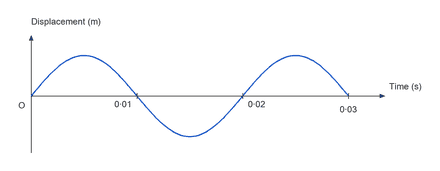
The diagram shown below depicts a displacement-time graph of particle a wave travelling with speed 20 m/s.
The frequency of the wave is :
Solve with AIAnswer
- Correct
(A) 50 Hz
(B) 33.3 Hz
(C) 100 Hz
(D) 1000 Hz
Answer: (A) 50 Hz
Concept: On a displacement-time graph, the time period T is the time for one complete wave, that is one crest AND one trough. The frequency is f = 1 ÷ T.
Step 1 — Read the time period.
The wave starts at O, makes a crest, comes back to the axis at 0.01 s, makes a trough and returns to the axis at 0.02 s. So one complete wave takes 0.02 s.

Step 2 — Find the frequency.
The frequency is the reciprocal of the time period.
Step 3 — Note the extra data.
The speed 20 m s⁻¹ is not needed for the frequency. It would give the wavelength instead.
Watch out: 0.01 s is only HALF a wave (one crest); the period needs a crest and a trough.
Why the other options are wrong:
- (B) 33.3 Hz: 33.3 Hz comes from taking 0.03 s (one and a half waves) as the period.
- (C) 100 Hz: 100 Hz comes from taking 0.01 s (only half a wave) as the period.
- (D) 1000 Hz: 1000 Hz comes from a decimal slip, 1 ÷ 0.001.
Therefore, the frequency of the wave is 50 Hz, option (A).
- 141 mark
Question 14
Assertion (A) : Sound waves can travel in vacuum, but light waves cannot.
Reason (R) : Light is an electromagnetic wave, but sound is a mechanical wave.
Solve with AIAnswer
(A) both A and R are true and R is the correct explaination of A
(B) both A and R are True and R is not the correct explanation of A
- Correct
(C) assertion is false but reason is true
(D) assertion is true but reason is false
Answer: (C) assertion is false but reason is true
Concept: In an assertion–reason item, judge the assertion (A) and the reason (R) separately as true or false, and then decide whether R correctly explains A. Mechanical waves need a material medium; electromagnetic waves do not.
Step 1 — Judge the reason.
Light is an electromagnetic wave (vibrating electric and magnetic fields) and needs no medium. Sound is a mechanical wave, carried by vibrating particles of a medium. R is true.
Step 2 — Judge the assertion.
In vacuum there are no particles to vibrate, so sound CANNOT travel through vacuum, while light can (sunlight reaches us through space). A says the opposite, so A is false.
Step 3 — Pick the option.
A false assertion with a true reason is option (C).
Watch out: The assertion swaps sound and light; read which wave is said to travel in vacuum.
Why the other options are wrong:
- (A) both A and R are true and R is the correct explaination of A: it calls the assertion true, but sound cannot travel in vacuum.
- (B) both A and R are True and R is not the correct explanation of A: it also calls the assertion true, which it is not.
- (D) assertion is true but reason is false: it calls the reason false, but light really is electromagnetic and sound mechanical.
Therefore, the assertion is false and the reason is true, option (C).
- 151 mark
Question 15
Assertion (A) : The speed of sound in a gas increases with an increase in humidity.
Reason (R) : Density of a gas decreases with increase in humidity.
Solve with AIAnswer
- Correct
(A) both A and R are true and R is the correct explaination of A
(B) both A and R are True and R is not the correct explanation of A
(C) assertion is false but reason is true
(D) assertion is true but reason is false
Answer: (A) both A and R are true and R is the correct explaination of A
Concept: In an assertion–reason item, judge the assertion (A) and the reason (R) separately as true or false, and then decide whether R correctly explains A. The speed of sound in a gas is V = √(γP ÷ d), so a gas of lower density carries sound faster.
Step 1 — Judge the reason.
Water vapour is lighter than dry air (molecular mass 18 against about 29). When the humidity rises, part of the air is replaced by water vapour, so the density decreases. R is true.
Step 2 — Judge the assertion.
Sound does travel faster in humid air than in dry air at the same temperature. A is true.
Step 3 — Check the link.
The lower density in Step 1, put into V = √(γP ÷ d), gives the higher speed in Step 2. So R correctly explains A.
Watch out: Humid air feels 'heavy', but it is actually LESS dense than dry air.
Why the other options are wrong:
- (B) both A and R are True and R is not the correct explanation of A: it says R does not explain A, but the lower density is exactly why the speed rises.
- (C) assertion is false but reason is true: it calls the assertion false, but sound is faster in humid air.
- (D) assertion is true but reason is false: it calls the reason false, but humid air is less dense than dry air.
Therefore, both A and R are true and R is the correct explanation of A, option (A).
- 161 mark
Question 16
Assertion (A) : The flash of lightning is seen before the sound of thunder is heard.
Reason (R) : The speed of sound is greater than the speed of light.
Solve with AIAnswer
(A) both A and R are true and R is the correct explaination of A
(B) both A and R are True and R is not the correct explanation of A
(C) assertion is false but reason is true
- Correct
(D) assertion is true but reason is false
Answer: (D) assertion is true but reason is false
Concept: In an assertion–reason item, judge the assertion (A) and the reason (R) separately as true or false, and then decide whether R correctly explains A. The flash and the thunder are produced at the same instant, so whichever travels faster reaches us first.
Step 1 — Judge the assertion.
We always see the flash of lightning first and hear the thunder later. A is true.
Step 2 — Judge the reason.
Light travels at about 3 × 10⁸ m s⁻¹, while sound travels at only about 330 m s⁻¹ in air. Light is nearly a million times faster, so R, which says sound is faster, is false.
Step 3 — Pick the option.
A true assertion with a false reason is option (D). It is the far greater speed of LIGHT that makes the flash arrive first.
Watch out: The reason has the speeds the wrong way round.
Why the other options are wrong:
- (A) both A and R are true and R is the correct explaination of A: it calls the reason true, but sound is far slower than light.
- (B) both A and R are True and R is not the correct explanation of A: it also calls the reason true, which it is not.
- (C) assertion is false but reason is true: it calls the assertion false, but the flash is indeed seen before the thunder is heard.
Therefore, the assertion is true but the reason is false, option (D).
- 172 marks
Question 17
State two factors on which the speed of a wave travelling in a medium depends.
Solve with AIWritten solution
Solution:
Concept: The speed of a wave is fixed by the medium, not by the source: V = √(E ÷ d), where E is the elasticity and d the density of the medium. For a gas the elasticity is γP (γ is the ratio of the two specific heats, P the pressure), so V = √(γP ÷ d).
Step 1 — First factor: elasticity of the medium.
The greater the elasticity E of the medium, the faster the wave travels. This is why sound travels faster in solids than in gases.
Step 2 — Second factor: density of the medium.
The greater the density d of the medium, the more slowly the wave travels, because d is in the denominator of V = √(E ÷ d).
Step 3 — What this means for a gas.
For a gas V = √(γP ÷ d), so the speed of sound in a gas also rises with temperature and with humidity, since both lower the density.
Watch out: The speed does not depend on the source (its loudness or frequency); it depends only on the medium.
Therefore, the speed of a wave in a medium depends on (1) the elasticity and (2) the density of the medium.
- 182 marks
Question 18
What are mechanical waves ?
Solve with AIWritten solution
Solution:
Concept: A wave is a disturbance that carries energy from one place to another through a medium. The particles of the medium only vibrate about their mean positions; they do not travel with the wave.
Step 1 — Define mechanical waves.
Mechanical waves are waves that need a material medium (solid, liquid or gas) for their propagation. They are produced by the vibrations of the particles of the medium about their mean positions.
Step 2 — Say how they travel.
Each particle passes its energy on to the next, so the disturbance and the energy move forward, while the particles themselves stay where they are. With no particles to vibrate, mechanical waves cannot travel through vacuum.
Step 3 — Name the two kinds.
They are longitudinal (particles vibrate along the direction of travel, for example sound in air) or transverse (particles vibrate at right angles to it, for example waves on a stretched string).
Watch out: Light is a wave but not a mechanical wave; it needs no medium.
Therefore, mechanical waves are waves produced by the vibrations of the particles of a material medium; they need a medium and cannot travel through vacuum.
- 194 marks
Question 19
Define the following terms in relation to a wave : (a) amplitude, (b) frequency, (c) wavelength, and (d) wave velocity.
Solve with AIWritten solution
Solution:
Concept: A wave is a disturbance that carries energy from one place to another through a medium. The particles of the medium only vibrate about their mean positions; they do not travel with the wave. Amplitude and frequency describe one particle; wavelength and wave velocity describe the wave as a whole.
(a) Amplitude (a)
Step 1 — Define amplitude.
The amplitude is the maximum displacement of a particle of the medium on either side of its mean position. Its S.I. unit is the metre (m).
(b) Frequency (f)
Step 2 — Define frequency.
The frequency is the number of vibrations made by a particle of the medium in one second. Its unit is the hertz (Hz), and f = 1 ÷ T, where T is the time period.
(c) Wavelength (λ)
Step 3 — Define wavelength.
The wavelength is the distance travelled by the wave in the time a particle of the medium completes one vibration. It equals the distance between two successive crests (or two successive compressions). Its unit is the metre (m).
(d) Wave velocity (V)
Step 4 — Define wave velocity.
The wave velocity is the distance travelled by the wave in one second. Its unit is m s⁻¹. The wave moves one wavelength in each vibration, and there are f vibrations each second, so
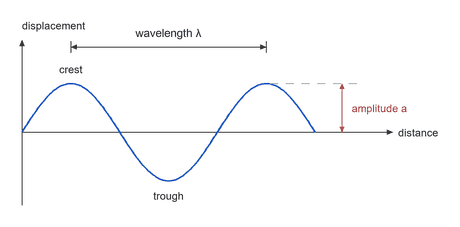
Watch out: The amplitude is measured from the MEAN position to a crest, not from a crest to a trough (that is 2a).
Therefore, (a) amplitude = maximum displacement from the mean position, (b) frequency = vibrations per second, (c) wavelength = distance moved by the wave in one vibration, and (d) wave velocity = distance moved by the wave in one second, V = fλ.
- 202 marks
Question 20
A wave passes from one medium to another medium. Mention one property of the wave out of speed, frequency or wavelength (i) which changes, (ii) which does not change.
Solve with AIWritten solution
Solution:
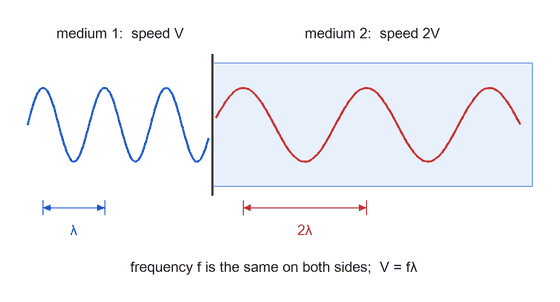
Concept: The frequency of a wave is fixed by its source; the speed is fixed by the medium. When a wave enters a new medium, the source is the same but the medium is different.
(i) The property that changes
Step 1 — Speed changes.
The new medium has a different elasticity and density, so the wave travels at a different speed. Since λ = V ÷ f with f fixed, the wavelength also changes, in the same ratio as the speed.
(ii) The property that does not change
Step 2 — Frequency stays the same.
The particles at the boundary are made to vibrate by the incoming wave, so they vibrate at the same frequency and pass it on. The frequency stays that of the source.
Watch out: The wavelength changes too; only the frequency is unchanged.
Therefore, (i) the speed (and with it the wavelength) changes, and (ii) the frequency does not change.
- 212 marks
Question 21
State two differences between light and sound waves.
Solve with AIWritten solution
Solution:
Concept: Light is an electromagnetic wave and sound is a mechanical wave. Most of their differences follow from this.
Step 1 — First difference: the medium.
Light waves need no medium and can travel through vacuum. Sound waves need a material medium and cannot travel through vacuum.
Step 2 — Second difference: the speed.
Light travels very fast, about 3 × 10⁸ m s⁻¹ in air. Sound travels slowly, about 330 m s⁻¹ in air.
The two differences side by side:
Light waves Sound waves 1. Electromagnetic: can travel through vacuum. 1. Mechanical: need a medium, cannot travel through vacuum. 2. Speed about 3 × 10⁸ m s⁻¹ in air. 2. Speed about 330 m s⁻¹ in air. Step 3 — Other differences.
Light waves are transverse, while sound waves in air are longitudinal. Visible light has a very short wavelength (about 4 × 10⁻⁷ m to 7 × 10⁻⁷ m), while audible sound in air has wavelengths from about 1.7 cm to 17 m.
Watch out: Both are waves and both carry energy, so 'one carries energy and the other does not' is not a difference.
Therefore, light can travel through vacuum and moves at about 3 × 10⁸ m s⁻¹, while sound needs a medium and moves at only about 330 m s⁻¹ in air.
- 223 marks
Question 22
What do you mean by reflection of sound ? State one condition for the reflection of a sound wave. Name a device in which reflection of sound wave is used.
Solve with AIWritten solution
Solution:
Concept: Sound is reflected in the same way as light and obeys the same laws of reflection. The difference is in the kind of surface it needs.
Step 1 — Define reflection of sound.
The return of a sound wave into the same medium on striking a surface (such as a wall, a metal sheet or plywood) is called the reflection of sound. The angle of incidence equals the angle of reflection, and the incident wave, the reflected wave and the normal lie in one plane.

Step 2 — State one condition.
The size of the reflecting surface must be bigger than the wavelength of the sound wave. The surface need not be smooth or polished.
Step 3 — Name a device.
A megaphone (speaking tube) uses reflection: its cone reflects the sound again and again and sends it forward in one direction, so it carries farther. A sound board and an ear trumpet also use it.
Watch out: A smooth, polished surface is a condition for the regular reflection of light, not of sound.
Therefore, reflection of sound is its return into the same medium from a surface; the surface must be bigger than the wavelength; a megaphone uses it.
- 232 marks
Question 23
What is meant by an echo ? State two conditions necessary for an echo to be heard distinctly.
Solve with AIWritten solution
Solution:
Concept: The sensation of a sound stays in our ear for about 0.1 s after the sound stops (persistence of hearing). An echo is heard as a separate sound only if the reflected sound arrives at least 0.1 s after the original. Sound goes to the reflector and back, a total distance 2d, so 2d = Vt, that is d = Vt ÷ 2.
Step 1 — Define an echo.
The sound heard after reflection from a distant obstacle (a cliff, a hillside, the wall of a building or the edge of a forest), after the original sound has ceased, is called an echo.
Step 2 — First condition: enough distance.
The reflected sound must reach the ear at least 0.1 s after the original sound. In air (340 m s⁻¹) this needs the obstacle to be at least
away. In sea water (1400 m s⁻¹) the minimum is 70 m.
Step 3 — Second condition: a large reflector.
The size of the reflecting surface must be large compared with the wavelength of the sound. (The reflected sound must also be loud enough to be heard.)
Watch out: The 17 m is the distance to the reflector, not the total path; the total path is 34 m.
Therefore, an echo is a reflected sound heard after the original has ceased; it needs (1) the reflector at least 17 m away in air, so the delay is at least 0.1 s, and (2) a reflector larger than the wavelength.
- 242 marks
Question 24
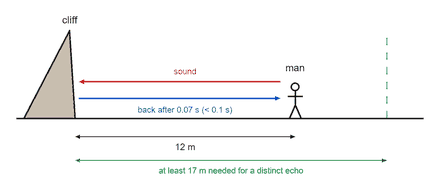
A man is standing at a distance of 12 m from a cliff. Will he be able to hear a clear echo of his sound ? Give a reason for your answer.
Solve with AIWritten solution
Solution:
Concept: The sensation of a sound stays in our ear for about 0.1 s after the sound stops (persistence of hearing). An echo is heard as a separate sound only if the reflected sound arrives at least 0.1 s after the original. Sound goes to the reflector and back, a total distance 2d, so 2d = Vt, that is d = Vt ÷ 2.
Given: distance from the cliff d = 12 m; speed of sound in air V = 340 m s⁻¹ (assumed)
Step 1 — Find the time for the reflected sound.
The sound goes to the cliff and back, a distance 2d, at the speed of sound in air, taken as 340 m s⁻¹ (the book's value).
Step 2 — Compare with 0.1 s.
0.07 s is less than 0.1 s, the time for which the sensation of the original sound persists in the ear. So the reflected sound mixes with the original sound and is not heard separately.
Step 3 — Say what would be needed.
For a clear echo he must stand at least 17 m from the cliff.
Watch out: A reflected sound is still there at 12 m; it just arrives too soon to be heard as a separate echo.
Therefore, no, he will not hear a clear echo, because the reflected sound returns after only about 0.07 s, less than 0.1 s.
- 252 marks
Question 25
State two applications of echo.
Solve with AIWritten solution
Solution:
Concept: In every use of echo a sound (usually ultrasonic) is sent out and the time t for its echo to return is measured. The distance of the reflector is then d = Vt ÷ 2.
Step 1 — First application: SONAR (echo depth sounding).
A ship sends ultrasonic pulses down into the sea and times their echoes. This gives the depth of the sea, and locates submarines, icebergs, sunken ships and shoals of fish.
Step 2 — Second application: medical imaging.
In ultrasonography, ultrasonic waves sent into the body are echoed by the organs, and the echoes are turned into an image of organs such as the liver, gall bladder and uterus (and of the heart, in echocardiography).
Step 3 — Other uses.
Bats and dolphins find obstacles and prey by echoes, and the speed of sound can be measured by the echo method. (RADAR works the same way but with radio waves, not sound.)
Therefore, two applications of echo are SONAR (finding the depth of the sea) and medical imaging by ultrasound.
- 263 marks
Question 26
Explain how the speed of sound can be determined by the method of echo.
Solve with AIWritten solution
Solution:
Concept: If the distance d to a reflector is known and the time t for the echo is measured, the sound has covered 2d in time t, so its speed is V = 2d ÷ t.
Step 1 — Set up.
Stand at a measured distance d (at least 50 m) from a large reflecting surface such as a wall or a cliff.
Step 2 — Measure the time.
Produce a short, sharp sound (a clap or a gunshot) and start a stopwatch (least count 0.01 s) at the same instant. Stop the watch the moment the echo is heard, and note the time interval t.

Step 3 — Calculate the speed.
In time t the sound goes to the wall and comes back, a total distance 2d.
Step 4 — Improve the accuracy.
Repeat the experiment several times and take the average of the values of V.
Step 5 — A sample calculation.
Suppose (for illustration) d = 85 m and the echo is heard after t = 0.5 s.
Watch out: Use 2d, not d: the measured time is for the journey there AND back.
Therefore, the speed of sound is found from V = 2d ÷ t, where d is the distance of the reflector and t the time after which the echo is heard.
- 273 marks
Question 27
State the use of echo by a bat, dolphin and fisherman.
Solve with AIWritten solution
Solution:
Concept: All three use the echo of ultrasonic waves: they send out ultrasound, receive its reflection, and judge the position (and distance) of the reflecting object from it.
Step 1 — Bat.
A bat produces and hears ultrasonic sound while flying. The waves reflect from an obstacle in its path, and from the echo the bat knows where the obstacle is, even in the dark, so it flies safely without colliding. This is called sound ranging (echolocation).
Step 2 — Dolphin.
A dolphin emits ultrasonic waves and hears their echoes to detect its enemies and obstacles under water, and to hunt its prey.
Step 3 — Fisherman.
A fisherman (trawlerman) sends an ultrasonic pulse into the sea and receives, in a detector, the pulse reflected from a shoal of fish. From the time t of the to-and-fro journey he finds the distance of the fish, where V is about 1400 m s⁻¹ in sea water.
Therefore, a bat uses echoes to avoid obstacles, a dolphin to detect enemies, obstacles and prey, and a fisherman to locate a shoal of fish.
- 282 marks
Question 28
How do bats avoid obstacles in their way, when in flight?
Solve with AIWritten solution
Solution:
Concept: Bats use echoes of ultrasonic waves to 'see' with sound; this is called echolocation (sound ranging).
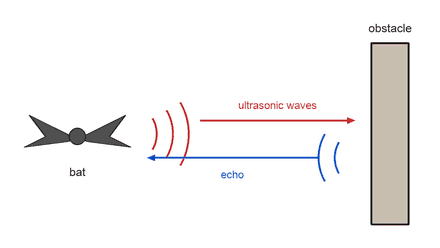
Step 1 — The bat sends out ultrasound.
While flying, the bat produces ultrasonic waves of very high frequency (above 20 kHz).
Step 2 — An obstacle reflects it.
The waves are reflected by any obstacle in its path, and the bat hears the echo.
Step 3 — The bat steers away.
From how soon the echo returns and from which direction, the bat knows where the obstacle is, so it changes its path and flies on without colliding, even in complete darkness.
Watch out: Bats do not 'see' the obstacle in the dark; they hear its echo.
Therefore, bats avoid obstacles by sending out ultrasonic waves and judging the obstacle's position from the echo.
- 292 marks
Question 29
What is meant by sound ranging ? Give one use of sound ranging.
Solve with AIWritten solution
Solution:
Concept: Sound ranging measures a distance using an echo: send a sound, time its return, and use d = Vt ÷ 2.
Step 1 — Define sound ranging.
Sound ranging is the process of finding the distance (range) of an object by sending sound waves (usually ultrasonic) towards it and measuring the time t taken by the echo to return. The sound goes to the object and back, so
where V is the speed of sound in the medium.
Step 2 — Give one use.
It is used to find the depth of the sea (echo depth sounding by SONAR). It also locates submarines, icebergs and shoals of fish, and bats use it to detect obstacles.
Therefore, sound ranging is finding the distance of an object from the time taken by the echo of a sound sent to it; one use is to find the depth of the sea.
- 302 marks
Question 30
Name the waves used for sound ranging. State one reason for their use. Why are the waves mentioned by you not audible to us ?
Solve with AIWritten solution
Solution:
Concept: Ultrasonic waves have frequencies above 20 kHz, so their wavelength is very short. Because of this they travel undeviated through long distances, can be confined to a narrow beam and are not easily absorbed in the medium. Their speed in a medium is the same as that of audible sound in it.
Step 1 — Name the waves.
Sound ranging uses ultrasonic waves, of frequency above 20 kHz.
Step 2 — Give one reason for their use.
They can be confined to a narrow beam and travel undeviated through long distances, so the pulse goes straight to the object and the echo comes straight back. (They are also not easily absorbed.) Ordinary audible sound would spread out in all directions.
Step 3 — Say why we cannot hear them.
The human ear hears only sounds of frequency 20 Hz to 20 000 Hz. Ultrasonic waves have frequencies above 20 000 Hz, beyond the upper limit of human hearing.
Watch out: We cannot hear them because of their FREQUENCY, not because they are too soft.
Therefore, ultrasonic waves are used; they can be sent as a narrow beam; we cannot hear them because their frequency is above 20 000 Hz.
- 313 marks
Question 31
What is 'SONAR' ? State the principle on which it is based.
Solve with AIWritten solution
Solution:
Concept: SONAR is sound ranging under water: it times the echo of an ultrasonic pulse to find how far away an object is.
Step 1 — Say what SONAR is.
SONAR stands for SOund Navigation And Ranging. It is a device used on ships to find the depth of the sea and to locate objects under water, such as an enemy submarine, an iceberg or a sunken ship.
Step 2 — State the principle.
It is based on the reflection of ultrasonic waves (echo). A transmitter on the ship sends ultrasonic waves into the sea; they are reflected by the sea bed or an obstacle, and a receiver on the ship picks up the reflected waves.

Step 3 — Find the distance.
The time interval t between sending and receiving the waves is measured. The waves go to the object and come back, so the distance is
where V is the speed of ultrasonic waves in sea water (about 1400 m s⁻¹).
Therefore, SONAR (SOund Navigation And Ranging) is a device that finds distances under water, based on the reflection (echo) of ultrasonic waves.
- 322 marks
Question 32
State the use of echo in medical field.
Solve with AIWritten solution
Solution:
Concept: Ultrasonic waves sent into the body are reflected (echoed) differently by different organs and tissues, and the echoes can be turned into a picture.
Step 1 — Ultrasonography.
A probe sends ultrasonic waves into the body. The echoes from the organs (liver, gall bladder, uterus) are received and converted into an image on a screen. Doctors use it, for example, to detect stones in the gall bladder and to watch the growth of a baby in the womb.
Step 2 — Echocardiography.
The same echo method is used to obtain an image of the heart.
Step 3 — Why it is preferred.
Ultrasound is a mechanical wave and does not use ionising radiation as X-rays do, so it is safe for such scans.
Therefore, in medicine the echo of ultrasonic waves is used to form images of organs (ultrasonography) and of the heart (echocardiography).
- 333 marks
Question 33
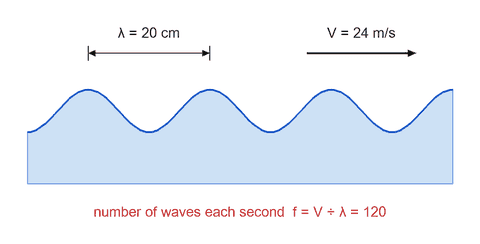
The wavelength of waves produced on the surface of water is 20 cm. If the wave velocity is 24 m s, calculate : (i) the number of waves produced in one second, and (ii) the time in which one wave is produced.
Solve with AIWritten solution
Solution:
Concept: In the time T of one vibration of a particle, the wave moves forward by one wavelength λ. So its speed is λ ÷ T, and since the frequency (vibrations per second, unit hertz) is f = 1 ÷ T, the wave equation is V = fλ. The number of waves produced in one second is the frequency f, and the time for one wave is the time period T = 1 ÷ f.
Given: wavelength λ = 20 cm; wave velocity V = 24 m s⁻¹
(i) Number of waves produced in one second
Step 1 — Change the wavelength into metres.
The speed is in m s⁻¹, so the wavelength must be in metres.
Step 2 — Find the frequency.
Rearrange V = fλ for f and put in the values.
(ii) Time in which one wave is produced
Step 3 — Find the time period.
One wave is produced in one time period, the reciprocal of the frequency.
Watch out: Change 20 cm into 0.2 m before dividing; using 20 gives 1.2, which is wrong.
Therefore, (i) 120 waves are produced in one second, and (ii) one wave is produced in 1/120 s ≈ 8.3 × 10⁻³ s.
- 343 marks
Question 34
Calculate the minimum distance in air required between the source of sound and the obstacle to hear an echo. Take speed of sound in air = 350 m s.
Solve with AIWritten solution
Solution:
Concept: The sensation of a sound stays in our ear for about 0.1 s after the sound stops (persistence of hearing). An echo is heard as a separate sound only if the reflected sound arrives at least 0.1 s after the original. Sound goes to the reflector and back, a total distance 2d, so 2d = Vt, that is d = Vt ÷ 2. The minimum distance is the one for which the echo takes exactly 0.1 s.
Given: speed of sound in air V = 350 m s⁻¹; least time for a distinct echo t = 0.1 s
Step 1 — Write the relation.
In time t the sound covers 2d, so the distance of the obstacle is
Step 2 — Put in the values.
Use V = 350 m s⁻¹ and the least time for a distinct echo, t = 0.1 s.
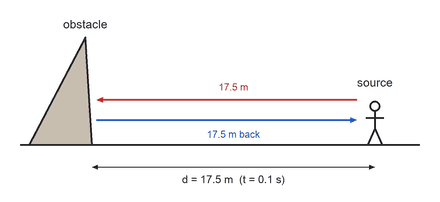
Step 3 — Interpret.
If the obstacle is any nearer, the echo returns within 0.1 s and merges with the original sound.
Watch out: Do not use d = Vt; that would be the whole to-and-fro path (35 m), not the distance to the obstacle.
Therefore, the minimum distance between the source and the obstacle is 17.5 m.
- 353 marks
Question 35
What should be the minimum distance between the source and reflector in water so that the echo is heard distinctly ? (The speed of sound in water = 1400 m s).
Solve with AIWritten solution
Solution:
Concept: The sensation of a sound stays in our ear for about 0.1 s after the sound stops (persistence of hearing). An echo is heard as a separate sound only if the reflected sound arrives at least 0.1 s after the original. Sound goes to the reflector and back, a total distance 2d, so 2d = Vt, that is d = Vt ÷ 2. The 0.1 s rule is about our ear, so it holds in water too; only the speed changes.
Given: speed of sound in water V = 1400 m s⁻¹; least time for a distinct echo t = 0.1 s
Step 1 — Write the relation.
The least distance is the one for which the echo takes exactly 0.1 s.
Step 2 — Put in the values.
Use the speed of sound in water, 1400 m s⁻¹.
Step 3 — Compare with air.
Sound is about four times faster in water than in air, so the reflector must be about four times farther away than the 17 m needed in air.
Watch out: The 0.1 s does not change in water; it belongs to the ear, not to the medium.
Therefore, the minimum distance between the source and the reflector in water is 70 m.
- 363 marks
Question 36
A man standing 25 m away from a wall produces a sound and receives the reflected sound. (a) Calculate the time after which he receives the reflected sound if the speed of sound in air is 350 m s. (b) Will the man be able to hear a distinct echo ? Explain the answer.
Solve with AIWritten solution
Solution:
Concept: The sensation of a sound stays in our ear for about 0.1 s after the sound stops (persistence of hearing). An echo is heard as a separate sound only if the reflected sound arrives at least 0.1 s after the original. Sound goes to the reflector and back, a total distance 2d, so 2d = Vt, that is d = Vt ÷ 2.
Given: distance from the wall d = 25 m; speed of sound V = 350 m s⁻¹
(a) Time after which the reflected sound is received
Step 1 — Write the relation.
The reflected sound covers 2d at speed V.
Step 2 — Put in the values.
Use d = 25 m and V = 350 m s⁻¹.
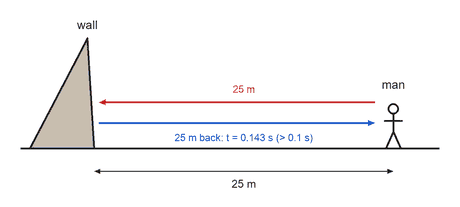
(b) Will he hear a distinct echo?
Step 3 — Compare with 0.1 s.
The reflected sound arrives 0.143 s after the original sound, which is more than 0.1 s. By then the sensation of the original sound has died out, so the reflected sound is heard separately, as a distinct echo. (The wall is farther than the minimum of 17.5 m at this speed.)
Watch out: Compare the time with 0.1 s, or the distance with 17.5 m (not 17 m, since here V = 350 m s⁻¹).
Therefore, (a) he receives the reflected sound after about 0.143 s, and (b) yes, he hears a distinct echo, because 0.143 s is more than 0.1 s.
- 373 marks
Question 37
A RADAR sends a signal with a speed of m s to an aeroplane at a distance 300 km from it. After how much time is the signal received back after reflection from the aeroplane ?
Solve with AIWritten solution
Solution:
Concept: RADAR uses the echo method with radio waves instead of sound. The signal goes to the aeroplane and comes back, covering 2d, so t = 2d ÷ V.
Given: speed of the signal V = 3 × 10⁸ m s⁻¹; distance of the aeroplane d = 300 km
Step 1 — Change the distance into metres.
The speed is in m s⁻¹, so the distance must be in metres.
Step 2 — Find the time.
The signal travels 2d at the speed of light.
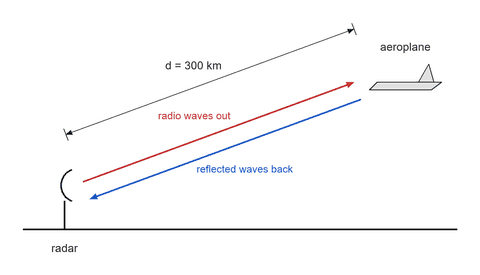
Step 3 — Interpret.
The time is only 2 milliseconds, because radio waves travel at the speed of light.
Watch out: The 300 km is the distance along the signal's path to the aeroplane; use 2d for the return journey.
Therefore, the signal is received back after 2 × 10⁻³ s (2 ms).
- 383 marks
Question 38
A man standing 48 m away from a wall fires a gun. Calculate the time after which an echo is heard. (The speed of sound in air is 320 m s).
Solve with AIWritten solution
Solution:
Concept: The sensation of a sound stays in our ear for about 0.1 s after the sound stops (persistence of hearing). An echo is heard as a separate sound only if the reflected sound arrives at least 0.1 s after the original. Sound goes to the reflector and back, a total distance 2d, so 2d = Vt, that is d = Vt ÷ 2.
Given: distance from the wall d = 48 m; speed of sound V = 320 m s⁻¹
Step 1 — Find the total distance.
The sound of the shot goes to the wall and back to the man.
Step 2 — Find the time.
Divide the total distance by the speed of sound.
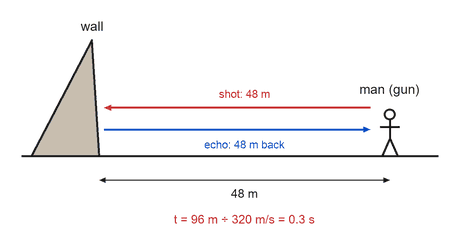
Step 3 — Check it is a distinct echo.
0.3 s is more than 0.1 s, so it is heard as a distinct echo.
Watch out: Use the to-and-fro distance 96 m, not 48 m (which gives 0.15 s).
Therefore, the echo is heard after 0.3 s.
- 393 marks
Question 39
A ship on the surface of water sends a signal and receives it back from a submarine inside water after 4 s. Calculate the distance of the submarine from the ship. (The speed of sound in water is 1450 m s).
Solve with AIWritten solution
Solution:
Concept: This is SONAR. The 4 s is the time for the round trip, down to the submarine and back, so the distance is d = Vt ÷ 2.
Given: time for the signal to return t = 4 s; speed of sound in water V = 1450 m s⁻¹
Step 1 — Write the relation.
In time t the signal covers 2d.
Step 2 — Put in the values.
Use V = 1450 m s⁻¹ and t = 4 s.
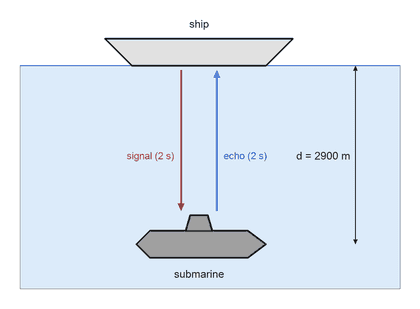
Watch out: Vt = 5800 m is the whole there-and-back path; halve it.
Therefore, the submarine is 2900 m (2.9 km) from the ship.
- 403 marks
Question 40
A pendulum has a frequency of 5 vibrations per second. An observer starts the pendulum and fires a gun simultaneously. He hears echo from the cliff after 8 vibrations of the pendulum. If the velocity of sound in air is 340 m s, find the distance between the cliff and the observer.
Solve with AIWritten solution
Solution:
Concept: The pendulum is used as a clock: its frequency gives the time of one vibration, and 8 vibrations give the echo time t. Then d = Vt ÷ 2.
Given: frequency of the pendulum f = 5 vibrations per second; echo after 8 vibrations; V = 340 m s⁻¹
Step 1 — Find the time of one vibration.
The time period is the reciprocal of the frequency.
Step 2 — Find the echo time.
The echo is heard after 8 vibrations.
Step 3 — Find the distance.
In 1.6 s the sound goes to the cliff and back (2d).
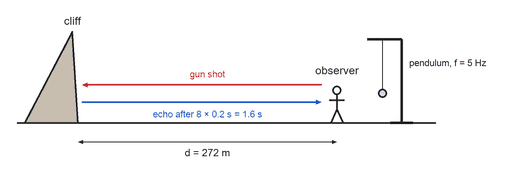
Watch out: 8 vibrations take 8 × T = 1.6 s, not 8 × f.
Therefore, the cliff is 272 m from the observer.
- 413 marks
Question 41
A person standing between two vertical cliffs produces a sound.
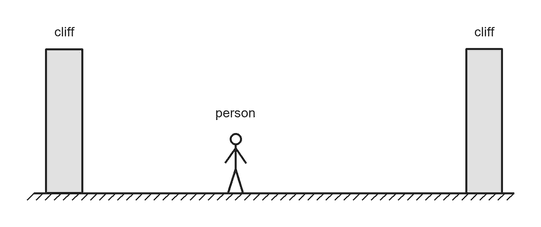
Two successive echoes are heard at 4 s and 6 s. Calculate the distance between the cliffs.
(Speed of sound in air = 320 m s)
[Hint : First echo will be heard from the nearer cliff and the second echo from the farther cliff.]
Solve with AIWritten solution
Solution:
Concept: Each echo comes from a different cliff: the nearer cliff gives the first echo (4 s) and the farther cliff the second (6 s). Find each distance with d = Vt ÷ 2 and add them, because the person stands between the cliffs.
Given: V = 320 m s⁻¹; first echo after t₁ = 4 s; second echo after t₂ = 6 s
Step 1 — Distance of the nearer cliff.
Its echo takes t₁ = 4 s.
Step 2 — Distance of the farther cliff.
Its echo takes t₂ = 6 s.
Step 3 — Distance between the cliffs.
The person is between the cliffs, so the two distances add.
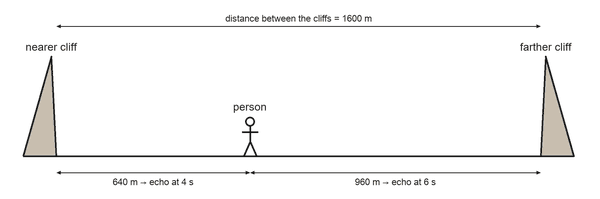
Watch out: '6 s' is the time of the second echo from the moment the sound was made, not 6 s after the first echo.
Therefore, the distance between the cliffs is 1600 m.
- 424 marks
Question 42
A person standing at a distance in front of a cliff fires a gun. Another person B standing behind the person A at distance from the cliff hears two sounds of the fired shot after 2s and 3s respectively.
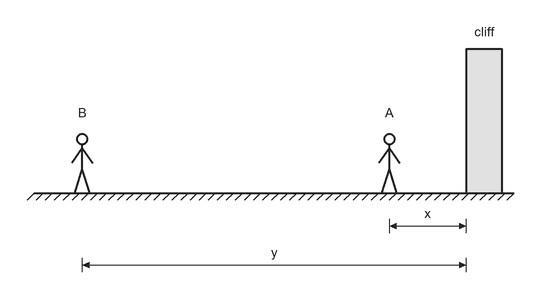
Calculate and (take speed of sound 320 ms).
Solve with AIWritten solution
Solution:
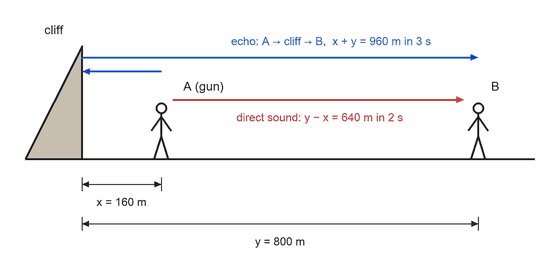
Concept: B hears the shot twice: first the direct sound from A, then the echo from the cliff. Each gives one equation in x and y (distance = speed × time).
Given: A at distance x from the cliff; B behind A at distance y from the cliff; V = 320 m s⁻¹; sounds heard after 2 s and 3 s
Step 1 — Use the direct sound.
A and B stand on the same side of the cliff, B behind A, so the distance between them is y − x. The direct sound covers it in 2 s.
Step 2 — Use the echo.
The echo goes from A to the cliff (x) and then from the cliff to B (y), in 3 s.
Step 3 — Solve for y.
Adding the two equations removes x.
Step 4 — Solve for x.
Put the value of y into the echo equation and subtract.
Check: Both paths give the times stated in the question.
Watch out: The echo path is x + y (A to the cliff, then the cliff to B), not 2x or 2y.
Therefore, x = 160 m and y = 800 m.
- 433 marks
Question 43
On sending an ultrasonic wave from a ship towards the bottom of a sea, the time interval between sending the wave and receiving it back is found to be 1·5 s. If the velocity of wave in sea water is 1400 m s, find the depth of sea.
Solve with AIWritten solution
Solution:
Concept: This is echo depth sounding (SONAR). The 1.5 s is for the wave to go down to the sea bed and come back up, so it covers twice the depth: d = Vt ÷ 2.
Given: time interval t = 1·5 s; velocity of the wave in sea water V = 1400 m s⁻¹
Step 1 — Write the relation.
In time t the wave covers 2d.
Step 2 — Put in the values.
Use V = 1400 m s⁻¹ and t = 1.5 s.
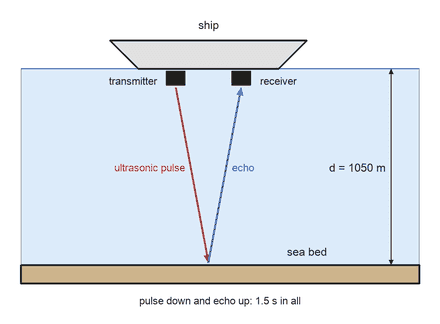
Watch out: Halve Vt; 2100 m is the down-and-up path, not the depth.
Therefore, the depth of the sea is 1050 m.
- 443 marks
Question 44
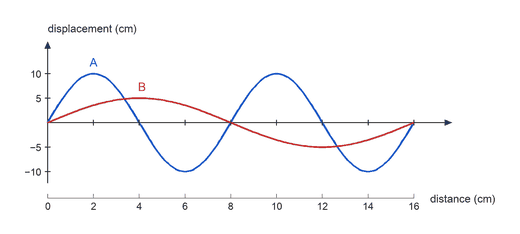
Figure below shows the distance-displacement graph of two waves A and B. Compare (i) the amplitude, (ii) the wavelength of the two waves.
 Solve with AI
Written solution
Solution:
Concept: On a displacement-distance graph, the amplitude is the height of a crest above the axis, and the wavelength is the distance after which the wave repeats itself (one crest and one trough).
Step 1 — Read wave A.
Wave A has its crest at 10 cm, so its amplitude is 10 cm. It completes one wave at 8 cm and repeats from 8 cm to 16 cm, so its wavelength is 8 cm.
Step 2 — Read wave B.
Wave B has its crest at 5 cm, so its amplitude is 5 cm. It completes one wave only at 16 cm, so its wavelength is 16 cm.
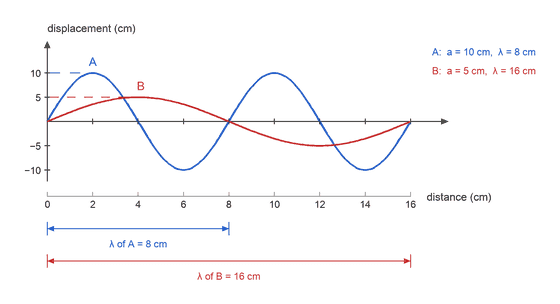
(i) Amplitudes
Step 3 — Compare the amplitudes.
Divide the amplitude of A by that of B.
(ii) Wavelengths
Step 4 — Compare the wavelengths.
Divide the wavelength of A by that of B.
Watch out: The wave first returns to the axis after HALF a wavelength (4 cm for A); a full wavelength needs a crest and a trough.
Therefore, (i) the amplitudes are in the ratio , and (ii) the wavelengths are in the ratio .
- 451 mark
Question 45
The period (or frequency) of natural vibrations depends on :
Solve with AIAnswer
(A) shape
(B) size
(C) external force
- Correct
(D) both (A) and (B)
Answer: (D) both (A) and (B)
Concept: When a body is disturbed and left to itself, it vibrates with its own natural frequency, which is fixed by the body's shape and size (and material). If no resistance acts (in vacuum), the amplitude stays constant: these are natural (free) vibrations.
Step 1 — See what fixes the natural frequency.
The natural frequency belongs to the body itself. It depends on the body's shape and size (and its material). For example, a long pendulum swings more slowly than a short one.
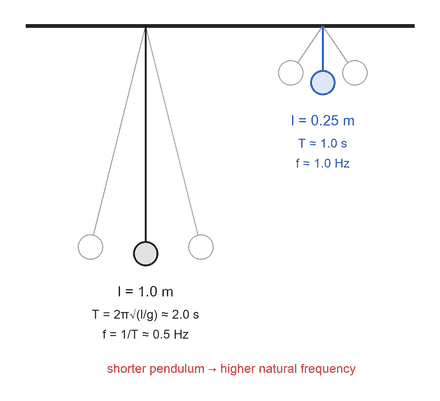
Step 2 — See what the external force does.
The external force only starts the vibration. It decides how big the first swing is (the amplitude), not how often the body vibrates.
Watch out: Pushing a swing harder makes it swing higher, not more often.
Why the other options are wrong:
- (A) shape: shape alone is only half the answer; size matters too.
- (B) size: size alone is only half the answer; shape matters too.
- (C) external force: the external force that starts the vibration does not change the natural frequency.
Therefore, the natural frequency depends on both shape and size, option (D).
- 461 mark
Question 46
The natural frequency of a simple pendulum of length 1.0 m on earth's surface is :
[Take = 9.8 m/s]
Solve with AIAnswer
- Correct
(A) 0.5 Hz
(B) 100 Hz
(C) 50 Hz
(D) 5 Hz
Answer: (A) 0.5 Hz
Concept: A simple pendulum of length l vibrates with the natural time period T = 2π√(l ÷ g), and its natural frequency is f = 1 ÷ T.
Step 1 — Find the time period.
Put l = 1.0 m and g = 9.8 m s⁻² into the formula.
Step 2 — Find the frequency.
The frequency is the reciprocal of the time period.
Step 3 — Interpret.
The pendulum makes one complete oscillation about every 2 seconds.
Watch out: F is the reciprocal of T; do not give T (2 s) as the answer.
Why the other options are wrong:
- (B) 100 Hz: 100 Hz would mean 100 oscillations every second; a 1 m pendulum takes about 2 s for one.
- (C) 50 Hz: 50 Hz would mean 50 oscillations every second, far too fast for a 1 m pendulum.
- (D) 5 Hz: 5 Hz is ten times too large; it would need a period of only 0.2 s.
Therefore, the natural frequency of the pendulum is about 0.5 Hz, option (A).
- 471 mark
Question 47
A wire stretched between two fixed supports is plucked exactly in the middle and then released. It executes (neglect the resistance of the medium) :
Solve with AIAnswer
(A) resonant vibrations
- Correct
(B) natural vibrations
(C) damped vibrations
(D) forced vibrations
Answer: (B) natural vibrations
Concept: When a body is disturbed and left to itself, it vibrates with its own natural frequency, which is fixed by the body's shape and size (and material). If no resistance acts (in vacuum), the amplitude stays constant: these are natural (free) vibrations.
Step 1 — See what acts after release.
Once the wire is released, no outside periodic force acts on it, so it vibrates at its own natural frequency.
Step 2 — Use the condition given.
The question tells us to neglect the resistance of the medium, so no energy is lost and the amplitude stays constant. These are natural vibrations.

Watch out: Without the words 'neglect the resistance' the answer would be damped vibrations, as for any real wire in air.
Why the other options are wrong:
- (A) resonant vibrations: resonant vibrations need an external periodic force whose frequency equals the natural frequency.
- (C) damped vibrations: damped vibrations need a resistance that reduces the amplitude, and here it is neglected.
- (D) forced vibrations: forced vibrations need a continuing external periodic force, and there is none after release.
Therefore, the wire executes natural vibrations, option (B).
- 481 mark
Question 48
In an organ pipe with one closed end, the frequencies of different modes are in the ratio :
Solve with AIAnswer
(A) 1 : 2 : 3 ....
- Correct
(B) 1 : 3 : 5 ....
(C) 1 : 2 : 4 ....
(D) 2 : 4 : 6
Answer: (B) 1 : 3 : 5 …
Concept: In a pipe closed at one end, the air cannot move at the closed end (a node) and moves most at the open end (an antinode). The distance from a node to the next antinode is a quarter wavelength.
Step 1 — Fit the modes into the pipe.
The simplest way to have a node at one end and an antinode at the other is l = λ ÷ 4. The next ways add half a wavelength each time.
Step 2 — Turn wavelengths into frequencies.
Since f = V ÷ λ, the wavelengths 4l, 4l/3, 4l/5 give the frequencies f, 3f, 5f, and so on: only the odd multiples of the lowest frequency.

Step 3 — Write the ratio.
The frequencies are therefore in the ratio of the odd numbers.
Watch out: The even multiples (2f, 4f) are missing in a closed pipe, because they would need an antinode at the closed end.
Why the other options are wrong:
- (A) 1 : 2 : 3 : 1 : 2 : 3 is the series for a pipe open at both ends or a string fixed at both ends, which has even multiples too.
- (C) 1 : 2 : 4 : 1 : 2 : 4 doubles each time; it is not the series of modes of any pipe.
- (D) 2 : 4 : 6: 2 : 4 : 6 is just 1 : 2 : 3 again, with even multiples that a closed pipe cannot give.
Therefore, the frequencies of a pipe closed at one end are in the ratio 1 : 3 : 5 …, option (B).
- 491 mark
Question 49
The frequency of a vibration in a stretched string depends on :
Solve with AIAnswer
(A) length
(B) radius
(C) tension T
- Correct
(D) all of these
Answer: (D) all of these
Concept: The natural frequency of a stretched string is f = (1 ÷ 2l) √(T ÷ m), where l is the vibrating length, T the tension and m the mass per unit length. For a wire of radius r and density ρ, m = πr²ρ, so f ∝ 1/l, f ∝ √T and f ∝ 1/r.
Step 1 — Length.
l is in the denominator, so f ∝ 1/l: a shorter string gives a higher frequency.
Step 2 — Tension.
T is under the square root in the numerator, so f ∝ √T: a tighter string gives a higher frequency.
Step 3 — Radius.
m = πr²ρ is in the denominator under the square root, so f ∝ 1/r: a thinner string gives a higher frequency.

Step 4 — Conclude.
The frequency depends on all three: length, radius and tension.
Why the other options are wrong:
- (A) length : length is one factor, but the radius and the tension matter as well.
- (B) radius : radius is one factor, but the length and the tension matter as well.
- (C) tension T: tension is one factor, but the length and the radius matter as well.
Therefore, the frequency of a stretched string depends on all of these, option (D).
- 501 mark
Question 50
The frequency of the note produced by a string can be increased by :
Solve with AIAnswer
(A) decreasing the length of the string
(B) decreasing the radius of the string
(C) increasing the Tension T of the string
- Correct
(D) All of these
Answer: (D) All of these
Concept: The natural frequency of a stretched string is f = (1 ÷ 2l) √(T ÷ m), where l is the vibrating length, T the tension and m the mass per unit length. For a wire of radius r and density ρ, m = πr²ρ, so f ∝ 1/l, f ∝ √T and f ∝ 1/r.
Step 1 — Decrease the length.
Since f ∝ 1/l, a shorter vibrating length gives a higher frequency.
Step 2 — Decrease the radius.
Since f ∝ 1/r, a thinner string gives a higher frequency.
Step 3 — Increase the tension.
Since f ∝ √T, a tighter string gives a higher frequency.
Step 4 — Conclude.
All three changes raise the frequency, and all three are used in tuning stringed instruments.
Why the other options are wrong:
- (A) decreasing the length of the string: decreasing the length does raise f, but it is only one of the three correct ways.
- (B) decreasing the radius of the string: decreasing the radius does raise f, but it is only one of the three correct ways.
- (C) increasing the Tension T of the string: increasing the tension does raise f, but it is only one of the three correct ways.
Therefore, the frequency can be increased by all of these, option (D).
- 511 mark
Question 51
If is the length of the string stretched between its ends, the wavelength of different modes in Figure (1), (2) and (3) will be :
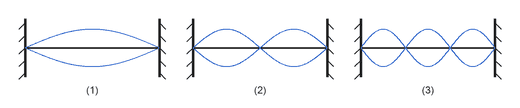 Solve with AI
Answer
(A)
(B)
- Correct
(C)
(D)
Answer: (C)
Concept: A string fixed at both ends vibrates in loops, and each loop is half a wavelength long. With n loops on a string of length l, n × λ/2 = l, so λ = 2l ÷ n.
Step 1 — Count the loops.
Figure (1) has 1 loop, figure (2) has 2 loops and figure (3) has 3 loops.
Step 2 — Find each wavelength.
Put n = 1, 2 and 3 into λ = 2l ÷ n.
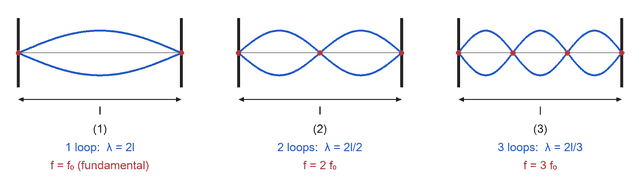
Watch out: One loop is HALF a wavelength, so a one-loop string has λ = 2l, not l.
Why the other options are wrong:
- (A) : it gives 2l/2 for figure (1), but one loop is half a wavelength, so λ = 2l there.
- (B) : it lists the three values in the reverse order.
- (D) : it swaps figures (2) and (3): more loops always mean a shorter wavelength.
Therefore, the wavelengths are 2l, 2l/2 and 2l/3, option (C).
- 521 mark
Question 52
When a body vibrates under a periodic force, the vibrations of a body are :
Solve with AIAnswer
- Correct
(A) forced vibrations
(B) damped vibrations
(C) resonant vibrations
(D) natural vibrations
Answer: (A) forced vibrations
Concept: When an external periodic force keeps acting on a body, the body vibrates with the frequency of the force, not its own natural frequency. These are forced vibrations; their amplitude is usually small.
Step 1 — See what acts on the body.
A periodic force keeps acting on the body, so the body does not vibrate at its own natural frequency; it is made to vibrate at the frequency of the force.
Step 2 — Name the vibrations.
Vibrations under an external periodic force are forced vibrations. An example is the table top made to vibrate when the stem of a vibrating tuning fork is pressed on it.
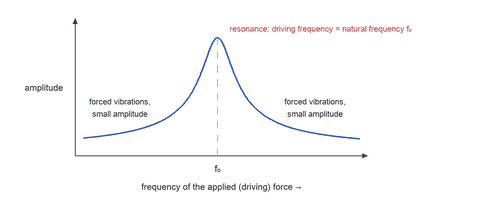
Watch out: Resonance is only the special case of forced vibrations with equal frequencies; the question describes the general case.
Why the other options are wrong:
- (B) damped vibrations: damped vibrations happen after a body is left to itself in a resisting medium, with no periodic force.
- (C) resonant vibrations: resonant vibrations need the force's frequency to EQUAL the natural frequency; the question does not say so.
- (D) natural vibrations: natural vibrations happen with no external force at all.
Therefore, the vibrations of a body under a periodic force are forced vibrations, option (A).
- 531 mark
Question 53
A slim branch of a tree is pulled and released. It makes .......... vibrations.
Solve with AIAnswer
- Correct
(A) damped
(B) natural
(C) forced
(D) resonant
Answer: (A) damped
Concept: In a real medium a vibrating body does work against the resistance (friction) of the medium and loses energy, mostly as heat. Its amplitude decreases with time while its frequency stays the natural frequency: these are damped vibrations.
Step 1 — See what acts after release.
Once released, the branch vibrates at its own natural frequency; no periodic force acts on it.
Step 2 — See what happens to the amplitude.
Air resistance and friction inside the wood take away its energy quickly, so its swings die down after a few vibrations. The vibrations are damped.

Watch out: A body vibrating in air is never exactly 'natural'; natural vibrations with constant amplitude need vacuum.
Why the other options are wrong:
- (B) natural: natural vibrations keep a constant amplitude, which needs vacuum; the branch's swings die away.
- (C) forced: forced vibrations need a continuing external periodic force, and none acts after release.
- (D) resonant: resonant vibrations need a periodic force at the natural frequency, and none acts here.
Therefore, the branch makes damped vibrations, option (A).
- 541 mark
Question 54
A body is vibrating under the influence of an external periodic force of frequency exactly equal to the natural frequency of the vibrations of the body. It executes :
Solve with AIAnswer
(A) damped vibrations
(B) forced vibrations
- Correct
(C) resonant vibrations
(D) natural vibrations
Answer: (C) resonant vibrations
Concept: Resonance is the special case of forced vibrations in which the frequency of the applied periodic force is equal to the natural frequency of the body. The body then takes in energy most easily and vibrates with a very large amplitude, so a loud sound is heard.
Step 1 — See what kind of vibration it is.
The body is driven by an external periodic force, so its vibrations are forced vibrations.
Step 2 — Use the special condition.
The force's frequency is exactly equal to the body's natural frequency, so the body vibrates with a very large amplitude. This special case is called resonance.
Why the other options are wrong:
- (A) damped vibrations: damped vibrations happen with no external periodic force.
- (B) forced vibrations: the vibrations are forced, but the special case of equal frequencies has its own name, resonance.
- (D) natural vibrations: natural vibrations happen with no external force at all.
Therefore, the body executes resonant vibrations, option (C).
- 551 mark
Question 55
At resonance, a loud sound is heard because the body vibrating with a large ..... sends forth a large amount of energy in the medium.
Solve with AIAnswer
- Correct
(A) amplitude
(B) frequency
(C) wavelength
(D) time period
Answer: (A) amplitude
Concept: Resonance is the special case of forced vibrations in which the frequency of the applied periodic force is equal to the natural frequency of the body. The body then takes in energy most easily and vibrates with a very large amplitude, so a loud sound is heard. The energy carried by a sound wave grows with the square of its amplitude.
Step 1 — See what is large at resonance.
At resonance the body vibrates with a large amplitude, so with each vibration it pushes a lot of air.
Step 2 — Link it to loudness.
A large amplitude sends a large amount of energy into the medium, and more energy reaching the ear means a louder sound.
Watch out: At resonance the FREQUENCY is not large; it is simply equal to the natural frequency.
Why the other options are wrong:
- (B) frequency: at resonance the body vibrates at its natural frequency; the frequency does not become large.
- (C) wavelength: the wavelength is fixed by the frequency and the medium; it decides nothing about loudness.
- (D) time period: the time period is fixed by the frequency; it decides the pitch, not the loudness.
Therefore, a loud sound is heard because the body vibrates with a large amplitude, option (A).
- 561 mark
Question 56
The sound box of a musical instrument is so constructed that the air column inside it has a natural frequency .......... that of the string stretched in it.
Solve with AIAnswer
(A) greater than
(B) smaller than
- Correct
(C) equal to
(D) cannot say
Answer: (C) equal to
Concept: Resonance is the special case of forced vibrations in which the frequency of the applied periodic force is equal to the natural frequency of the body. The body then takes in energy most easily and vibrates with a very large amplitude, so a loud sound is heard.
Step 1 — See what the box is for.
The sound box makes the feeble sound of a string louder by resonance, and resonance needs equal frequencies.
Step 2 — State the design.
So the air column inside the box is made to have a natural frequency equal to that of the string.
Step 3 — See the effect.
When the string vibrates, the air in the box resonates: it vibrates with a large amplitude and sets a large mass of outside air vibrating, so the sound becomes much louder.
Why the other options are wrong:
- (A) greater than: with a greater natural frequency the air would make only weak forced vibrations, and the sound would stay feeble.
- (B) smaller than: with a smaller natural frequency the air would also make only weak forced vibrations.
- (D) cannot say: the condition is definite: the frequencies must be equal.
Therefore, the air column has a natural frequency equal to that of the string, option (C).
- 571 mark
Question 57
Column X shows the kind of vibrations and column Y shows their examples.
Column X Column Y (A) Natural vibrations (1) A tuning fork when stroked on a rubber pad. (B) Damped vibrations (2) When a guitarist plucks or strums the guitar strings with his/her fingers. (C) Forced vibrations (3) When a troop crosses a suspension bridge. (D) Resonant vibrations (4) A load suspended from a spring. Choose the correct pairing :
Solve with AIAnswer
(A) A—(4) B—(2) C—(3) D—(1)
- Correct
(B) A—(4) B—(1) C—(2) D—(3)
(C) A—(4) B—(3) C—(1) D—(2)
(D) A—(2) B—(3) C—(4) D—(1)
Answer: (B) A—(4) B—(1) C—(2) D—(3)
Concept: Match each kind of vibration to what is acting on the body: nothing (natural), friction that reduces the amplitude (damped), an outside periodic force (forced), or a periodic force at the natural frequency (resonant).
Step 1 — Natural vibrations.
A load suspended from a spring, pulled and left free, oscillates at its own natural frequency. So the first kind in column X goes with example 4.
Step 2 — Damped vibrations.
A tuning fork struck on a rubber pad vibrates in air, and its sound slowly dies away as its amplitude falls. So damped vibrations go with example 1.
Step 3 — Forced vibrations.
The guitarist's fingers set the strings vibrating, and the strings in turn force the guitar's body to vibrate (the book's pairing). So forced vibrations go with example 2.
Step 4 — Resonant vibrations.
Soldiers marching in step over a suspension bridge may push it at its natural frequency and make it resonate. So resonant vibrations go with example 3.
Watch out: Column X uses the letters A to D for its rows too; match by the kind of vibration, not by the option letter.
Why the other options are wrong:
- (A) A—(4) B—(2) C—(3) D—(1): it pairs damped vibrations with the guitar and resonance with the tuning fork on a rubber pad.
- (C) A—(4) B—(3) C—(1) D—(2): it pairs damped vibrations with the marching troop and forced vibrations with the rubber pad.
- (D) A—(2) B—(3) C—(4) D—(1): it pairs natural vibrations with the guitar and forced vibrations with the spring.
Therefore, the correct pairing is natural–4, damped–1, forced–2, resonant–3, option (B).
- 582 marks
Question 58
(a) Name one factor on which the frequency of sound emitted due to vibrations in an air column depends.
(b) How does the frequency depend on the factor stated in part (a).
Solve with AIWritten solution
Solution:
Concept: An air column (in a flute, a bottle or a tube partly filled with water) vibrates with a natural frequency that depends on its length: the shorter the air column, the higher its frequency, f ∝ 1/l.
(a) Factor
Step 1 — Name the factor.
The frequency of an air column depends on the length of the air column.
(b) How the frequency depends on it
Step 2 — State the relation.
The frequency is inversely proportional to the length of the air column.
Step 3 — Give an example.
As a bottle fills with water, its air column gets shorter, so the note rises (becomes shriller).

Watch out: A LONGER air column gives a LOWER note, not a higher one.
Therefore, (a) the frequency depends on the length of the air column, and (b) it is inversely proportional to it, f ∝ 1/l.
- 591 mark
Question 59
State one way of increasing the frequency of a note produced by an air column.
Solve with AIWritten solution
Solution:
Concept: An air column (in a flute, a bottle or a tube partly filled with water) vibrates with a natural frequency that depends on its length: the shorter the air column, the higher its frequency, f ∝ 1/l.
Step 1 — Use the relation.
Since f ∝ 1/l, making the air column shorter raises its frequency.
Step 2 — Give ways of doing it.
Pour more water into the tube, or, on a flute, open a hole nearer the mouthpiece so that the vibrating air column is shorter.
Therefore, the frequency is increased by decreasing the length of the air column.
- 602 marks
Question 60
How does the frequency of sound given by a stretched string depend on its (a) length, (b) tension ?
Solve with AIWritten solution
Solution:
Concept: The natural frequency of a stretched string is f = (1 ÷ 2l) √(T ÷ m), where l is the vibrating length, T the tension and m the mass per unit length. For a wire of radius r and density ρ, m = πr²ρ, so f ∝ 1/l, f ∝ √T and f ∝ 1/r.
(a) Length
Step 1 — Relation with length.
The frequency is inversely proportional to the vibrating length, f ∝ 1/l. Halving the length doubles the frequency.
(b) Tension
Step 2 — Relation with tension.
The frequency is directly proportional to the square root of the tension, f ∝ √T. Making the tension four times doubles the frequency, because √4 is 2.
Watch out: The frequency varies as the SQUARE ROOT of the tension; doubling T raises f only about 1.41 times.
Therefore, (a) f ∝ 1/l, and (b) f ∝ √T.
- 611 mark
Question 61
A tuning fork is vibrating in air. State whether the vibrations are natural or damped ?
Solve with AIWritten solution
Solution:
Concept: In a real medium a vibrating body does work against the resistance (friction) of the medium and loses energy, mostly as heat. Its amplitude decreases with time while its frequency stays the natural frequency: these are damped vibrations.
Step 1 — See where the fork vibrates.
The fork vibrates in air, and air resistance acts on its prongs.
Step 2 — See what happens.
The fork loses energy in each vibration, so its amplitude decreases gradually and its sound slowly dies away.
Watch out: Natural vibrations with a constant amplitude are possible only in vacuum.
Therefore, the vibrations of a tuning fork in air are damped.
- 621 mark
Question 62
State the condition for the resonance to occur.
Solve with AIWritten solution
Solution:
Concept: Resonance is the special case of forced vibrations in which the frequency of the applied periodic force is equal to the natural frequency of the body. The body then takes in energy most easily and vibrates with a very large amplitude, so a loud sound is heard.
Step 1 — State the condition.
Resonance occurs when the frequency of the applied (driving) periodic force is equal to the natural frequency of the body.
Step 2 — Say what is seen.
The body then vibrates with a very large amplitude, as the peak of the curve shows.
Therefore, for resonance the frequency of the driving force must equal the natural frequency of the body.
- 631 mark
Question 63
Complete the following sentence :
Resonance is a special case of …….. vibrations, when frequency of the driving force is .......... natural frequency of the driven body.
Solve with AIWritten solution
Solution:
Concept: Resonance is the special case of forced vibrations in which the frequency of the applied periodic force is equal to the natural frequency of the body. The body then takes in energy most easily and vibrates with a very large amplitude, so a loud sound is heard.
Step 1 — Fill the first blank.
Resonance happens under an outside periodic force, so it is a special case of forced vibrations.
Step 2 — Fill the second blank.
The special condition is that the two frequencies are equal.
Completed sentence: Resonance is a special case of forced vibrations, when frequency of the driving force is equal to the natural frequency of the driven body.
Therefore, the blanks are 'forced' and 'equal to the'.
- 642 marks
Question 64
What do you understand by natural vibrations of a body ? Give one example.
Solve with AIWritten solution
Solution:
Concept: When a body is disturbed and left to itself, it vibrates with its own natural frequency, which is fixed by the body's shape and size (and material). If no resistance acts (in vacuum), the amplitude stays constant: these are natural (free) vibrations.
Step 1 — Define natural vibrations.
When a body is disturbed slightly from its position of rest and then left to itself, it vibrates with its own natural frequency and, if no resistance acts on it, with a constant amplitude. These are natural (free) vibrations.
Step 2 — Give an example.
A simple pendulum oscillating in vacuum, or a tuning fork vibrating in vacuum: its swings keep the same size and the same frequency.
Watch out: A pendulum in AIR is an example of damped vibrations, not natural vibrations.
Therefore, natural vibrations are the vibrations of a body left to itself, at its own frequency with a constant amplitude; for example, a simple pendulum oscillating in vacuum.
- 652 marks
Question 65
What is meant by the natural frequency of vibrations of a body ? Name one factor on which it depends.
Solve with AIWritten solution
Solution:
Concept: When a body is disturbed and left to itself, it vibrates with its own natural frequency, which is fixed by the body's shape and size (and material). If no resistance acts (in vacuum), the amplitude stays constant: these are natural (free) vibrations.
Step 1 — Define natural frequency.
The frequency with which a body vibrates freely, when it is disturbed and left to itself with no external force acting, is called its natural frequency.
Step 2 — Name one factor.
It depends on the shape and size of the body (and its material). For a simple pendulum it depends on the length: a shorter pendulum has a higher natural frequency.
Step 3 — Other examples.
A string's natural frequency depends on its length and tension, and an air column's on its length.
Therefore, the natural frequency is the frequency of free vibration of a body; it depends on the body's shape and size (for a pendulum, its length).
- 661 mark
Question 66
State one condition for a body to execute natural vibrations.
Solve with AIWritten solution
Solution:
Concept: A vibrating body keeps its amplitude constant only if it loses no energy.
Step 1 — State the condition.
No resistive (frictional) force must act on the body, so the body must vibrate in vacuum.
Step 2 — Say why it works.
Then no energy is lost to the surroundings, and the body keeps vibrating at its natural frequency with a constant amplitude.
Therefore, for natural vibrations the body must vibrate in vacuum, with no resistive force acting on it.
- 672 marks
Question 67
State two ways of increasing the frequency of vibrations of a stretched string.
Solve with AIWritten solution
Solution:
Concept: The natural frequency of a stretched string is f = (1 ÷ 2l) √(T ÷ m), where l is the vibrating length, T the tension and m the mass per unit length. For a wire of radius r and density ρ, m = πr²ρ, so f ∝ 1/l, f ∝ √T and f ∝ 1/r.
Step 1 — First way: increase the tension.
Since f ∝ √T, tighten the string, for example by turning its tuning peg.
Step 2 — Second way: decrease the vibrating length.
Since f ∝ 1/l, shorten the vibrating part, for example by pressing the string with a finger nearer to one end.
Step 3 — A third way.
A thinner string also gives a higher frequency, since f ∝ 1/r.
Therefore, the frequency of a stretched string is increased by increasing its tension or decreasing its vibrating length.
- 682 marks
Question 68
What adjustments would you make for tuning a stringed instrument for it to emit a note of a desired frequency ?
Solve with AIWritten solution
Solution:
Concept: The natural frequency of a stretched string is f = (1 ÷ 2l) √(T ÷ m), where l is the vibrating length, T the tension and m the mass per unit length. For a wire of radius r and density ρ, m = πr²ρ, so f ∝ 1/l, f ∝ √T and f ∝ 1/r. So the note can be set by changing the tension T or the vibrating length l.
Step 1 — Adjust the tension.
Turn the tuning peg of the string: tighten it to raise the frequency, loosen it to lower the frequency, until the string gives the desired note.
Step 2 — Adjust the vibrating length.
While playing, press the string at different points with the fingers; a shorter vibrating length gives a higher frequency.
Step 3 — Choose the string.
Strings of different thickness are used for notes of very different frequency.
Therefore, a stringed instrument is tuned by adjusting the tension of each string (with its peg) and the vibrating length (with the fingers).
- 691 mark
Question 69
A blade, fixed at one end, is made to vibrate by pressing its other end and then releasing it. State one way in which the frequency of vibrations of the blade can be lowered.
Solve with AIWritten solution
Solution:
Concept: The natural frequency of a vibrating blade depends on its size: a longer (or heavier) vibrating part vibrates more slowly.
Step 1 — Give one way.
Increase the length of the vibrating part of the blade by pushing more of it beyond the fixed end. Its frequency is lowered and a lower note is heard.
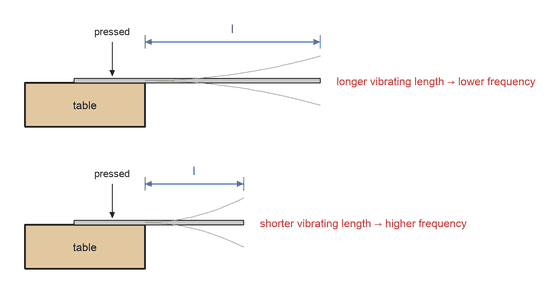
Step 2 — Another way.
Stick a small weight on its free end to increase its mass; this also lowers the frequency.
Therefore, the frequency is lowered by increasing the length of the vibrating part of the blade.
- 702 marks
Question 70
How does the medium affect the amplitude of the natural vibrations of a body ?
Solve with AIWritten solution
Solution:
Concept: In a real medium a vibrating body does work against the resistance (friction) of the medium and loses energy, mostly as heat. Its amplitude decreases with time while its frequency stays the natural frequency: these are damped vibrations.
Step 1 — See what the medium does.
In a medium such as air, the vibrating body has to work against the resistance of the medium.
Step 2 — See the effect on the amplitude.
It loses some energy in every vibration, mostly as heat, so it cannot move as far from its mean position: its amplitude decreases gradually until the vibrations stop.
Step 3 — Compare media.
The denser the medium, the more resistance it offers and the faster the amplitude decreases. Only in vacuum would the amplitude stay constant.
Watch out: The medium reduces the AMPLITUDE; the frequency stays the natural frequency.
Therefore, the medium makes the amplitude decrease gradually (the vibrations become damped), faster in a denser medium.
- 712 marks
Question 71
What are forced vibrations ? Give one example to illustrate your answer.
Solve with AIWritten solution
Solution:
Concept: When an external periodic force keeps acting on a body, the body vibrates with the frequency of the force, not its own natural frequency. These are forced vibrations; their amplitude is usually small.
Step 1 — Define forced vibrations.
The vibrations of a body under an external periodic force, at the frequency of that force (not at its own natural frequency), are called forced vibrations.
Step 2 — Give an example.
When the stem of a vibrating tuning fork is pressed on a table top, the table top is forced to vibrate at the frequency of the fork, and a louder sound is heard.

Step 3 — Another example.
The sound board of a stringed instrument is forced to vibrate by its strings.
Therefore, forced vibrations are vibrations at the frequency of an applied periodic force; for example, a table top made to vibrate by a tuning fork pressed on it.
- 722 marks
Question 72
On keeping the stem of a vibrating tuning fork on the surface of a table, a loud sound is heard. Give reason.
Solve with AIWritten solution
Solution:
Concept: A small vibrating surface moves only a little air; a large vibrating surface moves much more air and sends out more sound energy.
Step 1 — Name what happens to the table.
The vibrating fork makes the table top undergo forced vibrations at the frequency of the fork.
Step 2 — Explain the loud sound.
The table top has a large surface area, so it sets a much larger mass of air vibrating than the thin prongs could. More sound energy goes into the air, and a louder sound is heard.
Watch out: The table does not resonate here; it is simply forced to vibrate at the fork's frequency.
Therefore, the loud sound is heard because the large table top, forced to vibrate by the fork, sets a large mass of air vibrating.
- 732 marks
Question 73
State two differences between natural and forced vibrations.
Solve with AIWritten solution
Solution:
Concept: In natural vibrations the body vibrates on its own; in forced vibrations an outside periodic force keeps it vibrating.
Step 1 — Compare the frequency.
In natural vibrations the body vibrates with its own natural frequency; in forced vibrations it vibrates with the frequency of the applied periodic force.
Step 2 — Compare the force and the amplitude.
In natural vibrations no external force acts once the vibration starts, and the amplitude stays constant (in vacuum); in forced vibrations a continuous external periodic force is needed, and the amplitude depends on how close its frequency is to the natural frequency.
The table gives the two differences.
Natural vibrations Forced vibrations 1. It vibrates at the body's own natural frequency. 1. It vibrates at the frequency of the applied periodic force. 2. No external force after the start; constant amplitude (in vacuum). 2. A continuous external periodic force is needed; the amplitude is usually small. Therefore, natural vibrations are at the body's own frequency with no external force, while forced vibrations are at the frequency of a continuously applied periodic force.
- 742 marks
Question 74
State two differences between forced and resonant vibrations.
Solve with AIWritten solution
Solution:
Concept: Resonance is the special case of forced vibrations in which the frequency of the applied periodic force is equal to the natural frequency of the body. The body then takes in energy most easily and vibrates with a very large amplitude, so a loud sound is heard.
Step 1 — Compare the frequencies.
In forced vibrations the frequency of the applied force differs from the natural frequency of the body; in resonant vibrations it is equal to it.
Step 2 — Compare the amplitudes.
Forced vibrations usually have a small amplitude; resonant vibrations have a very large amplitude, so the sound is loud.
The table gives the two differences.
Forced vibrations Resonant vibrations 1. Frequency of the force differs from the natural frequency. 1. Frequency of the force equals the natural frequency. 2. Amplitude usually small. 2. Amplitude very large; loud sound. Step 3 — Read the resonance curve.
The curve shows both: the amplitude is small away from f₀ and largest at f₀.
Therefore, resonant vibrations differ from forced vibrations in having the force's frequency equal to the natural frequency, and a very large amplitude.
- 752 marks
Question 75
Why is a loud sound heard at resonance ?
Solve with AIWritten solution
Solution:
Concept: Resonance is the special case of forced vibrations in which the frequency of the applied periodic force is equal to the natural frequency of the body. The body then takes in energy most easily and vibrates with a very large amplitude, so a loud sound is heard.
Step 1 — See what is large.
At resonance the body takes in energy most easily, so it vibrates with a very large amplitude.
Step 2 — Link amplitude and energy.
The energy of a sound wave grows with the square of its amplitude, so a body vibrating with a large amplitude sends a large amount of energy into the air.
Step 3 — Conclude.
More energy reaches the ear, so a loud sound is heard.
Therefore, a loud sound is heard at resonance because the body vibrates with a very large amplitude and sends much energy into the medium.
- 762 marks
Question 76
When a troop crosses a suspension bridge, the soldiers are asked to break their steps. Why ?
Solve with AIWritten solution
Solution:
Concept: Resonance is the special case of forced vibrations in which the frequency of the applied periodic force is equal to the natural frequency of the body. The body then takes in energy most easily and vibrates with a very large amplitude, so a loud sound is heard.
Step 1 — See what marching in step does.
Soldiers marching in step strike the bridge periodically, at the frequency of their steps.
Step 2 — See the danger.
If this frequency equals the natural frequency of the bridge, the bridge resonates and vibrates with a very large amplitude, which may damage or even break it.
Step 3 — See how breaking step helps.
Out of step, the pushes on the bridge are irregular and have no single frequency, so resonance cannot build up.
Therefore, soldiers break step so that the bridge is not made to resonate, which could make it vibrate violently and break.
- 772 marks
Question 77
Why are stringed instruments like guitar provided with a hollow sound box ?
Solve with AIWritten solution
Solution:
Concept: A thin vibrating string by itself moves very little air, so its sound is feeble. The sound box makes it louder by resonance.
Step 1 — See what the box contains.
The air in the hollow sound box has a natural frequency matching that of the strings, so it resonates with them.
Step 2 — See the effect.
The box and the air inside it vibrate with a large amplitude and set a large mass of outside air vibrating, so the sound becomes much louder.
Therefore, stringed instruments have a hollow sound box so that its air resonates with the strings and the sound becomes louder.
- 783 marks
Question 78
How do you tune your radio set to a particular station ? Name the phenomenon involved in doing so and define it.
Solve with AIWritten solution
Solution:
Concept: Tuning a radio means matching the natural frequency of its circuit to the frequency of the station's radio waves.
Step 1 — Tune the set.
Turning the tuning knob changes the natural frequency of the receiver's electrical circuit. When it becomes equal to the frequency of the radio waves sent by the desired station, the circuit picks up that station's signal strongly, and that station is heard. Stations of other frequencies are picked up only weakly.
Step 2 — Name the phenomenon.
The phenomenon involved is resonance.
Step 3 — Define it.
When a body is made to vibrate by an external periodic force whose frequency is equal to its natural frequency, it vibrates with a large amplitude. This is called resonance.
Therefore, a radio is tuned by making the natural frequency of its circuit equal to the station's frequency; the phenomenon is resonance.
- 794 marks
Question 79
(a) Draw a graph between displacement and time for a body executing natural vibrations.
(b) Where can a body execute natural vibrations?
Solve with AIWritten solution
Solution:
Concept: When a body is disturbed and left to itself, it vibrates with its own natural frequency, which is fixed by the body's shape and size (and material). If no resistance acts (in vacuum), the amplitude stays constant: these are natural (free) vibrations.
(a) Displacement-time graph
Step 1 — Describe the graph.
The graph is a regular wave of constant height: every crest reaches the same height +a, every trough the same depth −a, and each complete wave takes the same time T.
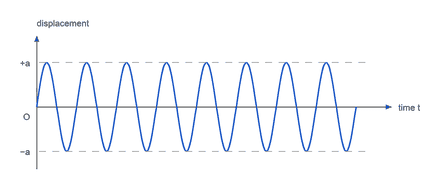
Step 2 — Read it.
The equal heights show the constant amplitude; the equal spacing shows the constant frequency.
(b) Where natural vibrations are possible
Step 3 — State the place.
A body can execute natural vibrations only in vacuum. There is no medium there to offer resistance, so the body loses no energy and its amplitude does not decrease.
Watch out: Do not draw the crests getting smaller; that is the graph of damped vibrations.
Therefore, (a) the graph is a wave of constant amplitude and constant period, and (b) a body executes natural vibrations only in vacuum.
- 804 marks
Question 80
The diagram in Fig. 7.12 shows three ways in which a string of length in an instrument can vibrate.
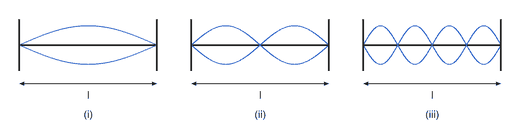
(a) Which of the diagram shows the principal note?
(b) Which vibration has a frequency four times that of the first ?
(c) Which vibration is of the longest wavelength ?
(d) What is the ratio of frequency of vibrations in diagrams (i) and (ii) ?
Solve with AIWritten solution
Solution:
Concept: A string fixed at both ends vibrates in loops, each loop half a wavelength long. With n loops on a string of length l, λ = 2l ÷ n, and the frequency f = V ÷ λ is n times the lowest (fundamental) frequency.
Step 1 — Count the loops.
Diagram (i) has 1 loop, (ii) has 2 loops and (iii) has 4 loops.
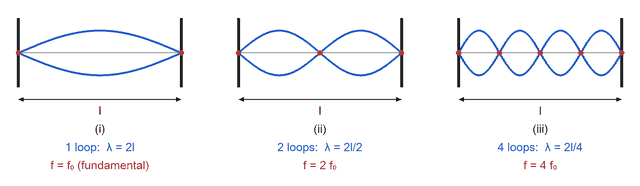
(a) Principal note
Step 2 — Find the principal note.
One loop gives the lowest frequency, the fundamental (principal) note, so it is diagram (i).
(b) Frequency four times the first
Step 3 — Find four times the frequency.
Diagram (iii) has 4 loops, so its frequency is 4 times that of diagram (i).
(c) Longest wavelength
Step 4 — Find the longest wavelength.
Fewer loops mean a longer wavelength, so diagram (i), with λ = 2l, has the longest.
(d) Ratio of frequencies in (i) and (ii)
Step 5 — Find the ratio.
The frequency is proportional to the number of loops.
Watch out: More loops mean a HIGHER frequency but a SHORTER wavelength.
Therefore, (a) diagram (i), (b) diagram (iii), (c) diagram (i), and (d) f₁ : f₂ = 1 : 2.
- 813 marks
Question 81
Explain why strings of different thickness are provided on a stringed instrument.
[Hint : Natural frequency of vibration of a stretched string is inversely proportional to the radius (or thickness) of the string, so notes of different frequencies can be obtained by producing vibrations in different strings.]
Solve with AIWritten solution
Solution:
Concept: The natural frequency of a stretched string is f = (1 ÷ 2l) √(T ÷ m), where l is the vibrating length, T the tension and m the mass per unit length. For a wire of radius r and density ρ, m = πr²ρ, so f ∝ 1/l, f ∝ √T and f ∝ 1/r. A string twice as thick (same length and tension) gives half the frequency.
Step 1 — See what the instrument needs.
A stringed instrument must give notes over a wide range of frequencies.
Step 2 — See the limits of length and tension.
Its strings all have about the same length, and their tension cannot be changed too much: too loose a string gives a poor sound, and too tight a string may snap.
Step 3 — Use the thickness.
Since f ∝ 1/r, strings of different thickness give notes of different frequency: thick strings for low (bass) notes and thin strings for high (treble) notes.
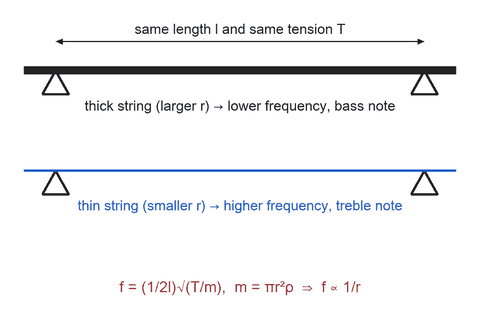
Watch out: A THICKER string gives a LOWER note, not a higher one.
Therefore, strings of different thickness are provided because the frequency of a string is inversely proportional to its thickness, so thick strings give low notes and thin strings high notes.
- 824 marks
Question 82
What are damped vibrations ? How do they differ from free vibrations ? Give one example of each.
Solve with AIWritten solution
Solution:
Concept: In a real medium a vibrating body does work against the resistance (friction) of the medium and loses energy, mostly as heat. Its amplitude decreases with time while its frequency stays the natural frequency: these are damped vibrations.
Step 1 — Define damped vibrations.
The vibrations of a body whose amplitude goes on decreasing with time, because of the resistance of the surrounding medium, until the body comes to rest, are called damped vibrations. The energy lost appears as heat.
Step 2 — Say how they differ from free vibrations.
In free (natural) vibrations, which happen in vacuum, the amplitude stays constant; in damped vibrations, which happen in a real medium, the amplitude decreases with time. The frequency is the natural frequency in both.
Step 3 — Give one example of each.
Free: a simple pendulum swinging in vacuum. Damped: a simple pendulum swinging in air, or a tuning fork vibrating in air, whose swings or sound slowly die away.
Watch out: Damping changes the amplitude, not the frequency.
Therefore, damped vibrations have a decreasing amplitude because of the medium's resistance, while free vibrations have a constant amplitude; a pendulum in air is damped, a pendulum in vacuum is free.
- 834 marks
Question 83
The diagram in Fig. 7.13 shows the displacement-time graph of a vibrating body.
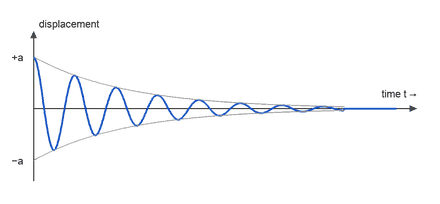
(i) Name the kind of vibrations.
(ii) Give one example of such vibrations.
(iii) Why is the amplitude of vibrations gradually decreasing ?
(iv) What happens to the vibrations of the body after some time ?
Solve with AIWritten solution
Solution:
Concept: The graph shows vibrations whose time period stays the same while the height of the waves becomes smaller and smaller. In a real medium a vibrating body does work against the resistance (friction) of the medium and loses energy, mostly as heat. Its amplitude decreases with time while its frequency stays the natural frequency: these are damped vibrations.
(i) Kind of vibrations
Step 1 — Name them.
The amplitude decreases with time, so these are damped vibrations.
(ii) One example
Step 2 — Give an example.
A simple pendulum oscillating in air, or a tuning fork vibrating in air.
(iii) Why the amplitude decreases
Step 3 — Explain.
The body has to overcome the resistance of the surrounding medium. In each vibration it loses some energy, mostly as heat, so it cannot move as far from its mean position, and its amplitude decreases.
(iv) After some time
Step 4 — Say what happens.
When all its energy is used up, the vibrations die out and the body comes to rest at its mean position.
Therefore, (i) damped vibrations, (ii) a pendulum swinging in air, (iii) energy is lost against the resistance of the medium, and (iv) the vibrations die out and the body comes to rest.
- 843 marks
Question 84
Draw a sketch showing displacement against time for a body executing damped vibrations.
Solve with AIWritten solution
Solution:
Concept: In a real medium a vibrating body does work against the resistance (friction) of the medium and loses energy, mostly as heat. Its amplitude decreases with time while its frequency stays the natural frequency: these are damped vibrations.
Step 1 — Draw the axes.
Draw displacement on the vertical axis and time on the horizontal axis.
Step 2 — Draw the curve.
Draw a wave whose crests and troughs get smaller one after another, while the spacing between them (the time period) stays the same. It ends on the time axis when the body comes to rest.
Step 3 — Show the envelope.
The thin outline joining the crests (the envelope) slopes down towards zero, showing the falling amplitude.
Watch out: Keep the spacing of the crests equal; only the height falls.
Therefore, the sketch is a wave of constant period whose amplitude decreases steadily to zero.
- 855 marks
Question 85
What is meant by resonance ? Describe a simple experiment to illustrate the phenomenon of resonance and explain it.
Solve with AIWritten solution
Solution:
Concept: Resonance is the special case of forced vibrations in which the frequency of the applied periodic force is equal to the natural frequency of the body. The body then takes in energy most easily and vibrates with a very large amplitude, so a loud sound is heard.
Step 1 — Define resonance.
When a body is made to vibrate by an external periodic force whose frequency is equal to its natural frequency, it begins to vibrate with a large amplitude. This phenomenon is called resonance.
Step 2 — Set up the experiment.
Take two tuning forks A and B of the same frequency, mounted on two hollow sound boxes with the open ends of the boxes facing each other. Strike fork A, and after a few seconds stop it by touching its prongs.
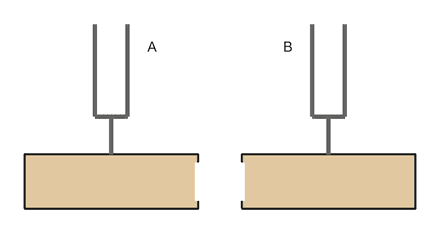
Step 3 — Observe.
A sound is still heard: fork B has started vibrating on its own.
Step 4 — Explain.
The vibrations of A travel through the air in the boxes to B as a periodic force. This force has the same frequency as B's natural frequency, so B resonates: it takes in energy and vibrates with a large amplitude, producing an audible sound.
Check: Stick a little wax on one prong of B, so that its frequency changes; B then no longer responds noticeably. This shows that equal frequencies are needed.
The same can be shown with pendulums of equal length hung from one elastic string.
Watch out: Stop fork A before listening; otherwise you cannot tell whether the sound comes from A or B.
Therefore, resonance is the large-amplitude vibration of a body driven at its natural frequency; it is shown by a second tuning fork of the same frequency starting to vibrate when the first is sounded.
- 864 marks
Question 86
Fig. 7.14 shows two tuning forks A and B of the same frequency mounted on two separate sound boxes with their open ends facing each other. The fork A is set into vibration. (a) Describe your observation. (b) State the principle illustrated by this experiment.
Solve with AIWritten solution
Solution:
Concept: Forks A and B have the same frequency, so the natural frequency of B equals the frequency of the periodic force that reaches it from A. Resonance is the special case of forced vibrations in which the frequency of the applied periodic force is equal to the natural frequency of the body. The body then takes in energy most easily and vibrates with a very large amplitude, so a loud sound is heard.
(a) Observation
Step 1 — Describe what is seen.
After a few seconds fork B also starts vibrating and gives a sound. This is clear if fork A is stopped by touching it: the sound from B can still be heard.
Step 2 — Say how B is driven.
The vibrations of A pass through the air in the facing sound boxes and push B periodically at A's frequency.
(b) Principle
Step 3 — Name the principle.
The principle is resonance: a body set vibrating by a periodic force of frequency equal to its natural frequency vibrates with a large amplitude.
Therefore, (a) fork B starts vibrating and sounding, and (b) the principle is resonance.
- 874 marks
Question 87
In Fig. 7.15, A, B, C and D are four pendulums suspended from the same elastic string XY. The lengths of pendulum A and D are equal, while the length of pendulum B is shorter and of the pendulum C is longer. Pendulum A is set into vibrations.
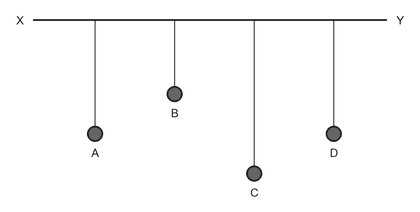
(a) What is your observation about the vibrations of pendulum D ? (b) Give reason for your observation in part (a). (c) What type of vibrations take place in pendulums B and C ? (d) Give reason for the answer in part (c).
Solve with AIWritten solution
Solution:
Concept: The natural frequency of a pendulum depends on its length. Through the elastic string XY, pendulum A pushes every other pendulum periodically at A's frequency.
(a) Observation about D
Step 1 — Describe D.
Pendulum D starts vibrating with a large amplitude, almost as large as A's.
(b) Reason
Step 2 — Explain D.
A and D have the same length, so they have the same natural frequency. A's vibrations reach D through the string XY as a periodic force whose frequency equals D's natural frequency, so D resonates.
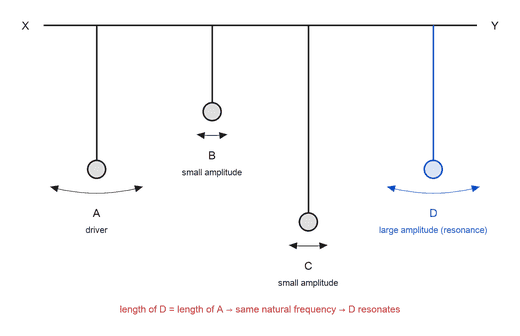
(c) Vibrations of B and C
Step 3 — Name them.
B and C execute forced vibrations, with a small amplitude.
(d) Reason
Step 4 — Explain B and C.
B is shorter and C is longer than A, so their natural frequencies differ from the frequency of the force applied by A. They are forced to vibrate at A's frequency, but they take in little energy, so their amplitude stays small.
Watch out: B and C vibrate at A's frequency (forced), not at their own natural frequencies.
Therefore, (a) D vibrates with a large amplitude, (b) because it has the same length and natural frequency as A (resonance), (c) B and C make forced vibrations of small amplitude, (d) because their natural frequencies differ from A's.
- 883 marks
Question 88
A vibrating tuning fork, held over an air column of a given length with its one end closed, produces a loud audible sound. Name the phenomenon responsible for it and explain the observation.
Solve with AIWritten solution
Solution:
Concept: An air column closed at one end has a natural frequency that depends on its length. Resonance is the special case of forced vibrations in which the frequency of the applied periodic force is equal to the natural frequency of the body. The body then takes in energy most easily and vibrates with a very large amplitude, so a loud sound is heard.
Step 1 — Name the phenomenon.
The phenomenon is resonance.
Step 2 — See what the fork does.
The vibrating fork pushes the air at the mouth of the column periodically, at the fork's frequency.
Step 3 — Explain the loud sound.
The length of the column is such that its natural frequency equals the frequency of the fork, so the air column resonates and vibrates with a large amplitude. The large vibrating air column sends a large amount of sound energy into the air, so a loud sound is heard.

Step 4 — Compare other lengths.
At other lengths the air column is only forced to vibrate feebly, and the sound is faint.
Therefore, the loud sound is due to resonance: the natural frequency of the air column equals the frequency of the tuning fork.
- 895 marks
Question 89
In Fig. 7.16, A, B, C and D represent the test tubes each of height 20 cm which are filled with water up to heights of 12 cm, 14 cm, 16 cm and 18 cm respectively. If a vibrating tuning fork is placed over the mouth of test tube D, a loud sound is heard.
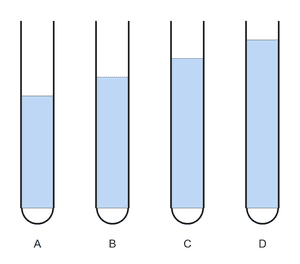
(a) Describe the observations with the tubes A, B and C when the vibrating tuning fork is placed over the mouth of each of these tubes.
(b) Give the reason for your observation in each tube.
(c) State the principle illustrated by the above experiment.
Solve with AIWritten solution
Solution:
Concept: Each tube is closed at the bottom by the water, so its air column is closed at one end. Such a column resonates with a fork when its length is λ/4, 3λ/4, 5λ/4, … (an ODD number of quarter wavelengths), where λ is the wavelength of the fork's sound.
Step 1 — Find the air columns.
Each tube is 20 cm high, so subtract the height of the water.
Step 2 — Find the wavelength from tube D.
D gives a loud sound in its simplest mode, so its 2 cm air column is a quarter wavelength.
(a) Observations
Step 3 — State what is heard.
A loud sound is heard with tube B as well. No loud sound is heard with tubes A and C.
(b) Reasons
Step 4 — Tube B.
The 6 cm column is three quarter wavelengths (3λ/4). Its second mode has a frequency equal to that of D's air column, that is, of the fork, so B also resonates.
Step 5 — Tubes A and C.
The 8 cm column (= λ, four quarters) and the 4 cm column (= λ/2, two quarters) are even numbers of quarter wavelengths, so neither has a natural frequency equal to the fork's. They make only feeble forced vibrations.
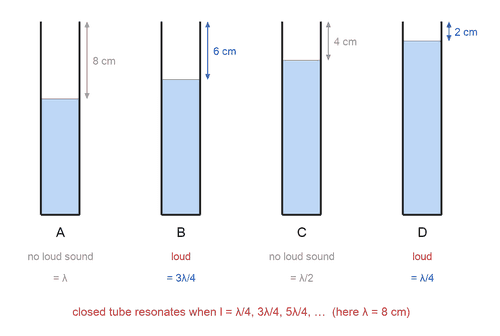
(c) Principle
Step 6 — State the principle.
The principle is resonance: when the natural frequency of the air column equals the frequency of the vibrating tuning fork, the air column vibrates with a large amplitude and a loud sound is heard.
Watch out: A column closed at one end resonates only at ODD multiples of λ/4; λ/2 and λ do not work.
Note: This uses the simple air-column rule without the end correction, as the book does. In a real tube the resonance in B would be weaker, because the open end adds a little to the effective length of each column.
Therefore, (a) a loud sound is heard with B but not with A and C, (b) because B's 6 cm column is 3λ/4 while A's 8 cm (λ) and C's 4 cm (λ/2) are not odd multiples of λ/4, and (c) the principle is resonance.
- 901 mark
Question 90
The intensity of a sound wave in air is proportional to the :
Solve with AIAnswer
(A) square of amplitude of vibrations
(B) square of frequency of vibrations
(C) density of air
- Correct
(D) all of the above
Answer: (D) all of the above
Concept: Intensity is the sound energy passing per second through a unit area held normal to the direction of the wave. Anything that makes the wave carry more energy each second raises its intensity.
Step 1 — Recall the book's factors.
The book states that the intensity of a sound wave in air is proportional to the square of the amplitude, the square of the frequency, the density of air and the speed of sound in air.
Step 2 — Match the options.
Each of (A), (B) and (C) is one of these factors, so the complete answer is 'all of the above'.
Watch out: Each single factor is true but incomplete; the question asks what the intensity is proportional to, and all three apply.
Why the other options are wrong:
- (A) square of amplitude of vibrations: the square of the amplitude is a correct factor, but the frequency and the density matter too.
- (B) square of frequency of vibrations: the square of the frequency is a correct factor, but the amplitude and the density matter too.
- (C) density of air: the density of air is a correct factor, but the amplitude and the frequency matter too.
Therefore, the intensity is proportional to all of these, option (D).
- 911 mark
Question 91
For normal ears, sensitivity is maximum at the frequency :
Solve with AIAnswer
(A) 5 kHz
(B) 10 kHz
- Correct
(C) 1 kHz
(D) 500 Hz
Answer: (C) 1 kHz
Concept: Loudness is subjective: it depends on the intensity and also on how sensitive the ear is. The ear is not equally sensitive to all frequencies.
Step 1 — Recall the book's value.
The book states that, for normal ears, the sensitivity is maximum at about 1 kHz, in the middle of the audible range of 20 Hz to 20 kHz.
Step 2 — See what it means.
So two sounds of the same intensity but different frequencies can seem different in loudness to the same listener.
Watch out: For the ICSE exam use the book's value of 1 kHz.
Note: Measurements of human hearing put the most sensitive region a little higher, at about 2 kHz to 5 kHz; the book's simpler value of 1 kHz is the key kept here.
Why the other options are wrong:
- (A) 5 kHz: 5 kHz is not the value the book gives for the ear's greatest sensitivity.
- (B) 10 kHz: 10 kHz is not the book's value; the ear becomes less sensitive towards its upper limit of 20 kHz.
- (D) 500 Hz: 500 Hz is below the book's value; the ear is less sensitive at low frequencies.
Therefore, for normal ears the sensitivity is maximum at 1 kHz (the book's value), option (C).
- 921 mark
Question 92
By reducing the amplitude of a sound wave, its :
Solve with AIAnswer
(A) pitch decreases
- Correct
(B) loudness decreases
(C) loudness increases
(D) pitch increases
Answer: (B) loudness decreases
Concept: Loudness depends on the amplitude of the wave: loudness ∝ (amplitude)². A body vibrating with a larger amplitude sends more energy into the medium, so the sound is louder. Pitch depends only on the frequency.
Step 1 — See what a smaller amplitude does.
A smaller amplitude means the wave carries less energy to the ear, so the sound is softer: its loudness decreases.
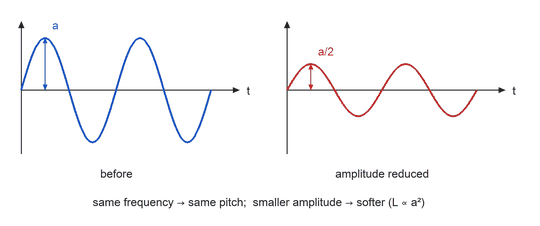
Step 2 — See what does not change.
Reducing the amplitude does not change the number of vibrations per second, so the frequency, and with it the pitch, stays the same.
Watch out: Amplitude and pitch are independent; a softer note can still be shrill.
Why the other options are wrong:
- (A) pitch decreases: pitch depends on frequency, not on amplitude, so it does not decrease.
- (C) loudness increases: loudness increases only when the amplitude is INCREASED; this is the opposite.
- (D) pitch increases: pitch depends on frequency, not on amplitude, so it does not increase either.
Therefore, reducing the amplitude decreases the loudness, option (B).
- 931 mark
Question 93
Sounds above ............... are termed as noise pollution.
Solve with AIAnswer
(A) 75 dB
- Correct
(B) 120 dB
(C) 100 dB
(D) 80 dB
Answer: (B) 120 dB
Concept: The sound level is measured in decibel (dB): L = 10 log₁₀(I ÷ I₀) dB, where I₀ = 10⁻¹² W m⁻² is the faintest sound a normal ear can hear (0 dB, the threshold of hearing). The book takes 0 to 80 dB as safe for our ears and sound above 120 dB as noise pollution.
Step 1 — Recall the book's definition.
Noise pollution is the disturbance caused in the environment by undesirable, loud and harsh sound. The book puts it at sound levels above 120 dB, from sources such as loudspeakers, sirens and moving vehicles.
Step 2 — Place the options on the scale.
The safe limit for our ears is 0 to 80 dB, and a police siren is about 120 dB.
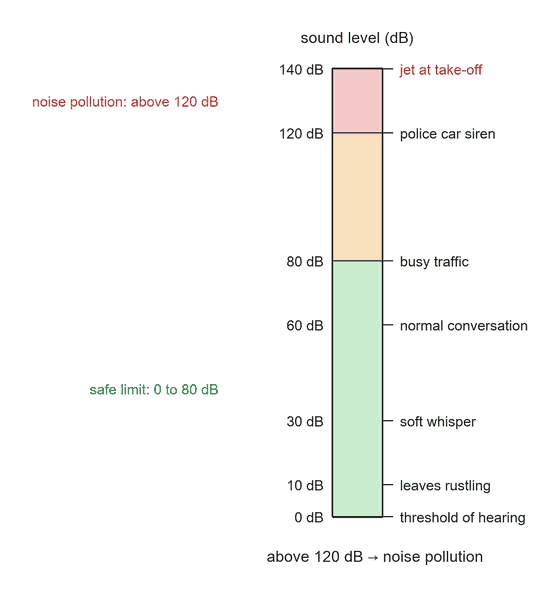
Watch out: 80 dB is the upper end of the SAFE range in the book; noise pollution begins above 120 dB.
Why the other options are wrong:
- (A) 75 dB: 75 dB lies inside the book's safe limit of 0 to 80 dB.
- (C) 100 dB: 100 dB is loud, but it is below the book's 120 dB level for noise pollution.
- (D) 80 dB: 80 dB is the top of the book's safe limit, not the start of noise pollution.
Therefore, sounds above 120 dB are termed noise pollution, option (B).
- 941 mark
Question 94
Two sounds of the same loudness and same pitch produced by two different instruments differ in their:
Solve with AIAnswer
(A) amplitudes
(B) frequencies
- Correct
(C) waveforms
(D) all of the above
Answer: (C) waveforms
Concept: Each characteristic of a sound depends on one property of its wave: loudness on amplitude, pitch on frequency and quality on waveform.
Step 1 — Use 'same loudness'.
The same loudness means the two sounds have the same amplitude.
Step 2 — Use 'same pitch'.
The same pitch means they have the same frequency.
Step 3 — Find what is left.
We can still tell the instruments apart, so the sounds differ in quality. Quality depends on the waveform, which is set by the subsidiary notes each instrument produces with its principal note.

Why the other options are wrong:
- (A) amplitudes: the amplitudes are equal, because the loudness is the same.
- (B) frequencies: the frequencies are equal, because the pitch is the same.
- (D) all of the above: only the waveform differs, so 'all of the above' is wrong.
Therefore, the two sounds differ in their waveforms, option (C).
- 951 mark
Question 95
Instruments A and B are producing sounds of the same amplitude, same waveform but frequencies F and 2F respectively. Which of the following statements is correct ?
Solve with AIAnswer
(A) both A and B differ in quality
(B) B is grave but A is shrill
- Correct
(C) A is grave but B is shrill
(D) B is louder than A
Answer: (C) A is grave but B is shrill
Concept: Pitch is the characteristic by which a shrill (acute) note is told apart from a grave (flat) note of the same loudness and quality. It depends on the frequency: the higher the frequency, the higher the pitch. A low-pitched sound is called grave (flat); a high-pitched one shrill.
Step 1 — Compare the frequencies.
A vibrates at frequency F and B at 2F, so in the same time B completes twice as many vibrations as A.

Step 2 — Compare the pitch.
B has the higher frequency, so B is shrill; A has the lower frequency, so A is grave.
Step 3 — Check the other properties.
The same amplitude means the same loudness, and the same waveform means the same quality.
Why the other options are wrong:
- (A) both A and B differ in quality: the waveforms are the same, so the quality is the same.
- (B) B is grave but A is shrill: it reverses grave and shrill: the higher frequency (B) gives the shrill sound.
- (D) B is louder than A: the amplitudes are the same, so the loudness is the same.
Therefore, A is grave but B is shrill, option (C).
- 961 mark
Question 96
Which of the following statements is incorrect with respect to music ?
Solve with AIAnswer
(A) It is pleasant to the ears.
- Correct
(B) Its waveform is irregular.
(C) The sound level is low.
(D) It is produced by periodic vibrations.
Answer: (B) Its waveform is irregular.
Concept: Music is a pleasant sound produced by regular, periodic vibrations, so its waveform repeats. Noise is an unpleasant sound produced by an irregular succession of disturbances, so its waveform has no repeating shape.
Step 1 — Look at the waveform of music.
The vibrations that produce music are periodic, so the same shape repeats again and again: the waveform of music is regular.
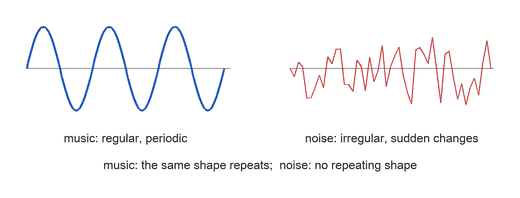
Step 2 — Find the incorrect statement.
An irregular waveform is the mark of noise, not of music, so statement (B) is the incorrect one.
Watch out: The question asks for the INCORRECT statement; the other three are true.
Why the other options are wrong:
- (A) It is pleasant to the ears: music is pleasant to the ears, so this statement is correct and is not the answer.
- (C) The sound level is low: the book describes music as having a low (comfortable) sound level, so this statement is correct and is not the answer.
- (D) It is produced by periodic vibrations: music is produced by periodic vibrations, so this statement is correct and is not the answer.
Therefore, the incorrect statement about music is that its waveform is irregular, option (B).
- 971 mark
Question 97
Out of the following, which instrument emits a monotone ?
Solve with AIAnswer
(A) guitar
(B) flute
(C) piano
- Correct
(D) tuning fork
Answer: (D) tuning fork
Concept: A monotone is a note of a single frequency (a pure tone); its waveform is a simple sine curve.
Step 1 — Recall the book's example.
The book states that a tuning fork emits a sound of a single frequency.
Step 2 — Compare the instruments.
A musical instrument produces a principal (fundamental) note together with subsidiary notes of higher frequencies. Their sum gives a complex waveform, not a sine curve.

Why the other options are wrong:
- (A) guitar: a guitar string produces subsidiary notes with its principal note, so it is not a monotone.
- (B) flute: a flute produces a few subsidiary notes with its principal note, so it is not a monotone either.
- (C) piano: a piano produces many subsidiary notes with its principal note, so it is not a monotone.
Therefore, the tuning fork emits a monotone, option (D).
- 981 mark
Question 98
The pitch of a note depends on :
Solve with AIAnswer
- Correct
(A) frequency
(B) amplitude
(C) waveform
(D) loudness
Answer: (A) frequency
Concept: Pitch is the characteristic by which a shrill (acute) note is told apart from a grave (flat) note of the same loudness and quality. It depends on the frequency: the higher the frequency, the higher the pitch.
Step 1 — State the factor.
Pitch depends on the frequency of the note: the higher the frequency, the higher the pitch.
Step 2 — Give an example.
A fork of 512 Hz sounds shriller than a fork of 256 Hz.
Why the other options are wrong:
- (B) amplitude: amplitude decides the loudness, not the pitch.
- (C) waveform: waveform decides the quality, not the pitch.
- (D) loudness: loudness is itself a separate characteristic; changing it does not change the pitch.
Therefore, the pitch of a note depends on its frequency, option (A).
- 991 mark
Question 99
The voice of a woman is of ........... pitch than that of a man.
Solve with AIAnswer
(A) lower
- Correct
(B) higher
(C) equal
(D) cannot say
Answer: (B) higher
Concept: Pitch is the characteristic by which a shrill (acute) note is told apart from a grave (flat) note of the same loudness and quality. It depends on the frequency: the higher the frequency, the higher the pitch.
Step 1 — Compare the vocal cords.
A woman's vocal cords are usually shorter and thinner than a man's, so they vibrate with a higher frequency.
Step 2 — Compare the pitch.
A higher frequency means a higher pitch, so a woman's voice is usually shriller than a man's. The book gives this as an example of a difference in pitch.
Why the other options are wrong:
- (A) lower: it is the opposite: a man's voice is the grave, lower-pitched one.
- (C) equal: the vocal cords vibrate at different frequencies, so the pitches are not equal.
- (D) cannot say: the book states that a woman's voice is usually of higher pitch, so we can say.
Therefore, the voice of a woman is of higher pitch than that of a man, option (B).
- 1001 mark
Question 100
The quality of a musical sound depends on :
Solve with AIAnswer
(A) number of subsidiary notes
(B) relative amplitudes
- Correct
(C) both (A) and (B)
(D) none of the above
Answer: (C) both (A) and (B)
Concept: Quality (timbre) is the characteristic by which two sounds of the same loudness and pitch are told apart. It depends on the waveform, which is set by the subsidiary notes produced with the principal note and by their relative amplitudes. The subsidiary notes have frequencies that are whole-number multiples of the principal frequency, and smaller amplitudes.
Step 1 — Change the number of subsidiary notes.
If an instrument adds a different number of subsidiary notes, the resultant waveform changes.
Step 2 — Change their relative amplitudes.
Even with the same subsidiary notes, different relative amplitudes give a different resultant waveform.
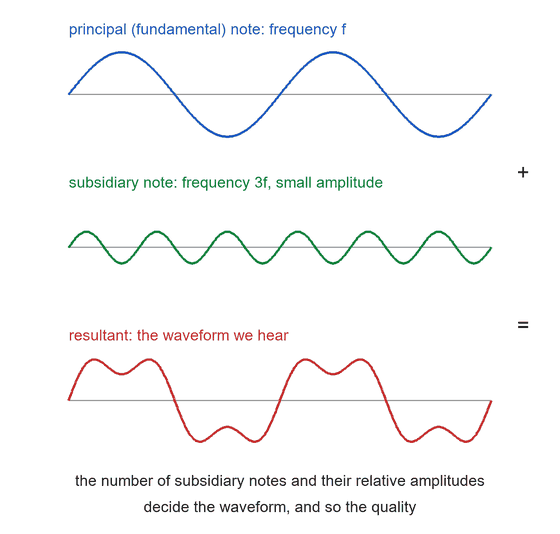
Step 3 — Conclude.
So the quality depends on both, which is what the book states.
Why the other options are wrong:
- (A) number of subsidiary notes: the number of subsidiary notes alone is only half of the rule.
- (B) relative amplitudes: the relative amplitudes alone are only half of the rule.
- (D) none of the above: both factors decide the waveform, so 'none of the above' is wrong.
Therefore, the quality depends on both the number of subsidiary notes and their relative amplitudes, option (C).
- 1011 mark
Question 101
Which statement about sound waves is incorrect ?
Solve with AIAnswer
(A) Sound waves can be reflected, refracted and transmitted.
(B) High pitch sound waves have a high frequency.
- Correct
(C) Quiet sound waves have a large amplitude.
(D) Sound waves are longitudinal waves.
Answer: (C) Quiet sound waves have a large amplitude.
Concept: Loudness depends on the amplitude of the wave: loudness ∝ (amplitude)². A body vibrating with a larger amplitude sends more energy into the medium, so the sound is louder.
Step 1 — Judge statement (C).
A quiet sound carries little energy, so its amplitude is SMALL, not large. Statement (C) is incorrect.

Step 2 — Check the others.
Statements (A), (B) and (D) are all true, as the bullets below show.
Watch out: The question asks for the INCORRECT statement.
Why the other options are wrong:
- (A) Sound waves can be reflected, refracted and transmitted: sound waves can be reflected (echo), refracted and transmitted, so this statement is correct.
- (B) High pitch sound waves have a high frequency: pitch depends on frequency, so a high-pitch sound does have a high frequency; this statement is correct.
- (D) Sound waves are longitudinal waves: in air the particles vibrate along the direction of travel, so sound waves are longitudinal; this statement is correct.
Therefore, the incorrect statement is that quiet sound waves have a large amplitude, option (C).
- 1021 mark
Question 102
Assertion (A) : When we start filling an empty pitcher with water, the pitch of the sound produced goes on decreasing.
Reason (R) : The pitch of sound increases with an increase in frequency.
Solve with AIAnswer
(A) both A and R are true and R is the correct explanation of A
(B) both A and R are True and R is not the correct explanation of A
- Correct
(C) assertion is false but reason is true
(D) assertion is true but reason is false
Answer: (C) assertion is false but reason is true
Concept: In an assertion–reason item, judge the assertion (A) and the reason (R) separately as true or false, and then decide whether R correctly explains A. The sound from a pitcher being filled comes from the air column above the water; a shorter air column vibrates with a higher frequency.
Step 1 — Judge the assertion.
As water fills the pitcher, the water level rises and the air column above it gets shorter. Its frequency increases, so the pitch goes on INCREASING, not decreasing. The assertion is false.
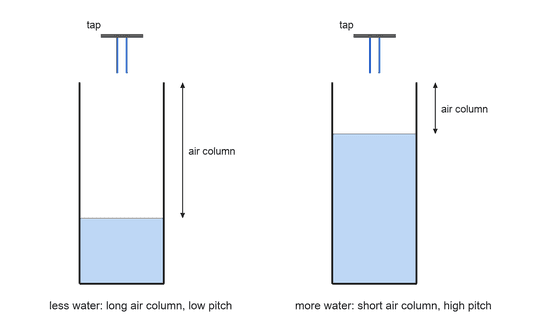
Step 2 — Judge the reason.
Pitch does increase with frequency, so the reason is true.
Step 3 — Pick the option.
A false assertion with a true reason is option (C).
Watch out: The note RISES as the pitcher fills, because the air column gets shorter.
Why the other options are wrong:
- (A) both A and R are true and R is the correct explanation of A: it needs the assertion to be true, but the pitch rises, it does not fall.
- (B) both A and R are True and R is not the correct explanation of A: it also needs the assertion to be true, which it is not.
- (D) assertion is true but reason is false: it has it the wrong way round: here the reason is true and the assertion is false.
Therefore, the assertion is false but the reason is true, option (C).
- 1032 marks
Question 103
(a) Which of the following quantity determines the loudness of a sound wave ?
(i) wavelength, (ii) frequency, and (iii) amplitude.
(b) How is loudness related to the quantity mentioned above in part (a) ?
Solve with AIWritten solution
Solution:
Concept: Each characteristic of a sound depends on one property of its wave: loudness on amplitude, pitch on frequency and quality on waveform.
(a) Quantity
Step 1 — Choose the quantity.
Of the three, amplitude decides how loud a sound is. Frequency decides the pitch, and the wavelength is fixed by the frequency and the medium. So the answer is (iii) amplitude.
(b) Relation
Step 2 — State the relation.
Loudness is proportional to the square of the amplitude.
Step 3 — Give its meaning.
If the amplitude is doubled, the loudness becomes four times.
Watch out: Loudness varies as the SQUARE of the amplitude, not as the amplitude itself.
Therefore, (a) the loudness is determined by (iii) the amplitude, and (b) loudness ∝ (amplitude)².
- 1041 mark
Question 104
If the amplitude of a wave is doubled, what will be the effect on its loudness ?
Solve with AIWritten solution
Solution:
Concept: Loudness depends on the amplitude of the wave: loudness ∝ (amplitude)². A body vibrating with a larger amplitude sends more energy into the medium, so the sound is louder.
Step 1 — Write the ratio.
Loudness ∝ a², so the ratio of the new loudness to the old is the square of the ratio of the amplitudes.
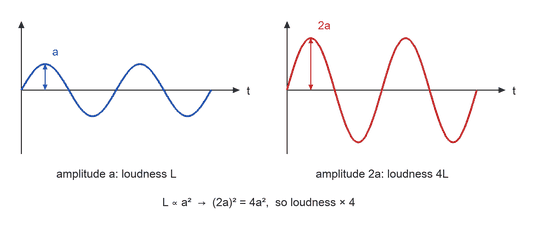
Step 2 — Check the pitch.
The frequency is unchanged, so the pitch does not change.
Watch out: Doubling the amplitude does not merely double the loudness; it makes it four times.
Therefore, if the amplitude is doubled, the loudness becomes four times.
- 1052 marks
Question 105
Two waves of the same pitch have amplitudes in the ratio 1 : 3. What will be the ratio of their (i) loudness, and (ii) frequencies ?
Solve with AIWritten solution
Solution:
Concept: Loudness depends on the amplitude of the wave: loudness ∝ (amplitude)². A body vibrating with a larger amplitude sends more energy into the medium, so the sound is louder. The same pitch means the same frequency.
Given: a₁ : a₂ = 1 : 3
(i) Ratio of loudness
Step 1 — Square the ratio of amplitudes.
The amplitudes are in the ratio 1 : 3, and loudness ∝ a².
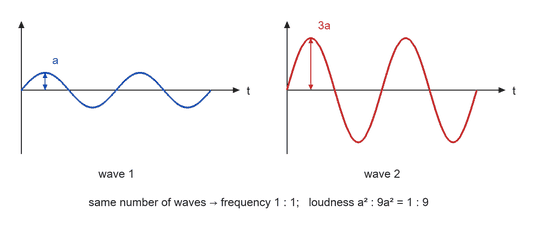
(ii) Ratio of frequencies
Step 2 — Use 'same pitch'.
The two waves have the same pitch, so they have the same frequency, and the ratio is 1 : 1.
Watch out: Square the amplitude ratio; 1 : 3 is the amplitude ratio, not the loudness ratio.
Therefore, (i) the loudness ratio is 1 : 9, and (ii) the frequency ratio is 1 : 1.
- 1061 mark
Question 106
Name the unit in which loudness of sound is measured.
Solve with AIWritten solution
Solution:
Concept: Loudness is the sensation of how loud a sound seems to a listener, so it is expressed by comparing the sound with a standard sound.
Step 1 — Name the unit.
The unit of loudness is the phon.
Step 2 — Say what it means.
The loudness of a sound in phon equals the sound level, in decibel, of a pure 1 kHz note that seems equally loud. (The sound level itself is expressed in decibel, dB.)
Watch out: Do not mix up loudness (phon) with sound level (decibel).
Therefore, loudness is measured in phon.
- 1071 mark
Question 107
Name the unit used to measure the sound level.
Solve with AIWritten solution
Solution:
Concept: The sound level is measured in decibel (dB): L = 10 log₁₀(I ÷ I₀) dB, where I₀ = 10⁻¹² W m⁻² is the faintest sound a normal ear can hear (0 dB, the threshold of hearing). The book takes 0 to 80 dB as safe for our ears and sound above 120 dB as noise pollution.
Step 1 — Name the unit.
The sound level is measured in decibel (dB).
Step 2 — Give the formula.
The sound level of a sound of intensity I is given by
where I₀ = 10⁻¹² W m⁻² is the faintest sound we can hear at 1 kHz.
Step 3 — Note the name.
The unit is named after Alexander Graham Bell; one bel is 10 dB.
Therefore, the sound level is measured in decibel (dB).
- 1081 mark
Question 108
What is the safe limit of sound level in dB for our ears ?
Solve with AIWritten solution
Solution:
Concept: The sound level is measured in decibel (dB): L = 10 log₁₀(I ÷ I₀) dB, where I₀ = 10⁻¹² W m⁻² is the faintest sound a normal ear can hear (0 dB, the threshold of hearing). The book takes 0 to 80 dB as safe for our ears and sound above 120 dB as noise pollution.
Step 1 — State the safe limit.
The safe limit of sound level for our ears is 0 to 80 dB.
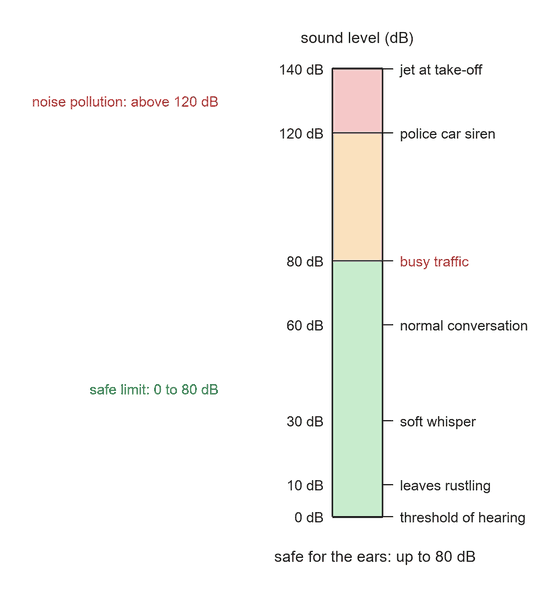
Step 2 — Say what lies beyond.
Sounds above this, heard for a long time, can harm the ears; sound above 120 dB is noise pollution and can cause headache and permanent damage to hearing.
Therefore, the safe limit of sound level for our ears is 0 to 80 dB.
- 1091 mark
Question 109
Name the subjective property of sound related to its frequency.
Solve with AIWritten solution
Solution:
Concept: A subjective property depends on the sensation of the listener; an objective quantity can be measured by an instrument.
Step 1 — Name the property.
The subjective property related to frequency is pitch.
Step 2 — Explain.
Pitch is the sensation of shrillness felt by a listener and may differ from listener to listener, while frequency is the measurable quantity it depends on. The higher the frequency, the higher the pitch.
Therefore, the subjective property of sound related to its frequency is pitch.
- 1101 mark
Question 110
The frequencies of notes given by flute, guitar and trumpet are respectively 400 Hz, 200 Hz and 500 Hz. Which one of these has the highest pitch ?
Solve with AIWritten solution
Solution:
Concept: Pitch is the characteristic by which a shrill (acute) note is told apart from a grave (flat) note of the same loudness and quality. It depends on the frequency: the higher the frequency, the higher the pitch.
Step 1 — Order the frequencies.
Put the three frequencies in order: guitar 200 Hz, flute 400 Hz, trumpet 500 Hz.
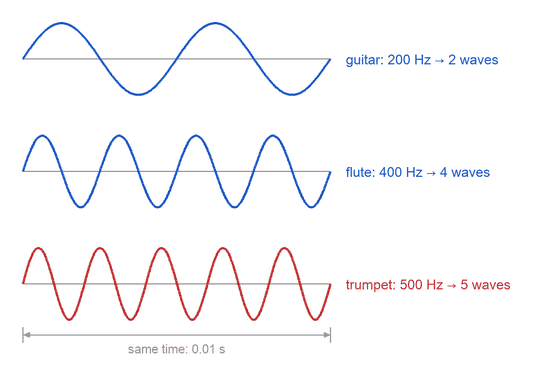
Step 2 — Pick the highest pitch.
The trumpet has the highest frequency, so it has the highest pitch.
Therefore, the trumpet (500 Hz) has the highest pitch.
- 1112 marks
Question 111
Complete the following sentences :
(a) The pitch of sound increases if its frequency ...............................................
(b) If the amplitude of a sound is halved, its loudness becomes .............................
Solve with AIWritten solution
Solution:
Concept: Pitch rises with frequency, and loudness is proportional to the square of the amplitude.
(a)
Step 1 — Complete the first sentence.
The pitch of sound increases if its frequency increases.
(b)
Step 2 — Work out the loudness.
Loudness ∝ a², so halving the amplitude gives
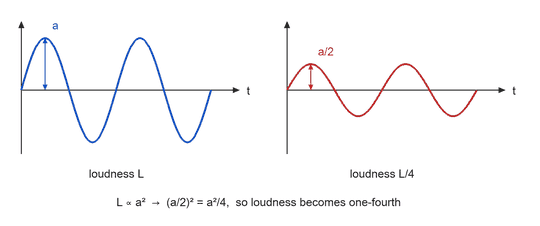
Step 3 — Complete the second sentence.
If the amplitude of a sound is halved, its loudness becomes one-fourth.
Watch out: Halving the amplitude makes the loudness a QUARTER, not a half.
Therefore, (a) the frequency increases, and (b) the loudness becomes one-fourth.
- 1121 mark
Question 112
Name the characteristic which enables one to distinguish the sound of two musical instruments even if they are of the same pitch and same loudness.
Solve with AIWritten solution
Solution:
Concept: Quality (timbre) is the characteristic by which two sounds of the same loudness and pitch are told apart. It depends on the waveform, which is set by the subsidiary notes produced with the principal note and by their relative amplitudes.
Step 1 — Use the given facts.
The same pitch means the same frequency, and the same loudness means the same amplitude.
Step 2 — Find what differs.
Each instrument produces its own set of subsidiary notes with the principal note, so their waveforms differ. The characteristic that depends on the waveform is quality (timbre).
Therefore, the characteristic is the quality (timbre) of the sound.
- 1131 mark
Question 113
Which characteristic of sound makes it possible to recognise a person by his voice without seeing him?
Solve with AIWritten solution
Solution:
Concept: Quality (timbre) is the characteristic by which two sounds of the same loudness and pitch are told apart. It depends on the waveform, which is set by the subsidiary notes produced with the principal note and by their relative amplitudes.
Step 1 — Name the characteristic.
We recognise a person by the quality (timbre) of his voice.
Step 2 — Explain.
The vocal cords of each person produce a voice with its own characteristic waveform, so we can recognise him, for example on the telephone, without seeing him.
Therefore, the quality (timbre) of sound makes it possible to recognise a person by his voice.
- 1142 marks
Question 114
State the factor that determines
(i) the pitch of a note,
(ii) the loudness of the sound heard, and
(iii) the quality of the note.
Solve with AIWritten solution
Solution:
Concept: Each characteristic of a sound depends on one property of its wave: loudness on amplitude, pitch on frequency and quality on waveform.
(i) Pitch
Step 1 — Factor for pitch.
The pitch of a note depends on its frequency: the higher the frequency, the higher the pitch.
(ii) Loudness
Step 2 — Factor for loudness.
The loudness depends on the amplitude of the wave: loudness ∝ (amplitude)².
(iii) Quality
Step 3 — Factor for quality.
The quality depends on the waveform, which is set by the number of subsidiary notes and their relative amplitudes.
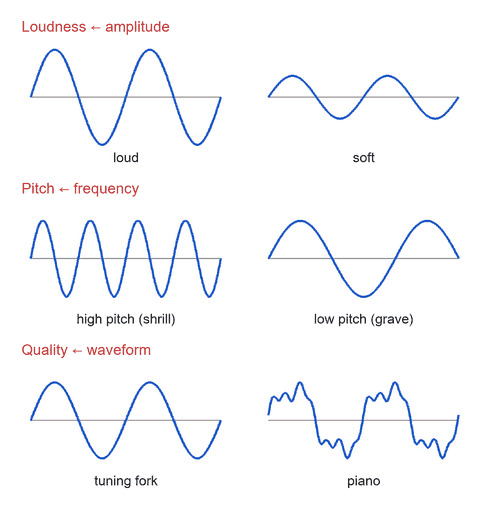
Therefore, (i) pitch depends on frequency, (ii) loudness on amplitude, and (iii) quality on waveform.
- 1152 marks
Question 115
Name the characteristic of sound affected due to a change in its (i) amplitude, (ii) wave form, and (iii) frequency.
Solve with AIWritten solution
Solution:
Concept: Each characteristic of a sound depends on one property of its wave: loudness on amplitude, pitch on frequency and quality on waveform. A change in a wave property changes the characteristic that depends on it.
(i) Amplitude
Step 1 — Change of amplitude.
A change in amplitude changes the loudness: a bigger amplitude gives a louder sound.
(ii) Waveform
Step 2 — Change of waveform.
A change in waveform changes the quality: the sound seems to come from a different source.
(iii) Frequency
Step 3 — Change of frequency.
A change in frequency changes the pitch: a higher frequency gives a shriller sound.
Therefore, (i) amplitude affects loudness, (ii) waveform affects quality, and (iii) frequency affects pitch.
- 1162 marks
Question 116
Sketches I to IV in Fig. 7.24 show sound waves, all formed in the same time interval.
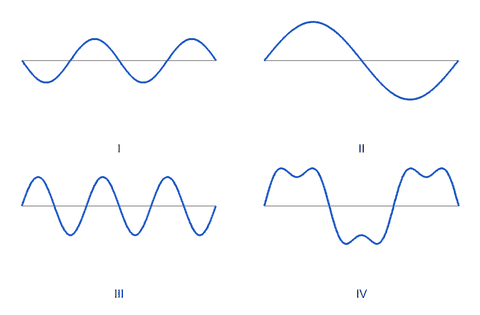
Which diagram shows
(i) a note from a musical instrument,
(ii) a soft (or feeble) note,
(iii) a bass (or low frequency) note.
Solve with AIWritten solution
Solution:
Concept: All four sketches cover the same time. So more waves means a higher frequency (higher pitch), lower crests mean a smaller amplitude (softer note), and a waveform that is not a simple sine curve means the note contains subsidiary notes, as from a musical instrument.
(i) A note from a musical instrument
Step 1 — Find the instrument's note.
Sketch IV is not a sine curve: the subsidiary notes added to the principal note give it extra humps. So it is IV.
(ii) A soft (feeble) note
Step 2 — Find the soft note.
Sketch I has the lowest crests, so it has the smallest amplitude, and loudness depends on amplitude. So it is I.
(iii) A bass (low frequency) note
Step 3 — Find the bass note.
Sketch II completes only one wave in the time in which I completes two and III three, so it has the lowest frequency. So it is II.
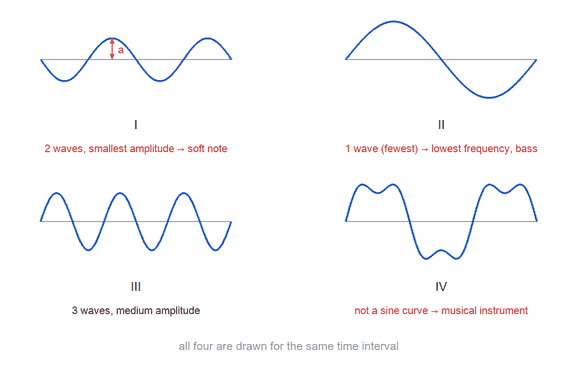
Watch out: Count the waves in the SAME time interval to compare frequencies; do not judge by the width of the sketch.
Therefore, (i) IV, (ii) I, and (iii) II.
- 1172 marks
Question 117
Fig. 7.25 shows wave patterns of three sounds A, B and C. Name the characteristic of sound which is the same between (i) A and B, (ii) B and C, and (iii) C and A.
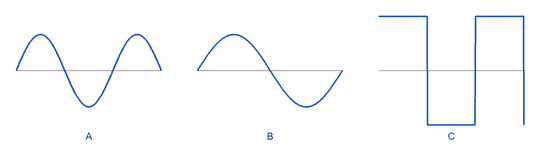 Solve with AI
Written solution
Solution:
Concept: Compare one wave property at a time: amplitude (height of the crests) decides loudness, the number of waves in the same time decides frequency and so pitch, and the shape of the wave decides quality.
Step 1 — Read the figure.
A is a sine wave of amplitude a with 1.5 waves; B is a sine wave of amplitude a with 1 wave; C is a square wave of larger amplitude with 1.5 waves.
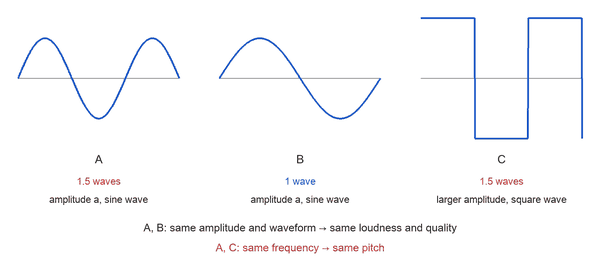
(i) A and B
Step 2 — Compare A and B.
They have the same amplitude and the same sine waveform, so the same loudness and quality. Their frequencies differ, so their pitch differs.
(ii) B and C
Step 3 — Compare B and C.
They differ in amplitude, in the number of waves and in shape, so no characteristic is the same.
(iii) C and A
Step 4 — Compare C and A.
They have the same number of waves in the same time, so the same frequency and the same pitch.
Therefore, (i) A and B have the same loudness and quality, (ii) B and C have no characteristic in common, and (iii) C and A have the same pitch.
- 1182 marks
Question 118
Name three characteristics of a musical sound.
Solve with AIWritten solution
Solution:
Concept: Each characteristic of a sound depends on one property of its wave: loudness on amplitude, pitch on frequency and quality on waveform.
Step 1 — First characteristic.
Loudness, which depends on the amplitude.
Step 2 — Second characteristic.
Pitch (or shrillness), which depends on the frequency.
Step 3 — Third characteristic.
Quality (or timbre), which depends on the waveform.
Therefore, the three characteristics of a musical sound are loudness, pitch and quality.
- 1192 marks
Question 119
Why is the loudness of the sound heard by a plucked wire increased when it is mounted on a sound board ?
Solve with AIWritten solution
Solution:
Concept: Loudness depends on the surface area of the vibrating body: a larger vibrating area sets more air into vibration and sends out more sound energy.
Step 1 — The wire alone.
A thin wire vibrating alone has a very small area, so it moves very little air and its sound is feeble.
Step 2 — The wire on a sound board.
On a sound board, the wire's vibrations are passed to the board, which is forced to vibrate at the same frequency (forced vibrations). The board, and the air enclosed in it, have a much larger surface area, so a much larger mass of air is set vibrating.

Step 3 — The result.
More sound energy reaches the ear, so the sound is louder. This is why stringed instruments have a sound chamber.
Therefore, the sound is louder because the large sound board, forced to vibrate by the wire, sets a much larger mass of air vibrating.
- 1202 marks
Question 120
Define the term intensity of a sound wave. State the unit in which it is measured.
Solve with AIWritten solution
Solution:
Concept: Intensity measures how much sound energy flows through an area each second; it is a measurable (objective) quantity.
Step 1 — Define intensity.
The intensity of a sound wave at a point is the amount of sound energy passing per second normally through a unit area held at that point, normal to the direction in which the wave travels.

Step 2 — State the unit.
Energy per second is power, in watt (joule per second), so the unit is watt per square metre, W m⁻².
Step 3 — Give a sense of size.
Ordinary conversation has an intensity of about 10⁻⁶ W m⁻², while the faintest sound we can hear at 1 kHz has 10⁻¹² W m⁻².
Watch out: The area must be held NORMAL to the direction of the wave.
Therefore, intensity is the sound energy passing per second normally through unit area, measured in W m⁻².
- 1212 marks
Question 121
How is loudness of sound related to the intensity of wave producing it ?
Solve with AIWritten solution
Solution:
Concept: Loudness increases with intensity, but not in the same proportion.
Step 1 — State the relation.
By the Weber–Fechner law, loudness is proportional to the logarithm of the intensity, where K is a constant.
Step 2 — See it in decibels.
In decibels the sound level is written as follows.

Step 3 — Interpret.
Making the intensity 10 times raises the sound level by only 10 dB, and making it 100 times raises it by 20 dB. So a large increase in intensity gives only a small increase in loudness.
Watch out: Loudness is NOT proportional to the intensity itself.
Therefore, the loudness of a sound is proportional to the logarithm of its intensity, L = K log I.
- 1222 marks
Question 122
Comment on the statement 'loudness of sound is of subjective nature, while intensity is of objective nature.'
Solve with AIWritten solution
Solution:
Concept: A quantity is objective if it can be measured and does not depend on who observes it; it is subjective if it depends on the sensation of the observer.
Step 1 — Intensity is objective.
Intensity is the sound energy per second per unit area. It is a measurable physical quantity: an instrument gives the same value whoever reads it.
Step 2 — Loudness is subjective.
Loudness is the sensation produced in the ear. It depends on the intensity and also on the sensitivity of the listener's ears, so a sound of a given intensity may seem loud to one person and soft to another.
Step 3 — An example.
Even for the same listener, two sounds of the same intensity but different frequencies may seem different in loudness, because the ear is not equally sensitive at all frequencies.
Therefore, the statement is correct: intensity is a measured physical quantity, while loudness depends on the listener's ears.
- 1233 marks
Question 123
State three factors which affect the loudness of a sound heard by a listener.
Solve with AIWritten solution
Solution:
Concept: The loudness heard depends on how much sound energy reaches the listener's ear. The book lists five factors; any three are enough.
Step 1 — Amplitude of vibration of the source.
Loudness ∝ (amplitude)². A body vibrating with a greater amplitude sends out more energy, so the sound is louder.
Step 2 — Distance of the listener from the source.
The book gives loudness ∝ 1/(distance)²: the closer the listener, the louder the sound, and at twice the distance it is about one-fourth as loud.
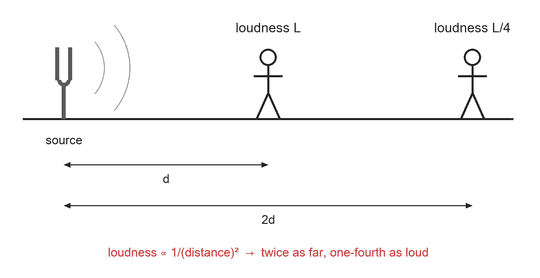
Step 3 — Surface area of the vibrating body.
A larger vibrating area sets more air vibrating, so the sound is louder, as with the big bells of temples.
Step 4 — The other two factors.
The density of the medium (a denser medium gives a louder sound) and the presence of resonant bodies near the source.
Watch out: Strictly, it is the intensity that falls as 1/(distance)² from a small source in open air; loudness follows it.
Therefore, three factors are the amplitude of the source, the distance of the listener from the source and the surface area of the vibrating body.
- 1242 marks
Question 124
The bells of a temple are big in size. Why ?
Solve with AIWritten solution
Solution:
Concept: Loudness depends on the surface area of the vibrating body.
Step 1 — See what a big bell does.
A big bell has a large vibrating surface. When struck, it sets a large mass of the surrounding air vibrating and sends out a large amount of sound energy.
Step 2 — See why that is wanted.
So its sound is loud and can be heard far away, which is what a temple bell is for. School bells are made big for the same reason.
Therefore, temple bells are big so that their large vibrating surface gives a loud sound that carries far.
- 1252 marks
Question 125
What is meant by noise pollution ? Name one source of sound causing noise pollution.
Solve with AIWritten solution
Solution:
Concept: The sound level is measured in decibel (dB): L = 10 log₁₀(I ÷ I₀) dB, where I₀ = 10⁻¹² W m⁻² is the faintest sound a normal ear can hear (0 dB, the threshold of hearing). The book takes 0 to 80 dB as safe for our ears and sound above 120 dB as noise pollution.
Step 1 — Define noise pollution.
Noise pollution is the disturbance produced in the environment by undesirable, loud and harsh sound of level above 120 dB. Constant exposure to it can cause headache and permanent damage to the ears.
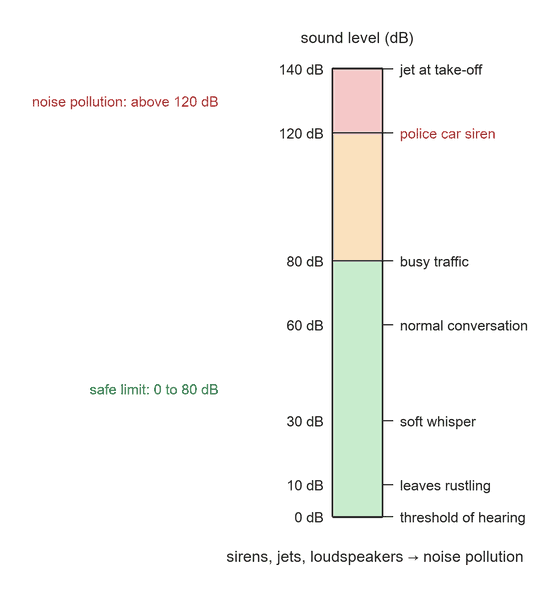
Step 2 — Name one source.
Loudspeakers. Others are sirens, the horns of vehicles, aircraft at take-off and heavy machines in factories.
Therefore, noise pollution is the disturbance caused by loud, undesirable sound above 120 dB; one source is a loudspeaker.
- 1261 mark
Question 126
What determines the pitch of a sound ?
Solve with AIWritten solution
Solution:
Concept: Pitch is the characteristic by which a shrill (acute) note is told apart from a grave (flat) note of the same loudness and quality. It depends on the frequency: the higher the frequency, the higher the pitch.
Step 1 — State the factor.
The frequency of the sound determines its pitch.
Step 2 — Give an example.
The higher the frequency, the shriller the sound: a fork of 512 Hz sounds shriller than a fork of 256 Hz.
Therefore, the pitch of a sound is determined by its frequency.
- 1272 marks
Question 127
Name and define the characteristic which enables one to distinguish two sounds of the same loudness, but of different frequencies, given by the same instrument.
Solve with AIWritten solution
Solution:
Concept: Pitch is the characteristic by which a shrill (acute) note is told apart from a grave (flat) note of the same loudness and quality. It depends on the frequency: the higher the frequency, the higher the pitch.
Step 1 — Name the characteristic.
The characteristic is pitch (shrillness).
Step 2 — Define it.
Pitch is the characteristic of sound by which an acute (shrill) note can be distinguished from a grave (flat) note of the same loudness and quality.
Step 3 — Apply it.
The two sounds come from the same instrument and have the same loudness, so they differ only in frequency, and the note of higher frequency sounds shriller.
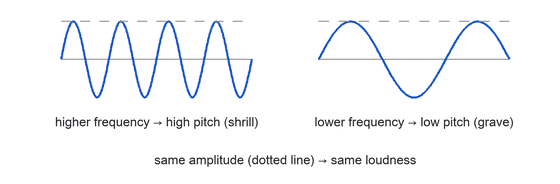
Therefore, the characteristic is pitch, by which a shrill note is told apart from a grave note of the same loudness and quality.
- 1282 marks
Question 128
How is it possible to detect the filling of a bottle under a water tap by hearing the sound at a distance ?
Solve with AIWritten solution
Solution:
Concept: An air column (in a flute, a bottle or a tube partly filled with water) vibrates with a natural frequency that depends on its length: the shorter the air column, the higher its frequency, f ∝ 1/l.
Step 1 — See the air column shrink.
As water fills the bottle, the water level rises and the air column above it becomes shorter.
Step 2 — See the pitch rise.
A shorter air column vibrates with a higher frequency, so the pitch keeps rising: the sound becomes shriller and shriller.
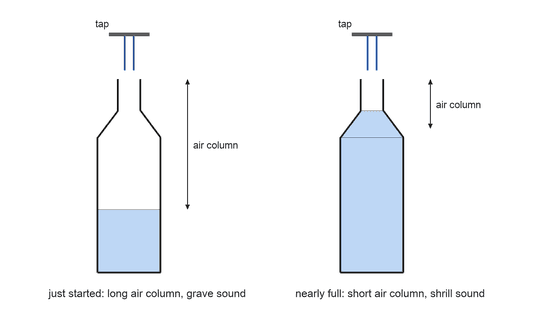
Step 3 — Judge the filling.
By listening to the pitch from a distance, one can tell how full the bottle is; when the sound becomes very shrill, the bottle is nearly full.
Therefore, the filling is detected by the rising pitch of the sound, as the air column above the water gets shorter.
- 1292 marks
Question 129
Two identical guitars are played by two persons to give notes of the same loudness and pitch. Will they differ in quality ? Give a reason for your answer.
Solve with AIWritten solution
Solution:
Concept: Quality (timbre) is the characteristic by which two sounds of the same loudness and pitch are told apart. It depends on the waveform, which is set by the subsidiary notes produced with the principal note and by their relative amplitudes.
Step 1 — Compare the instruments.
The two guitars are identical, so for notes of the same pitch and loudness they produce the same subsidiary notes in the same proportions.
Step 2 — Compare the waveforms.
Their waveforms are therefore the same, so the quality is the same.
Therefore, no, they will not differ in quality, because identical instruments give the same waveform.
- 1302 marks
Question 130
State one difference between a musical note and noise.
Solve with AIWritten solution
Solution:
Concept: Music is a pleasant sound produced by regular, periodic vibrations, so its waveform repeats. Noise is an unpleasant sound produced by an irregular succession of disturbances, so its waveform has no repeating shape.
Step 1 — State the difference.
A musical note is produced by regular, periodic vibrations, so its waveform is regular and it is pleasant to hear. Noise is produced by an irregular succession of disturbances, so its waveform is irregular and it is unpleasant to hear.
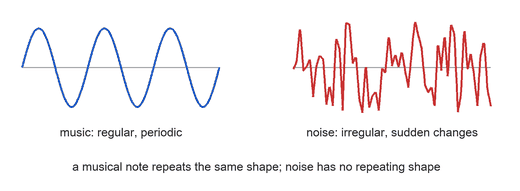
Step 2 — Another difference.
The book describes music as having a comfortable (low) sound level, while noise is usually loud.
Therefore, a musical note has a regular, periodic waveform, while noise has an irregular waveform.
- 1313 marks
Question 131
How does the wave pattern of a loud note differ from that of a soft note ? Draw a diagram.
Solve with AIWritten solution
Solution:
Concept: Loudness depends on the amplitude of the wave: loudness ∝ (amplitude)². A body vibrating with a larger amplitude sends more energy into the medium, so the sound is louder. Striking a tuning fork harder makes it vibrate with a larger amplitude, but its frequency stays the same.
Step 1 — State the difference.
The wave pattern of a loud note has a larger amplitude than that of a soft note: its crests are higher and its troughs deeper.
Step 2 — State what stays the same.
Both notes can have the same frequency (the same number of waves in a given time) and the same waveform, so the same pitch and quality.
Step 3 — Draw the diagram.
Draw both waves over the same time, with the same number of waves, the loud one taller.

Watch out: Keep the number of waves the same in both sketches; only the height should change.
Therefore, the wave pattern of a loud note has a larger amplitude than that of a soft note.
- 1323 marks
Question 132
Draw a diagram to show the wave pattern of a high pitch note and a low pitch note, but of the same loudness.
Solve with AIWritten solution
Solution:
Concept: Pitch is the characteristic by which a shrill (acute) note is told apart from a grave (flat) note of the same loudness and quality. It depends on the frequency: the higher the frequency, the higher the pitch. On a displacement-time graph, a higher frequency shows as more waves in the same time.
Step 1 — Keep the loudness the same.
The two notes must have the same amplitude, so their crests reach the same height.
Step 2 — Draw the high pitch note.
It has a higher frequency, so it shows more waves in the same time (each wave is narrower).
Step 3 — Draw the low pitch note.
It has a lower frequency, so it shows fewer waves in the same time.
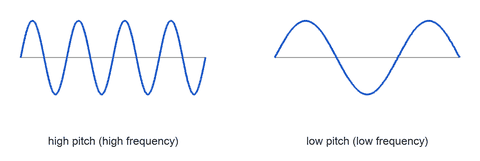
Watch out: Keep the crests the same height; a change of height would show a change of loudness.
Therefore, the high pitch note shows more waves and the low pitch note fewer waves in the same time, with the same amplitude.
- 1334 marks
Question 133
The diagram below shows three different modes of vibration P, Q and R of the same string of a given length.
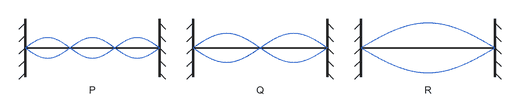
(a) Which vibration will produce a louder sound and why ?
(b) Which vibration will produce a sound of maximum shrillness (or pitch) and why ?
(c) What is the ratio of the wavelength of vibrations P and R ?
Solve with AIWritten solution
Solution:
Concept: For the same string, loudness depends on the amplitude of vibration, and the frequency rises with the number of loops: with n loops on a string of length l, each loop is half a wavelength, so λ = 2l ÷ n and f = V ÷ λ is proportional to n.
(a) Louder sound
Step 1 — Find the louder vibration.
R vibrates with the maximum amplitude, and loudness ∝ (amplitude)², so R produces the loudest sound.
(b) Maximum shrillness
Step 2 — Find the shrillest vibration.
P vibrates in the most loops (three), so its wavelength is the shortest and its frequency the highest. Pitch rises with frequency, so P is the shrillest.
(c) Ratio of wavelengths
Step 3 — Find each wavelength.
P has 3 loops and R has 1 loop on the same length l.
Step 4 — Divide.
Divide the two wavelengths.
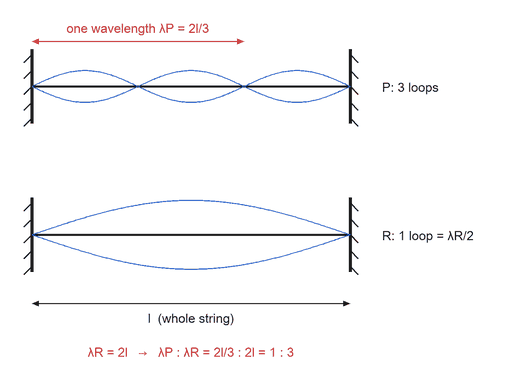
Watch out: More loops give a higher pitch but a SHORTER wavelength.
Therefore, (a) R gives the louder sound (largest amplitude), (b) P gives the shrillest sound (most loops, highest frequency), and (c) = 1 : 3.
- 1344 marks
Question 134
How do the two sounds of same loudness and same pitch produced by different instruments differ ? Draw diagrams to illustrate your answer.
Solve with AIWritten solution
Solution:
Concept: Quality (timbre) is the characteristic by which two sounds of the same loudness and pitch are told apart. It depends on the waveform, which is set by the subsidiary notes produced with the principal note and by their relative amplitudes.
Step 1 — Use the given facts.
The same loudness means the same amplitude, and the same pitch means the same frequency. What is left to differ is the waveform, so the sounds differ in quality.
Step 2 — See why the waveforms differ.
An instrument does not give a note of a single frequency. Along with the principal (fundamental) note, it produces subsidiary notes whose frequencies are whole-number multiples of the principal frequency, with smaller amplitudes.
Step 3 — Add the notes.
Different instruments produce different subsidiary notes in different relative amplitudes. These add to the principal note to give a different resultant waveform for each instrument.

Step 4 — Draw the diagrams.
Draw the waveforms of the two instruments with the same height and the same number of waves, but different shapes.

Watch out: The instruments differ in waveform only; do not draw different heights or different numbers of waves.
Therefore, the two sounds differ in quality (timbre), because their waveforms are different.
- 1353 marks
Question 135
Two musical notes of the same pitch and same loudness are played on two different instruments. Their wave patterns are shown in Fig. 7.27.
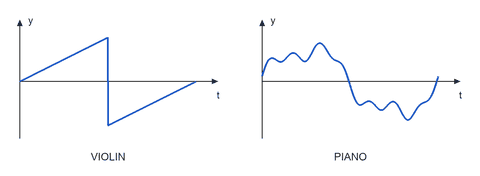
Explain why are the wave patterns different.
Solve with AIWritten solution
Solution:
Concept: Quality (timbre) is the characteristic by which two sounds of the same loudness and pitch are told apart. It depends on the waveform, which is set by the subsidiary notes produced with the principal note and by their relative amplitudes. Same pitch means the same frequency, and same loudness means the same amplitude.
Step 1 — See what each instrument produces.
Neither instrument gives a pure note of a single frequency. Each produces the principal note along with subsidiary notes of higher frequencies.
Step 2 — Compare the subsidiary notes.
The violin and the piano produce different subsidiary notes, in different relative amplitudes.
Step 3 — Explain the patterns.
The principal note adds up with the subsidiary notes to give the resultant waveform. Because the subsidiary notes differ, the resultant waveforms differ: sawtooth-like for the violin, rounded and irregular for the piano.
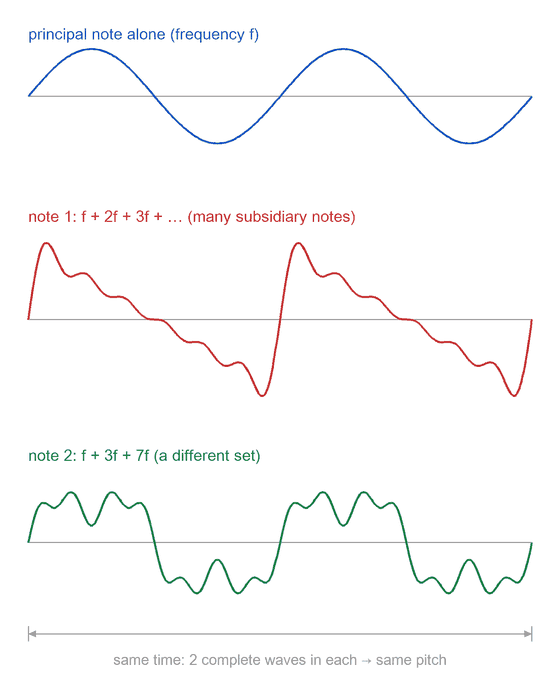
Therefore, the wave patterns are different because the two notes differ in quality: the instruments produce different subsidiary notes with the same principal note.
- 1364 marks
Question 136
A microphone is connected to the Y-input of a C.R.O. Three different sounds are made in turn in front of the microphone. Their traces (a), (b) and (c) produced on the screen are shown in Fig. 7.28.
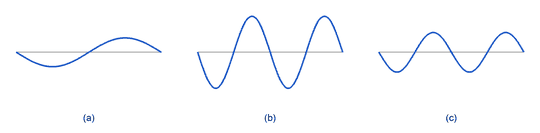
(i) Which trace is due to the loudest sound ? Give reason for your answer.
(ii) Which trace is due to the sound with the lowest pitch ? Explain your answer.
Solve with AIWritten solution
Solution:
Concept: The C.R.O. traces are all drawn over the same time. The height of a trace (amplitude) decides loudness; the number of waves on the screen decides frequency and so pitch.
(i) Loudest sound
Step 1 — Find the loudest trace.
Trace (b) has the largest amplitude: its crests are the highest. Loudness ∝ (amplitude)², so (b) is the loudest.
(ii) Lowest pitch
Step 2 — Find the lowest pitch.
Trace (a) shows only one wave, while (b) and (c) show two waves each in the same time. So (a) has the lowest frequency, and since pitch depends on frequency, the lowest pitch.
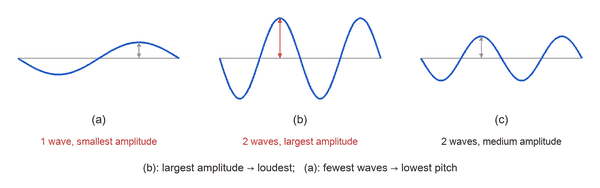
Therefore, (i) trace (b) is due to the loudest sound (largest amplitude), and (ii) trace (a) is due to the sound of lowest pitch (fewest waves, lowest frequency).
- 1373 marks
Question 137
In what respect does the wave pattern of noise and music differ ? Draw diagrams to explain your answer.
Solve with AIWritten solution
Solution:
Concept: Music is a pleasant sound produced by regular, periodic vibrations, so its waveform repeats. Noise is an unpleasant sound produced by an irregular succession of disturbances, so its waveform has no repeating shape.
Step 1 — Music.
Music is produced by regular, periodic vibrations, so its wave pattern is regular: the same shape repeats, with no sudden change in wavelength or amplitude.
Step 2 — Noise.
Noise is produced by an irregular succession of disturbances, so its wave pattern is irregular: there is no repeating shape, and the amplitude and wavelength change suddenly.
Step 3 — Draw the diagrams.
Draw music as a smooth repeating wave and noise as a jagged, non-repeating trace.
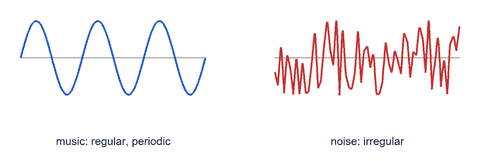
Therefore, music has a regular, repeating wave pattern, while noise has an irregular one with sudden changes.
What Class 10 Physics Ch 7 covers
The sections of the chapter, in the order the book takes them. Every question above comes from one of these.
- 01Sound Waves
- 02Reflection of Sound Waves
- 03Echo
- 04Use of Echoes
- 05Natural Vibrations
- 06Damped Vibrations
More ways to study this chapter
The same chapter asked three other ways. Practise it, revise it, and see what the board has set on Ch 7 before.
- Competency-Based Questions (CBQ)Case study questions: a situation, and the part of the chapter that answers it.40questionsOpen
- Previous Year QuestionsQuestions that have actually appeared in board papers, each tagged with its year.57questionsOpen
- Practice QuestionsExtra questions per chapter, for when one attempt at a method is not enough.42questionsOpen
Ch 7 in past ICSE papers
The same chapter as the board has actually asked it. These are worded differently from the textbook exercise, which is the point of reading them.
- 12 marks
Board paper question 1
The ratio of amplitude of two waves is 3 : 4. What is the ratio of their :
(i) loudness?
(ii) frequencies?
Solve with AIWritten solution
Solution:
Concept: Loudness depends on the amplitude of the wave: the loudness (and the intensity) is proportional to the square of the amplitude, L ∝ a². Pitch depends on the frequency, and quality on the waveform.
Given: Ratio of amplitudes 3 : 4.
Step 1 — Write the ratio of the amplitudes.
The amplitudes of the two waves are in the ratio 3 : 4.
Step 2 — Find the ratio of loudness (part i).
Loudness is proportional to the square of the amplitude, so we square the ratio of the amplitudes.
The wave of larger amplitude carries more energy to the ear, so it sounds louder.

Step 3 — Find the ratio of frequencies (part ii).
The frequency of a wave is fixed by its source; it does not depend on the amplitude. A change of amplitude changes only the loudness, so the two waves are taken to have the same frequency, and their frequencies are in the ratio 1 : 1.
Watch out: Square the amplitude ratio for loudness: 3 : 4 gives 9 : 16, not 3 : 4.
Note: strictly, an amplitude ratio alone cannot fix the frequencies; the expected answer 1 : 1 uses the fact that frequency does not depend on amplitude.
Therefore, (i) the ratio of loudness is 9 : 16 and (ii) the ratio of frequencies is 1 : 1.
- 22 marks
Board paper question 2
State two ways by which the frequency of transverse vibrations of a stretched string can be increased.
Solve with AIWritten solution
Solution:
Concept: The natural frequency of a stretched string is , where l is the vibrating length, T the tension and m the mass per unit length. So f ∝ 1/l (same tension and wire), f ∝ √T (same length and wire), and a thicker, heavier wire has a lower frequency.
Step 1 — Recall what fixes the frequency of a string.
The natural frequency of a stretched string depends on its vibrating length l, its tension T and its mass per unit length m.
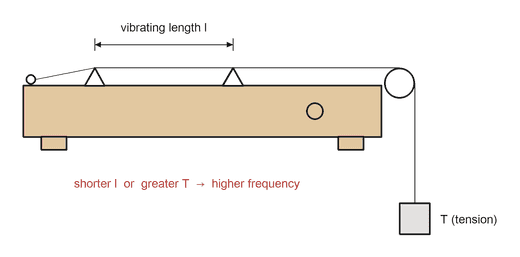
Step 2 — Way 1: increase the tension.
Tighten the string, for example by adding weight to the hanger of a sonometer or by turning the peg of a guitar. Since f ∝ √T, a greater tension gives a higher frequency.
Step 3 — Way 2: decrease the vibrating length.
Shorten the part of the string that vibrates, for example by moving the bridges closer together or by pressing the string with a finger. Since f ∝ 1/l, a shorter length gives a higher frequency.
Watch out: Tension raises the frequency only as its square root: four times the tension gives twice the frequency, not four times.
Therefore, the frequency can be increased (1) by increasing the tension of the string and (2) by decreasing its vibrating length (a thinner string of the same material also gives a higher frequency).
- 32 marks
Board paper question 3
What is meant by noise pollution? Name one source of sound causing noise pollution.
Solve with AIWritten solution
Solution:
Concept: Sound with a regular, repeating waveform is pleasant (music); sound with an irregular waveform and sudden changes is noise. Very loud noise that goes on for a long time harms people.
Step 1 — Define noise pollution.
Noise pollution is the disturbance produced in the environment by undesirable, loud and harsh sound of level above 120 dB from various sources. Constant exposure to such sound causes headache, loss of sleep and lasting damage to hearing.
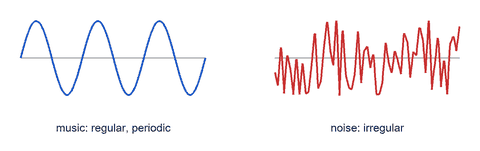
Step 2 — Name one source.
Loudspeakers are one source. Others are sirens and horns of vehicles, jet planes taking off and heavy machines in factories.
Watch out: Noise pollution is about the level (loudness) of unwanted sound and how long people are exposed to it, not about its pitch.
Note: long exposure even to sound of about 85 dB can damage hearing.
Therefore, noise pollution is the disturbance caused in the environment by loud, harsh, unwanted sound (level above 120 dB); one source is a loudspeaker.
- 43 marks
Board paper question 4
(i) Name the waves used for echo depth sounding.
(ii) Give one reason for their use for the above purpose.
(iii) Why are the waves mentioned by you not audible to us?
Solve with AIWritten solution
Solution:
Concept: Ultrasonic waves are sound waves of frequency above 20 kHz, beyond the upper limit of human hearing (the audible range is 20 Hz to 20 kHz). Their wavelength is very short, so they can be sent as a narrow beam in one direction, and they are not easily absorbed by water.
Step 1 — Name the waves (part i).
Echo depth sounding (SONAR) uses ultrasonic waves, that is, sound waves of frequency above 20 kHz.
Step 2 — Give a reason for their use (part ii).
Ultrasonic waves have a very short wavelength, so they can be sent as a narrow beam straight down to the sea bed, and the echo comes straight back. They are also not easily absorbed by water, so the echo is strong. Ordinary audible sound would spread out in all directions.
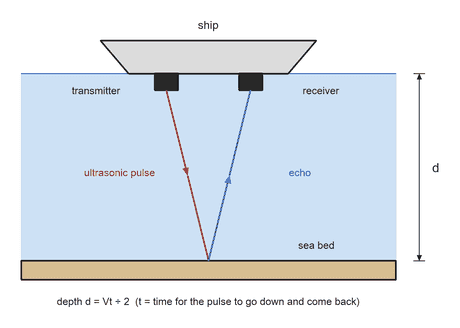
The depth is then found from the echo time t as d = Vt ÷ 2, where V is the speed of sound in water.
Step 3 — Explain why we cannot hear them (part iii).
The human ear hears only sounds of frequency 20 Hz to 20 kHz. Ultrasonic waves have a frequency above 20 kHz, beyond the upper limit of hearing, so they are not audible to us.
Watch out: Ultrasonic waves are not heard because their frequency is too HIGH, not because they are too faint.
Therefore, (i) ultrasonic waves are used; (ii) they can be sent as a narrow beam and are not easily absorbed by water; (iii) their frequency is above 20 kHz, beyond the audible range.
- 53 marks
Board paper question 5
(i) What is an echo?
(ii) State two conditions for an echo to take place.
Solve with AIWritten solution
Solution:
Concept: An echo is the sound heard after reflection from a distant obstacle, after the original sound has ceased. The sensation of a sound stays in our ear for about 0.1 s, so the echo is heard separately only if it arrives at least 0.1 s after the original sound. If the obstacle is at a distance d and the speed of sound is V, the sound goes to the obstacle and comes back, covering 2d in the echo time t, so 2d = Vt, that is d = Vt ÷ 2.
Step 1 — Define an echo (part i).
An echo is the sound heard after reflection from a distant obstacle, such as a cliff, a hillside or the wall of a building, after the original sound has ceased.
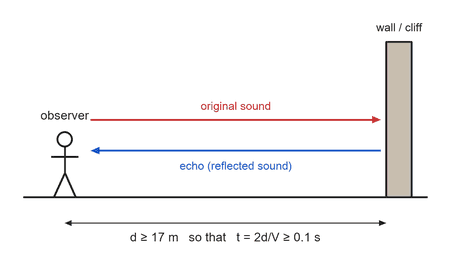
Step 2 — Condition 1: enough distance (part ii).
The reflected sound must reach the listener at least 0.1 s after the original sound. In air (speed 340 m s⁻¹) the sound covers 2d in 0.1 s, so the obstacle must be at least this far:
Step 3 — Condition 2: a large reflector (part ii).
The reflecting surface must be large compared with the wavelength of the sound, so that the sound is reflected back and not scattered round it. (The reflected sound must also be loud enough to be heard.)
Watch out: The 0.1 s is for the WHOLE trip, there and back; the obstacle itself is only half the distance covered, 17 m and not 34 m.
Therefore, (i) an echo is the reflected sound heard after the original sound has ceased; (ii) the reflector must be at least 17 m away in air (so that the echo arrives at least 0.1 s later), and it must be large compared with the wavelength.
- 64 marks
Board paper question 6
(i) Name the phenomenon involved in tuning a radio set to a particular station.
(ii) Define the phenomenon named by you in part (i) above.
(iii) What do you understand by loudness of sound?
(iv) In which units is the loudness of sound measured?
Solve with AIWritten solution
Solution:
Concept: Resonance is a special case of forced vibrations: when the frequency of the applied periodic force is equal to the natural frequency of the body, the body readily takes energy from the force and vibrates with a very large amplitude. Loudness depends on the amplitude of the wave: the loudness (and the intensity) is proportional to the square of the amplitude, L ∝ a². Pitch depends on the frequency, and quality on the waveform.
Step 1 — Name the phenomenon (part i).
Tuning a radio set to a station is an example of resonance.
Step 2 — Define resonance (part ii).
When the frequency of an externally applied periodic force on a body is equal to its natural frequency, the body readily begins to vibrate with a large amplitude. This is called resonance.
In a radio, turning the knob changes the natural frequency of the receiving circuit. When it becomes equal to the frequency of the waves from the wanted station, that station's signal is received strongly.

Step 3 — Explain loudness (part iii).
Loudness is the property of sound by which a loud sound can be told apart from a faint one of the same pitch and quality. It depends on the amplitude of the wave (L ∝ a²) and on the sensitivity of the listener's ear.
Step 4 — Give the unit (part iv).
The loudness (sound level) is measured in decibel (dB). (The phon is also used for the loudness level; for a note of 1 kHz the two scales agree.)
Watch out: Loudness is not the same as pitch: a loud sound can be of low or high pitch.
Therefore, (i) resonance; (ii) resonance is the large-amplitude vibration of a body when the frequency of the applied periodic force equals its natural frequency; (iii) loudness is the property by which a loud sound is told apart from a faint one; (iv) it is measured in decibel (dB).
All 57 board paper questions for this chapter, solved the same way.
Class 10 Physics Ch 7 questions students ask
How many questions are there in Class 10 Physics Ch 7?
137 questions. Every one is solved step by step on this page.
Are these Class 10 Physics solutions free?
Yes. Every question and its full working is free to read, with no account needed.
Can I download the Class 10 Physics Ch 7 solutions as a PDF?
There is no PDF to download. Every solution is on this page instead, which means it is searchable, always the current syllabus, and readable on a phone. Use your browser's print option if you want it on paper.