
Question 742 marksEasy
State two differences between forced and resonant vibrations.
Confirming your payment
Sign up now and get 250 free tokens.
Sound · Question 74 of 137
State two differences between forced and resonant vibrations.
Solution:
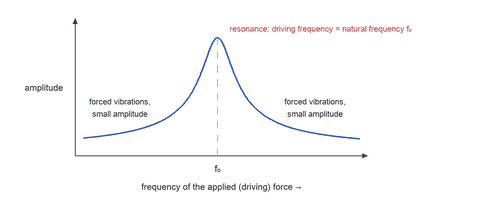
Concept: Resonance is the special case of forced vibrations in which the frequency of the applied periodic force is equal to the natural frequency of the body. The body then takes in energy most easily and vibrates with a very large amplitude, so a loud sound is heard.
Step 1 — Compare the frequencies.
In forced vibrations the frequency of the applied force differs from the natural frequency of the body; in resonant vibrations it is equal to it.
Step 2 — Compare the amplitudes.
Forced vibrations usually have a small amplitude; resonant vibrations have a very large amplitude, so the sound is loud.
The table gives the two differences.
| Forced vibrations | Resonant vibrations |
|---|---|
| 1. Frequency of the force differs from the natural frequency. | 1. Frequency of the force equals the natural frequency. |
| 2. Amplitude usually small. | 2. Amplitude very large; loud sound. |
Step 3 — Read the resonance curve.
The curve shows both: the amplitude is small away from f₀ and largest at f₀.
Therefore, resonant vibrations differ from forced vibrations in having the force's frequency equal to the natural frequency, and a very large amplitude.