
Question 732 marksEasy
State two differences between natural and forced vibrations.
Confirming your payment
Sign up now and get 250 free tokens.
Sound · Question 73 of 137
State two differences between natural and forced vibrations.
Solution:
Concept: In natural vibrations the body vibrates on its own; in forced vibrations an outside periodic force keeps it vibrating.
Step 1 — Compare the frequency.
In natural vibrations the body vibrates with its own natural frequency; in forced vibrations it vibrates with the frequency of the applied periodic force.
Step 2 — Compare the force and the amplitude.
In natural vibrations no external force acts once the vibration starts, and the amplitude stays constant (in vacuum); in forced vibrations a continuous external periodic force is needed, and the amplitude depends on how close its frequency is to the natural frequency.
The table gives the two differences.
| Natural vibrations | Forced vibrations |
|---|---|
| 1. It vibrates at the body's own natural frequency. | 1. It vibrates at the frequency of the applied periodic force. |
| 2. No external force after the start; constant amplitude (in vacuum). | 2. A continuous external periodic force is needed; the amplitude is usually small. |
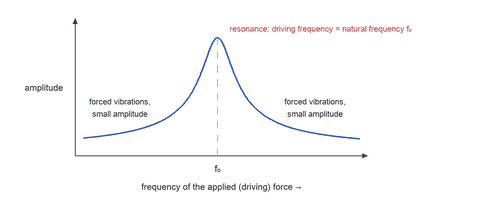
Therefore, natural vibrations are at the body's own frequency with no external force, while forced vibrations are at the frequency of a continuously applied periodic force.