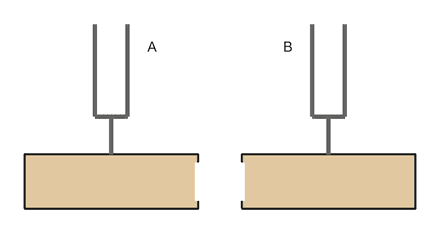
Solution:
Concept: Forks A and B have the same frequency, so the natural frequency of B equals the frequency of the periodic force that reaches it from A. Resonance is the special case of forced vibrations in which the frequency of the applied periodic force is equal to the natural frequency of the body. The body then takes in energy most easily and vibrates with a very large amplitude, so a loud sound is heard.
(a) Observation
Step 1 — Describe what is seen.
After a few seconds fork B also starts vibrating and gives a sound. This is clear if fork A is stopped by touching it: the sound from B can still be heard.
Step 2 — Say how B is driven.
The vibrations of A pass through the air in the facing sound boxes and push B periodically at A's frequency.
(b) Principle
Step 3 — Name the principle.
The principle is resonance: a body set vibrating by a periodic force of frequency equal to its natural frequency vibrates with a large amplitude.
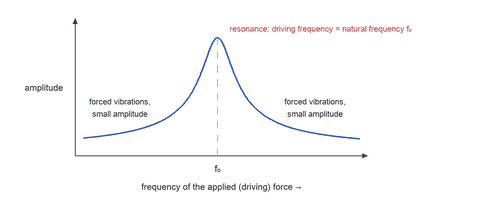
Therefore, (a) fork B starts vibrating and sounding, and (b) the principle is resonance.