
Question 855 marksMedium
What is meant by resonance ? Describe a simple experiment to illustrate the phenomenon of resonance and explain it.
Confirming your payment
Sign up now and get 250 free tokens.
Sound · Question 85 of 137
What is meant by resonance ? Describe a simple experiment to illustrate the phenomenon of resonance and explain it.
Solution:
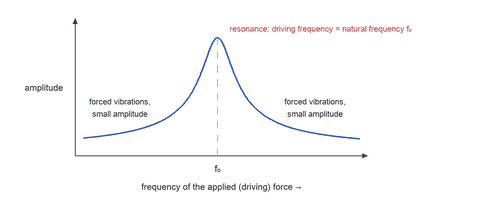
Concept: Resonance is the special case of forced vibrations in which the frequency of the applied periodic force is equal to the natural frequency of the body. The body then takes in energy most easily and vibrates with a very large amplitude, so a loud sound is heard.
Step 1 — Define resonance.
When a body is made to vibrate by an external periodic force whose frequency is equal to its natural frequency, it begins to vibrate with a large amplitude. This phenomenon is called resonance.
Step 2 — Set up the experiment.
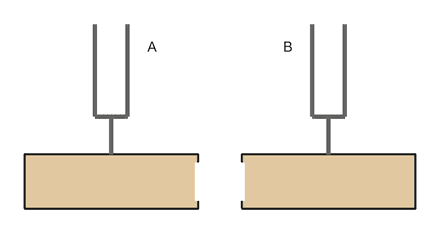
Take two tuning forks A and B of the same frequency, mounted on two hollow sound boxes with the open ends of the boxes facing each other. Strike fork A, and after a few seconds stop it by touching its prongs.
Step 3 — Observe.
A sound is still heard: fork B has started vibrating on its own.
Step 4 — Explain.
The vibrations of A travel through the air in the boxes to B as a periodic force. This force has the same frequency as B's natural frequency, so B resonates: it takes in energy and vibrates with a large amplitude, producing an audible sound.
Check: Stick a little wax on one prong of B, so that its frequency changes; B then no longer responds noticeably. This shows that equal frequencies are needed.
The same can be shown with pendulums of equal length hung from one elastic string.
Watch out: Stop fork A before listening; otherwise you cannot tell whether the sound comes from A or B.
Therefore, resonance is the large-amplitude vibration of a body driven at its natural frequency; it is shown by a second tuning fork of the same frequency starting to vibrate when the first is sounded.