Solution:
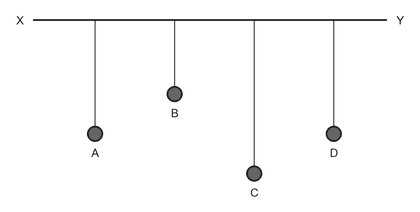
Concept: The natural frequency of a pendulum depends on its length. Through the elastic string XY, pendulum A pushes every other pendulum periodically at A's frequency.
(a) Observation about D
Step 1 — Describe D.
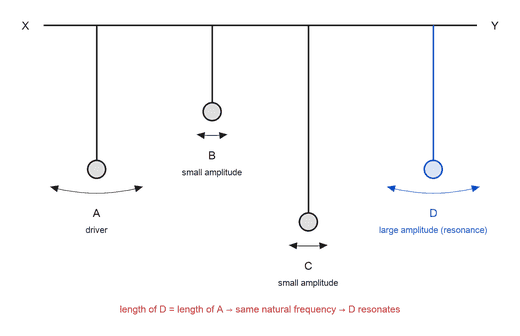
Pendulum D starts vibrating with a large amplitude, almost as large as A's.
(b) Reason
Step 2 — Explain D.
A and D have the same length, so they have the same natural frequency. A's vibrations reach D through the string XY as a periodic force whose frequency equals D's natural frequency, so D resonates.
(c) Vibrations of B and C
Step 3 — Name them.
B and C execute forced vibrations, with a small amplitude.
(d) Reason
Step 4 — Explain B and C.
B is shorter and C is longer than A, so their natural frequencies differ from the frequency of the force applied by A. They are forced to vibrate at A's frequency, but they take in little energy, so their amplitude stays small.
Watch out: B and C vibrate at A's frequency (forced), not at their own natural frequencies.
Therefore, (a) D vibrates with a large amplitude, (b) because it has the same length and natural frequency as A (resonance), (c) B and C make forced vibrations of small amplitude, (d) because their natural frequencies differ from A's.