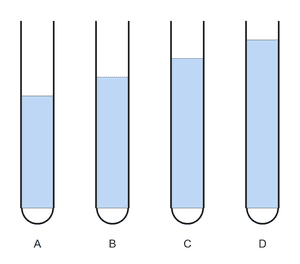
Solution:
Concept: Each tube is closed at the bottom by the water, so its air column is closed at one end. Such a column resonates with a fork when its length is λ/4, 3λ/4, 5λ/4, … (an ODD number of quarter wavelengths), where λ is the wavelength of the fork's sound.
Step 1 — Find the air columns.
Each tube is 20 cm high, so subtract the height of the water.
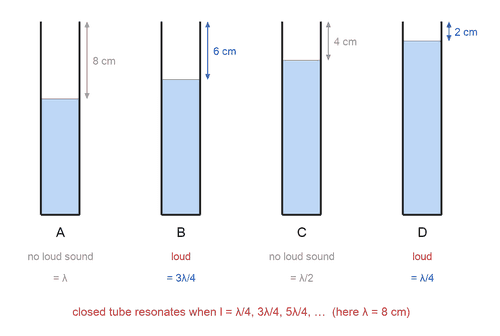
A: 20−12=8 cm
B: 20−14=6 cm
C: 20−16=4 cm
D: 20−18=2 cm
Step 2 — Find the wavelength from tube D.
D gives a loud sound in its simplest mode, so its 2 cm air column is a quarter wavelength.
4λ=2 cm
λ=8 cm
(a) Observations
Step 3 — State what is heard.
A loud sound is heard with tube B as well. No loud sound is heard with tubes A and C.
(b) Reasons
Step 4 — Tube B.
The 6 cm column is three quarter wavelengths (3λ/4). Its second mode has a frequency equal to that of D's air column, that is, of the fork, so B also resonates.
Step 5 — Tubes A and C.
The 8 cm column (= λ, four quarters) and the 4 cm column (= λ/2, two quarters) are even numbers of quarter wavelengths, so neither has a natural frequency equal to the fork's. They make only feeble forced vibrations.
(c) Principle
Step 6 — State the principle.
The principle is resonance: when the natural frequency of the air column equals the frequency of the vibrating tuning fork, the air column vibrates with a large amplitude and a loud sound is heard.
Watch out: A column closed at one end resonates only at ODD multiples of λ/4; λ/2 and λ do not work.
Note: This uses the simple air-column rule without the end correction, as the book does. In a real tube the resonance in B would be weaker, because the open end adds a little to the effective length of each column.
Therefore, (a) a loud sound is heard with B but not with A and C, (b) because B's 6 cm column is 3λ/4 while A's 8 cm (λ) and C's 4 cm (λ/2) are not odd multiples of λ/4, and (c) the principle is resonance.