Solution:
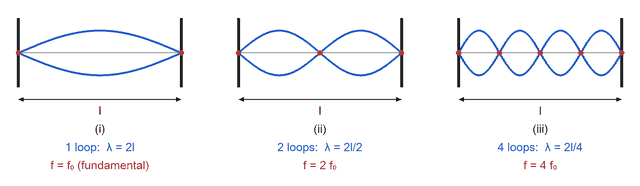
Concept: A string fixed at both ends vibrates in loops, each loop half a wavelength long. With n loops on a string of length l, λ = 2l ÷ n, and the frequency f = V ÷ λ is n times the lowest (fundamental) frequency.
Step 1 — Count the loops.
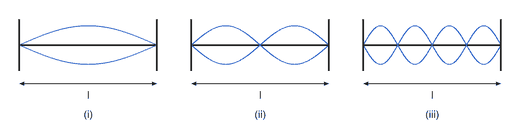
Diagram (i) has 1 loop, (ii) has 2 loops and (iii) has 4 loops.
λ=n2l
f=n×2lV
(a) Principal note
Step 2 — Find the principal note.
One loop gives the lowest frequency, the fundamental (principal) note, so it is diagram (i).
(b) Frequency four times the first
Step 3 — Find four times the frequency.
Diagram (iii) has 4 loops, so its frequency is 4 times that of diagram (i).
(c) Longest wavelength
Step 4 — Find the longest wavelength.
Fewer loops mean a longer wavelength, so diagram (i), with λ = 2l, has the longest.
(d) Ratio of frequencies in (i) and (ii)
Step 5 — Find the ratio.
The frequency is proportional to the number of loops.
f2f1=21
Watch out: More loops mean a HIGHER frequency but a SHORTER wavelength.
Therefore, (a) diagram (i), (b) diagram (iii), (c) diagram (i), and (d) f₁ : f₂ = 1 : 2.