Solution:
Concept: The natural frequency of a stretched string is f = (1 ÷ 2l) √(T ÷ m), where l is the vibrating length, T the tension and m the mass per unit length. For a wire of radius r and density ρ, m = πr²ρ, so f ∝ 1/l, f ∝ √T and f ∝ 1/r. A string twice as thick (same length and tension) gives half the frequency.
Step 1 — See what the instrument needs.
A stringed instrument must give notes over a wide range of frequencies.
Step 2 — See the limits of length and tension.
Its strings all have about the same length, and their tension cannot be changed too much: too loose a string gives a poor sound, and too tight a string may snap.
Step 3 — Use the thickness.
Since f ∝ 1/r, strings of different thickness give notes of different frequency: thick strings for low (bass) notes and thin strings for high (treble) notes.
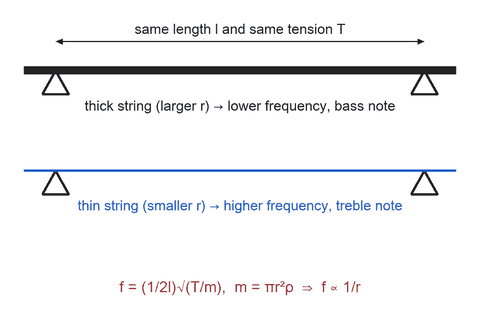
Watch out: A THICKER string gives a LOWER note, not a higher one.
Therefore, strings of different thickness are provided because the frequency of a string is inversely proportional to its thickness, so thick strings give low notes and thin strings high notes.
