
Question 794 marksEasy
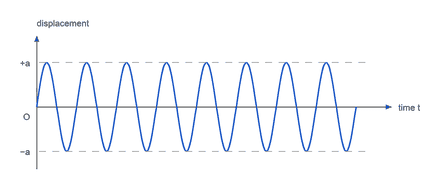
(a) Draw a graph between displacement and time for a body executing natural vibrations.
(b) Where can a body execute natural vibrations?
Confirming your payment
Sign up now and get 250 free tokens.
Sound · Question 79 of 137
(a) Draw a graph between displacement and time for a body executing natural vibrations.
(b) Where can a body execute natural vibrations?
Solution:
Concept: When a body is disturbed and left to itself, it vibrates with its own natural frequency, which is fixed by the body's shape and size (and material). If no resistance acts (in vacuum), the amplitude stays constant: these are natural (free) vibrations.
(a) Displacement-time graph
Step 1 — Describe the graph.
The graph is a regular wave of constant height: every crest reaches the same height +a, every trough the same depth −a, and each complete wave takes the same time T.
Step 2 — Read it.
The equal heights show the constant amplitude; the equal spacing shows the constant frequency.
(b) Where natural vibrations are possible
Step 3 — State the place.
A body can execute natural vibrations only in vacuum. There is no medium there to offer resistance, so the body loses no energy and its amplitude does not decrease.
Watch out: Do not draw the crests getting smaller; that is the graph of damped vibrations.
Therefore, (a) the graph is a wave of constant amplitude and constant period, and (b) a body executes natural vibrations only in vacuum.