
Question 22 marksAsked 2016Easy
State two ways by which the frequency of transverse vibrations of a stretched string can be increased.
Confirming your payment
Sign up now and get 250 free tokens.
Previous Year Questions · Question 2 of 57
State two ways by which the frequency of transverse vibrations of a stretched string can be increased.
Solution:
Concept: The natural frequency of a stretched string is , where l is the vibrating length, T the tension and m the mass per unit length. So f ∝ 1/l (same tension and wire), f ∝ √T (same length and wire), and a thicker, heavier wire has a lower frequency.
Step 1 — Recall what fixes the frequency of a string.
The natural frequency of a stretched string depends on its vibrating length l, its tension T and its mass per unit length m.
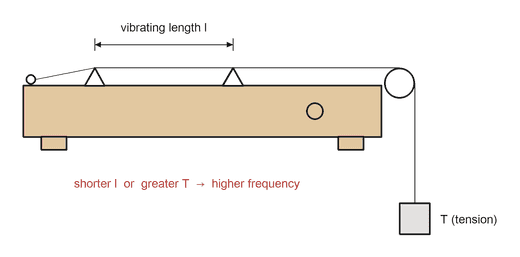
Step 2 — Way 1: increase the tension.
Tighten the string, for example by adding weight to the hanger of a sonometer or by turning the peg of a guitar. Since f ∝ √T, a greater tension gives a higher frequency.
Step 3 — Way 2: decrease the vibrating length.
Shorten the part of the string that vibrates, for example by moving the bridges closer together or by pressing the string with a finger. Since f ∝ 1/l, a shorter length gives a higher frequency.
Watch out: Tension raises the frequency only as its square root: four times the tension gives twice the frequency, not four times.
Therefore, the frequency can be increased (1) by increasing the tension of the string and (2) by decreasing its vibrating length (a thinner string of the same material also gives a higher frequency).