
Opening your dashboard
Class 10 Physics Chapter 7 Sound: Previous Year Questions
57 questions on Chapter 7, each solved step by step. Class 10 Physics, ICSE 2026-27.
57 questions with solutions
1–4 marks · Mixed difficulty
- 12 marks
Question 1
The ratio of amplitude of two waves is 3 : 4. What is the ratio of their :
(i) loudness?
(ii) frequencies?
Solve with AIWritten solution
Solution:
Concept: Loudness depends on the amplitude of the wave: the loudness (and the intensity) is proportional to the square of the amplitude, L ∝ a². Pitch depends on the frequency, and quality on the waveform.
Given: Ratio of amplitudes 3 : 4.
Step 1 — Write the ratio of the amplitudes.
The amplitudes of the two waves are in the ratio 3 : 4.
Step 2 — Find the ratio of loudness (part i).
Loudness is proportional to the square of the amplitude, so we square the ratio of the amplitudes.
The wave of larger amplitude carries more energy to the ear, so it sounds louder.

Step 3 — Find the ratio of frequencies (part ii).
The frequency of a wave is fixed by its source; it does not depend on the amplitude. A change of amplitude changes only the loudness, so the two waves are taken to have the same frequency, and their frequencies are in the ratio 1 : 1.
Watch out: Square the amplitude ratio for loudness: 3 : 4 gives 9 : 16, not 3 : 4.
Note: strictly, an amplitude ratio alone cannot fix the frequencies; the expected answer 1 : 1 uses the fact that frequency does not depend on amplitude.
Therefore, (i) the ratio of loudness is 9 : 16 and (ii) the ratio of frequencies is 1 : 1.
- 22 marks
Question 2
State two ways by which the frequency of transverse vibrations of a stretched string can be increased.
Solve with AIWritten solution
Solution:
Concept: The natural frequency of a stretched string is , where l is the vibrating length, T the tension and m the mass per unit length. So f ∝ 1/l (same tension and wire), f ∝ √T (same length and wire), and a thicker, heavier wire has a lower frequency.
Step 1 — Recall what fixes the frequency of a string.
The natural frequency of a stretched string depends on its vibrating length l, its tension T and its mass per unit length m.
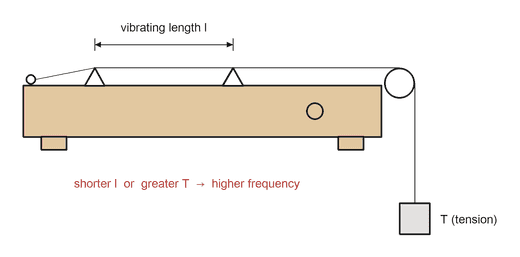
Step 2 — Way 1: increase the tension.
Tighten the string, for example by adding weight to the hanger of a sonometer or by turning the peg of a guitar. Since f ∝ √T, a greater tension gives a higher frequency.
Step 3 — Way 2: decrease the vibrating length.
Shorten the part of the string that vibrates, for example by moving the bridges closer together or by pressing the string with a finger. Since f ∝ 1/l, a shorter length gives a higher frequency.
Watch out: Tension raises the frequency only as its square root: four times the tension gives twice the frequency, not four times.
Therefore, the frequency can be increased (1) by increasing the tension of the string and (2) by decreasing its vibrating length (a thinner string of the same material also gives a higher frequency).
- 32 marks
Question 3
What is meant by noise pollution? Name one source of sound causing noise pollution.
Solve with AIWritten solution
Solution:
Concept: Sound with a regular, repeating waveform is pleasant (music); sound with an irregular waveform and sudden changes is noise. Very loud noise that goes on for a long time harms people.
Step 1 — Define noise pollution.
Noise pollution is the disturbance produced in the environment by undesirable, loud and harsh sound of level above 120 dB from various sources. Constant exposure to such sound causes headache, loss of sleep and lasting damage to hearing.
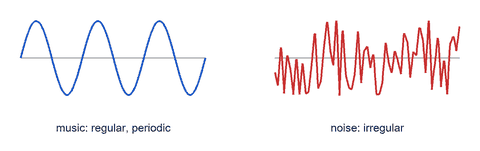
Step 2 — Name one source.
Loudspeakers are one source. Others are sirens and horns of vehicles, jet planes taking off and heavy machines in factories.
Watch out: Noise pollution is about the level (loudness) of unwanted sound and how long people are exposed to it, not about its pitch.
Note: long exposure even to sound of about 85 dB can damage hearing.
Therefore, noise pollution is the disturbance caused in the environment by loud, harsh, unwanted sound (level above 120 dB); one source is a loudspeaker.
- 43 marks
Question 4
(i) Name the waves used for echo depth sounding.
(ii) Give one reason for their use for the above purpose.
(iii) Why are the waves mentioned by you not audible to us?
Solve with AIWritten solution
Solution:
Concept: Ultrasonic waves are sound waves of frequency above 20 kHz, beyond the upper limit of human hearing (the audible range is 20 Hz to 20 kHz). Their wavelength is very short, so they can be sent as a narrow beam in one direction, and they are not easily absorbed by water.
Step 1 — Name the waves (part i).
Echo depth sounding (SONAR) uses ultrasonic waves, that is, sound waves of frequency above 20 kHz.
Step 2 — Give a reason for their use (part ii).
Ultrasonic waves have a very short wavelength, so they can be sent as a narrow beam straight down to the sea bed, and the echo comes straight back. They are also not easily absorbed by water, so the echo is strong. Ordinary audible sound would spread out in all directions.
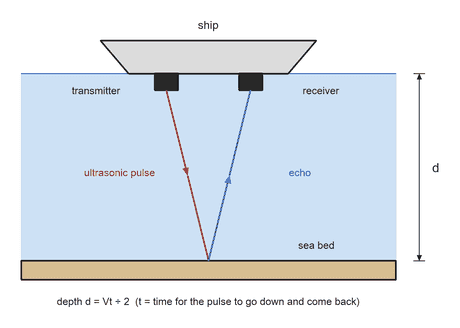
The depth is then found from the echo time t as d = Vt ÷ 2, where V is the speed of sound in water.
Step 3 — Explain why we cannot hear them (part iii).
The human ear hears only sounds of frequency 20 Hz to 20 kHz. Ultrasonic waves have a frequency above 20 kHz, beyond the upper limit of hearing, so they are not audible to us.
Watch out: Ultrasonic waves are not heard because their frequency is too HIGH, not because they are too faint.
Therefore, (i) ultrasonic waves are used; (ii) they can be sent as a narrow beam and are not easily absorbed by water; (iii) their frequency is above 20 kHz, beyond the audible range.
- 53 marks
Question 5
(i) What is an echo?
(ii) State two conditions for an echo to take place.
Solve with AIWritten solution
Solution:
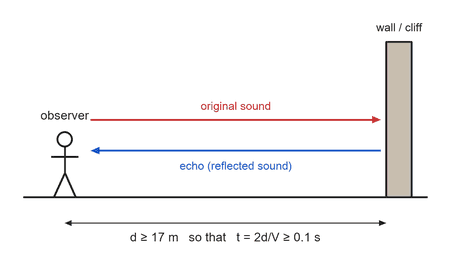
Concept: An echo is the sound heard after reflection from a distant obstacle, after the original sound has ceased. The sensation of a sound stays in our ear for about 0.1 s, so the echo is heard separately only if it arrives at least 0.1 s after the original sound. If the obstacle is at a distance d and the speed of sound is V, the sound goes to the obstacle and comes back, covering 2d in the echo time t, so 2d = Vt, that is d = Vt ÷ 2.
Step 1 — Define an echo (part i).
An echo is the sound heard after reflection from a distant obstacle, such as a cliff, a hillside or the wall of a building, after the original sound has ceased.
Step 2 — Condition 1: enough distance (part ii).
The reflected sound must reach the listener at least 0.1 s after the original sound. In air (speed 340 m s⁻¹) the sound covers 2d in 0.1 s, so the obstacle must be at least this far:
Step 3 — Condition 2: a large reflector (part ii).
The reflecting surface must be large compared with the wavelength of the sound, so that the sound is reflected back and not scattered round it. (The reflected sound must also be loud enough to be heard.)
Watch out: The 0.1 s is for the WHOLE trip, there and back; the obstacle itself is only half the distance covered, 17 m and not 34 m.
Therefore, (i) an echo is the reflected sound heard after the original sound has ceased; (ii) the reflector must be at least 17 m away in air (so that the echo arrives at least 0.1 s later), and it must be large compared with the wavelength.
- 64 marks
Question 6
(i) Name the phenomenon involved in tuning a radio set to a particular station.
(ii) Define the phenomenon named by you in part (i) above.
(iii) What do you understand by loudness of sound?
(iv) In which units is the loudness of sound measured?
Solve with AIWritten solution
Solution:
Concept: Resonance is a special case of forced vibrations: when the frequency of the applied periodic force is equal to the natural frequency of the body, the body readily takes energy from the force and vibrates with a very large amplitude. Loudness depends on the amplitude of the wave: the loudness (and the intensity) is proportional to the square of the amplitude, L ∝ a². Pitch depends on the frequency, and quality on the waveform.
Step 1 — Name the phenomenon (part i).
Tuning a radio set to a station is an example of resonance.
Step 2 — Define resonance (part ii).
When the frequency of an externally applied periodic force on a body is equal to its natural frequency, the body readily begins to vibrate with a large amplitude. This is called resonance.
In a radio, turning the knob changes the natural frequency of the receiving circuit. When it becomes equal to the frequency of the waves from the wanted station, that station's signal is received strongly.

Step 3 — Explain loudness (part iii).
Loudness is the property of sound by which a loud sound can be told apart from a faint one of the same pitch and quality. It depends on the amplitude of the wave (L ∝ a²) and on the sensitivity of the listener's ear.
Step 4 — Give the unit (part iv).
The loudness (sound level) is measured in decibel (dB). (The phon is also used for the loudness level; for a note of 1 kHz the two scales agree.)
Watch out: Loudness is not the same as pitch: a loud sound can be of low or high pitch.
Therefore, (i) resonance; (ii) resonance is the large-amplitude vibration of a body when the frequency of the applied periodic force equals its natural frequency; (iii) loudness is the property by which a loud sound is told apart from a faint one; (iv) it is measured in decibel (dB).
- 72 marks
Question 7
The human ear can detect continuous sounds in the frequency range from 20 Hz to 20,000 Hz. Assuming that the speed of sound in air is 330 for all frequencies, calculate the wavelengths corresponding to the given extreme frequencies of the audible range.
Solve with AIWritten solution
Solution:
Concept: For every wave, speed = frequency × wavelength, V = fλ. The frequency is fixed by the source; it does not change when the wave passes from one medium into another (only the speed and the wavelength change).
Given: Audible range 20 Hz to 20,000 Hz; V = 330 m s⁻¹.
Step 1 — Write the relation.
For any wave, speed = frequency × wavelength, so the wavelength is the speed divided by the frequency.
Step 2 — Find the wavelength at 20 Hz.
We put V = 330 m s⁻¹ and f = 20 Hz.
Step 3 — Find the wavelength at 20,000 Hz.
We put V = 330 m s⁻¹ and f = 20,000 Hz.

Watch out: At a fixed speed the LOWEST frequency gives the LONGEST wavelength; do not pair 20 Hz with the short wavelength.
Therefore, the wavelengths are 16.5 m (at 20 Hz) and 0.0165 m, that is 1.65 cm (at 20,000 Hz).
- 82 marks
Question 8
An enemy plane is at a distance of 300 km from a radar. In how much time the radar will be able to detect the plane? Take velocity of radio waves as .
Solve with AIWritten solution
Solution:
Concept: A radar finds an object by the echo of radio waves: the waves travel to the object and back, so in the echo time t they cover twice the distance d of the object, t = 2d ÷ V.
Given: d = 300 km; speed of radio waves V = 3 × 10⁸ m s⁻¹.
Step 1 — Change the distance into metres.
The plane is 300 km away, and 1 km = 1000 m.
Step 2 — Find the distance travelled by the radio waves.
The radar detects the plane by the echo of its radio waves: they go to the plane and come back, so they travel twice the distance.
Step 3 — Find the time.
Time = distance ÷ speed, with the speed of radio waves 3 × 10⁸ m s⁻¹.

Watch out: Use the round trip 2d, not d; using d alone gives half the correct time.
Therefore, the radar detects the plane after 2 × 10⁻³ s, that is 0.002 s (2 milliseconds).
- 92 marks
Question 9
How is the frequency of a stretched string related to:
(i) its length?
(ii) its tension?
Solve with AIWritten solution
Solution:
Concept: The natural frequency of a stretched string is , where l is the vibrating length, T the tension and m the mass per unit length. So f ∝ 1/l (same tension and wire), f ∝ √T (same length and wire), and a thicker, heavier wire has a lower frequency.
Step 1 — Write the formula for the frequency.
The natural frequency of a stretched string depends on its vibrating length l and its tension T (m is its mass per unit length).
Step 2 — Relate the frequency to the length (part i).
The frequency is inversely proportional to the vibrating length, f ∝ 1/l, when the tension and the string are kept the same. Halving the length doubles the frequency.
Step 3 — Relate the frequency to the tension (part ii).
The frequency is directly proportional to the square root of the tension, f ∝ √T, when the length and the string are kept the same. Making the tension four times doubles the frequency.
Watch out: The relation with tension is with its SQUARE ROOT, not with the tension itself.
Therefore, (i) f ∝ 1/l (frequency inversely proportional to the length) and (ii) f ∝ √T (frequency proportional to the square root of the tension).
- 103 marks
Question 10
Name the factor that determines:
(i) Loudness of the sound heard.
(ii) Quality of the note.
(iii) Pitch of the note.
Solve with AIWritten solution
Solution:
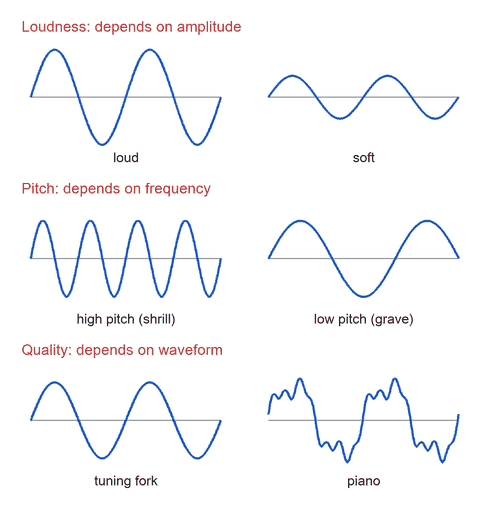
Concept: A musical sound has three characteristics: loudness depends on the amplitude (L ∝ a²), pitch on the frequency, and quality (timbre) on the waveform, that is, on the subsidiary notes present with the principal note and their relative amplitudes.
Step 1 — Loudness (part i).
The loudness of a sound is decided by the amplitude of the wave; loudness is proportional to the square of the amplitude.
Step 2 — Quality (part ii).
The quality of a note is decided by its waveform, that is, by the number of subsidiary notes present with the principal note and their relative amplitudes.
Step 3 — Pitch (part iii).
The pitch of a note is decided by its frequency: the higher the frequency, the higher (shriller) the pitch.
Watch out: Pitch depends on frequency, not on loudness; a loud note can still be of low pitch.
Therefore, (i) loudness depends on the amplitude, (ii) quality on the waveform and (iii) pitch on the frequency.
- 113 marks
Question 11
(i) What are damped vibrations?
(ii) Give one example of damped vibrations.
(iii) Name the phenomenon that causes a loud sound when the stem of a vibrating tuning fork is kept pressed on the surface of a table.
Solve with AIWritten solution
Solution:
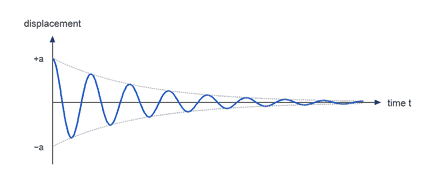
Concept: Damped vibrations are vibrations of decreasing amplitude: in a real medium a resistive (frictional) force opposes the motion, energy is lost as heat in every vibration, and the amplitude keeps falling, while the frequency stays the same. Forced vibrations are the vibrations of a body under an external periodic force: the body vibrates with the frequency of the applied force, not with its own natural frequency, and usually with a small amplitude.
Step 1 — Define damped vibrations (part i).
The periodic vibrations of a body of decreasing amplitude, in the presence of a resistive (frictional) force, are called damped vibrations. The energy lost in each vibration changes into heat.
Step 2 — Give an example (part ii).
A tuning fork struck on a rubber pad and left vibrating in air: its sound slowly dies away as its amplitude decreases. (A simple pendulum swinging in air is another example.)
Step 3 — Name the phenomenon (part iii).
When the stem of the vibrating fork is pressed on the table, the stem makes the table top vibrate with the frequency of the fork. These are forced vibrations. The table top has a much larger vibrating area, so it sets a much larger mass of air vibrating and a louder sound is heard.
Watch out: The table top is not in resonance: it is simply forced to vibrate at the fork's frequency, whatever its own natural frequency.
Therefore, (i) damped vibrations are vibrations of decreasing amplitude in the presence of a resistive force; (ii) example: a tuning fork vibrating in air; (iii) forced vibrations.
- 124 marks
Question 12
(i) A wire of length 80 cm has a frequency of 256 Hz. Calculate the length of a similar wire under similar tension, which will have frequency 1024 Hz.
(ii) A certain sound has a frequency of 256 hertz and a wavelength of 1.3 m.
(a) Calculate the speed with which this sound travels.
(b) What difference would be felt by a listener between the above sound and another sound travelling at the same speed, but of wavelength 2.6 m?
Solve with AIWritten solution
Solution:
Concept: The natural frequency of a stretched string is , where l is the vibrating length, T the tension and m the mass per unit length. So f ∝ 1/l (same tension and wire), f ∝ √T (same length and wire), and a thicker, heavier wire has a lower frequency. For every wave, speed = frequency × wavelength, V = fλ. The frequency is fixed by the source; it does not change when the wave passes from one medium into another (only the speed and the wavelength change).
Given: l₁ = 80 cm, f₁ = 256 Hz, f₂ = 1024 Hz; sound of 256 Hz and λ = 1.3 m; second sound λ' = 2.6 m.
(i)
Step 1 — Write the relation for the two wires.
For similar wires under the same tension, f ∝ 1/l, so the product of the frequency and the length is the same for both wires.
Step 2 — Find the length of the second wire.
We put f₁ = 256 Hz, l₁ = 80 cm and f₂ = 1024 Hz.
The frequency is 4 times, so the length is one-fourth.
(ii)(a)
Step 3 — Find the speed of the sound.
For any wave, speed = frequency × wavelength.

(ii)(b)
Step 4 — Find the frequency of the second sound.
The second sound travels at the same speed, 332.8 m s⁻¹, with wavelength 2.6 m.
Step 5 — Compare the two sounds.
The second sound has half the frequency, 128 Hz instead of 256 Hz. Pitch depends on frequency, so the listener hears it at a lower pitch: it sounds grave (flat), while the first one is shriller.
Watch out: Since f ∝ 1/l, a higher frequency needs a SHORTER wire, so the length is 80 ÷ 4, not 80 × 4.
Therefore, (i) the length is 20 cm; (ii)(a) the speed is 332.8 m s⁻¹; (ii)(b) the second sound (128 Hz) has a lower pitch: it is grave, while the first is shriller.
- 132 marks
Question 13
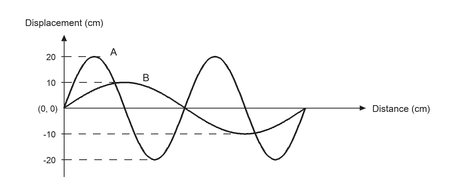
Displacement distance graph of two sound waves A and B, travelling in a medium, are as shown in the diagram below.
Study the two sound waves and compare their:
(i) Amplitudes
(ii) Wavelengths
Solve with AIWritten solution
Solution:
Concept: On a displacement–distance graph, the amplitude is the greatest displacement from the mean line, and the wavelength is the length of one complete wave (one crest and one trough).
Step 1 — Read the amplitudes.
The amplitude is the greatest displacement from the mean (zero) line. From the graph, wave A reaches 20 cm and wave B reaches 10 cm.
Step 2 — Read the wavelengths.
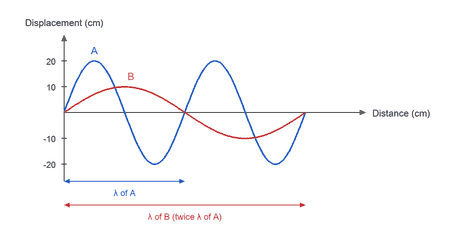
The wavelength is the length of one complete wave (one crest and one trough). Over the same distance, A completes two whole waves while B completes only one, so one wave of A is half as long as one wave of B.
Watch out: Count complete waves (crest + trough), not just crests, over the same distance.
Therefore, (i) amplitude of A : amplitude of B = 2 : 1 and (ii) wavelength of A : wavelength of B = 1 : 2.
- 142 marks
Question 14
(i) What do you understand by free vibrations of a body?
(ii) Why does the amplitude of a vibrating body continuously decrease during damped vibrations?
Solve with AIWritten solution
Solution:
Concept: Free (natural) vibrations are the vibrations of a body under its own restoring force only, with no resistive or external force. The body vibrates with its own natural frequency, and its amplitude and frequency stay constant. They are possible only in vacuum. Damped vibrations are vibrations of decreasing amplitude: in a real medium a resistive (frictional) force opposes the motion, energy is lost as heat in every vibration, and the amplitude keeps falling, while the frequency stays the same.
Step 1 — Define free vibrations (part i).
The periodic vibrations of a body of constant amplitude and constant (natural) frequency, under its own restoring force only and in the absence of any resistive or external force, are called free (natural) vibrations.
Step 2 — Explain why the amplitude decreases (part ii).
In a real medium a frictional (resistive) force acts on the vibrating body and opposes its motion. In each vibration the body does work against this force, so some of its energy is lost as heat. With less energy left, the body cannot move as far from its mean position, so its amplitude keeps decreasing until it stops.

Watch out: Damping lowers the amplitude, not the frequency; the body keeps vibrating at (nearly) the same frequency while its amplitude dies away.
Therefore, (i) free vibrations are vibrations of constant amplitude at the body's natural frequency with no resistive or external force; (ii) the amplitude decreases because energy is lost in overcoming the frictional force of the medium.
- 153 marks
Question 15
The diagram below shows a wire stretched over a sonometer. Stems of two vibrating tuning forks A and B are touched to the wooden box of the sonometer. It is observed that the paper rider (a small piece of paper folded at the centre) present on the wire flies off when the stem of vibrating tuning fork B is touched to the wooden box but the paper just vibrates when the stem of vibrating tuning fork A is touched to the wooden box.
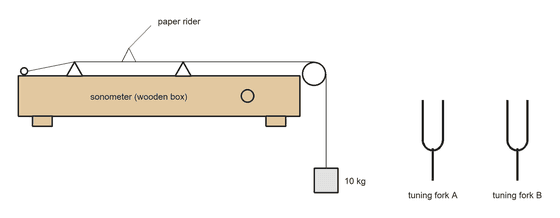
(i) Name the phenomenon when the paper rider just vibrates.
(ii) Name the phenomenon when the paper rider flies off.
(iii) Why does the paper rider fly off when the stem of tuning fork B is touched to the box?
Solve with AIWritten solution
Solution:
Concept: Forced vibrations are the vibrations of a body under an external periodic force: the body vibrates with the frequency of the applied force, not with its own natural frequency, and usually with a small amplitude. Resonance is a special case of forced vibrations: when the frequency of the applied periodic force is equal to the natural frequency of the body, the body readily takes energy from the force and vibrates with a very large amplitude.
Step 1 — Paper rider just vibrates (part i).
Fork A makes the wire vibrate with the frequency of A, which is different from the natural frequency of the wire. These are forced vibrations, of small amplitude, so the rider only flutters.
Step 2 — Paper rider flies off (part ii).
With fork B the wire vibrates with a very large amplitude: this is resonance (resonant vibrations).
Step 3 — Explain why the rider flies off with B (part iii).
The frequency of fork B is equal to the natural frequency of the stretched wire. The wire then takes energy from the fork readily and vibrates with a very large amplitude, and the strongly vibrating wire throws the paper rider off.
Watch out: Both forks force the wire to vibrate; only the fork whose frequency EQUALS the wire's natural frequency gives resonance.
Therefore, (i) forced vibrations; (ii) resonance; (iii) the frequency of fork B is equal to the natural frequency of the wire, so the wire resonates with a large amplitude and throws the rider off.
- 164 marks
Question 16
A person is standing at the sea shore. An observer on the ship which is anchored in between a vertical cliff and the person on the shore fires a gun. The person on the shore hears two sounds, 2 seconds and 3 seconds after seeing the smoke of the fired gun. If the speed of sound in the air is 320 then calculate:
(i) the distance between the observer on the ship and the person on the shore.
(ii) the distance between the cliff and the observer on the ship.
 Solve with AI
Written solution
Solution:
Concept: An echo is the sound heard after reflection from a distant obstacle, after the original sound has ceased. The sensation of a sound stays in our ear for about 0.1 s, so the echo is heard separately only if it arrives at least 0.1 s after the original sound. If the obstacle is at a distance d and the speed of sound is V, the sound goes to the obstacle and comes back, covering 2d in the echo time t, so 2d = Vt, that is d = Vt ÷ 2.
Given: V = 320 m s⁻¹; direct sound after t₁ = 2 s; echo after t₂ = 3 s.
Step 1 — Understand the two sounds.
The person on the shore hears the gun twice: first the direct sound from the ship, then the echo from the cliff. Light from the smoke arrives almost at once, so the times are the times taken by the sound.
Step 2 — Find the distance between the ship and the person (part i).
The direct sound travels straight from the ship to the person in 2 s, and distance = speed × time.
Step 3 — Write the path of the echo (part ii).
Let the cliff be x metres from the ship. The echo goes from the ship to the cliff (x), back to the ship (x) and then on to the person (640 m), and this takes 3 s.
Step 4 — Solve for x.
We take 640 from both sides and halve the result.
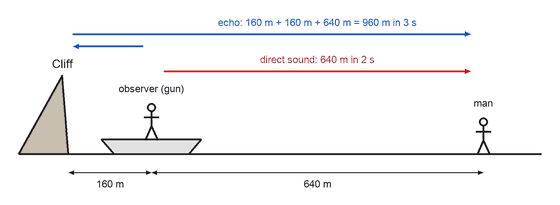
The echo arrives 1 s after the direct sound because it travels an extra 2 × 160 m = 320 m.
Watch out: The 3 s echo path is ship → cliff → ship → person; it is not just twice the cliff distance.
Therefore, (i) the ship is 640 m from the person, and (ii) the cliff is 160 m from the observer on the ship.
- 172 marks
Question 17
A man playing a flute is able to produce notes of different frequencies. If he closes the holes near his mouth, will the pitch of the note produced, increase or decrease? Give a reason.
Solve with AIWritten solution
Solution:
Concept: The note of a wind instrument or a jar comes from its vibrating air column. The natural frequency of an air column is inversely proportional to its length (f ∝ 1/l): a shorter air column gives a higher frequency, that is, a higher pitch (a shriller note).
Step 1 — Find the vibrating air column.
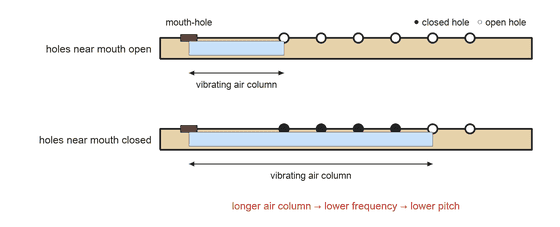
In a flute the note comes from the air column between the mouth-hole and the first open hole. Closing the holes near the mouth makes the first open hole farther from the mouth-hole, so the vibrating air column becomes longer.
Step 2 — Decide the change in pitch.
Since f ∝ 1/l, a longer air column vibrates with a lower frequency, and a lower frequency gives a lower pitch (a flatter note).
Watch out: It is the AIR column that vibrates, not the flute's tube; a longer air column lowers the pitch.
Therefore, the pitch decreases, because the vibrating air column becomes longer and its frequency falls.
- 182 marks
Question 18
Two waves of the same pitch have amplitudes in the ratio 1:3. What will be the ratio of their:
(i) intensities and
(ii) frequencies?
Solve with AIWritten solution
Solution:
Concept: Loudness depends on the amplitude of the wave: the loudness (and the intensity) is proportional to the square of the amplitude, L ∝ a². Pitch depends on the frequency, and quality on the waveform.
Given: Same pitch; amplitudes in the ratio 1 : 3.
Step 1 — Find the ratio of intensities (part i).
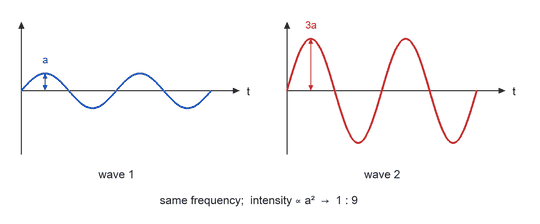
The intensity is proportional to the square of the amplitude, so we square the amplitude ratio 1 : 3.
Step 2 — Find the ratio of frequencies (part ii).
Pitch depends on frequency. The two waves have the same pitch, so they have the same frequency, and the ratio is 1 : 1.
Watch out: Square the amplitude ratio: 1 : 3 gives 1 : 9 for intensity, not 1 : 3.
Therefore, (i) the ratio of intensities is 1 : 9 and (ii) the ratio of frequencies is 1 : 1.
- 192 marks
Question 19
(i) Define resonant vibrations.
(ii) Which characteristic of sound, makes it possible to recognize a person by his voice without seeing him ?
Solve with AIWritten solution
Solution:
Concept: Resonance is a special case of forced vibrations: when the frequency of the applied periodic force is equal to the natural frequency of the body, the body readily takes energy from the force and vibrates with a very large amplitude. A musical sound has three characteristics: loudness depends on the amplitude (L ∝ a²), pitch on the frequency, and quality (timbre) on the waveform, that is, on the subsidiary notes present with the principal note and their relative amplitudes.
Step 1 — Define resonant vibrations (part i).
When a body vibrates under an external periodic force whose frequency is exactly equal to the natural frequency of the body, it vibrates with a large amplitude. These are called resonant vibrations.
Step 2 — Name the characteristic (part ii).
The vocal cords of each person vibrate with a waveform of their own (a different set of subsidiary notes). So the quality (timbre) of every voice is different, and we can recognise a person by his voice without seeing him.
Watch out: Two voices of the same pitch and loudness still differ in quality; that is why pitch or loudness cannot be the answer.
Therefore, (i) resonant vibrations are the large-amplitude vibrations of a body driven at its own natural frequency; (ii) the quality (timbre) of the sound.
- 203 marks
Question 20
It is observed that during march-past we hear a bass drum distinctly from a distance compared to the side drums.
(i) Name the characteristic of sound associated with the above observation.
(ii) Give a reason for the above observation.
Solve with AIWritten solution
Solution:
Concept: The loudness of a sound depends on the energy the source sends out, which depends on its amplitude and on the area of the vibrating surface: a larger vibrating area sets more air vibrating.
Step 1 — Name the characteristic (part i).
Hearing the bass drum more distinctly from far away is about loudness.
Step 2 — Give the reason (part ii).
A bass drum has a much larger vibrating surface (membrane) than a side drum. When it is struck, it sets a much larger mass of air vibrating, so it sends out more sound energy. The sound that reaches a distant listener is therefore of greater intensity, and the bass drum is heard louder and more distinctly.
Watch out: The bass drum is heard better because it is LOUDER (larger vibrating area), not because its pitch is higher; its pitch is in fact lower.
Therefore, (i) loudness; (ii) the bass drum has a larger vibrating area, so it sets more air vibrating and sends out more sound energy.
- 213 marks
Question 21
A pendulum has a frequency of 4 vibrations per second. An observer starts the pendulum and fires a gun simultaneously. He hears the echo from the cliff after 6 vibrations of the pendulum. If the velocity of sound in air is 340 , find the distance between the cliff and the observer.
Solve with AIWritten solution
Solution:
Concept: An echo is the sound heard after reflection from a distant obstacle, after the original sound has ceased. The sensation of a sound stays in our ear for about 0.1 s, so the echo is heard separately only if it arrives at least 0.1 s after the original sound. If the obstacle is at a distance d and the speed of sound is V, the sound goes to the obstacle and comes back, covering 2d in the echo time t, so 2d = Vt, that is d = Vt ÷ 2.
Given: Pendulum frequency 4 vibrations per second; echo after 6 vibrations; V = 340 m s⁻¹.
Step 1 — Find the echo time.
The pendulum makes 4 vibrations in 1 s, so 6 vibrations take 6 ÷ 4 seconds.
Step 2 — Find the distance of the cliff.
In this time the sound goes to the cliff and back, covering 2d.

Watch out: 4 vibrations per second means one vibration takes 1/4 s; 6 vibrations take 1.5 s, not 6 × 4 s.
Therefore, the cliff is 255 m from the observer.
- 224 marks
Question 22
Two pendulums C and D are suspended from a wire as shown in the given figure. Pendulum C is made to oscillate by displacing it from its mean position. It is seen that D also starts oscillating.

(i) Name the type of oscillation, C will execute.
(ii) Name the type of oscillation, D will execute.
(iii) If the length of D is made equal to C, then what difference will you notice in the oscillations of D?
(iv) What is the name of the phenomenon when the length of D is made equal to C?
Solve with AIWritten solution
Solution:
Concept: A pendulum's natural frequency depends on its length. Forced vibrations are the vibrations of a body under an external periodic force: the body vibrates with the frequency of the applied force, not with its own natural frequency, and usually with a small amplitude. Resonance is a special case of forced vibrations: when the frequency of the applied periodic force is equal to the natural frequency of the body, the body readily takes energy from the force and vibrates with a very large amplitude.
Step 1 — Oscillation of C (part i).
C is displaced and released, so it oscillates on its own with its natural frequency: natural (free) vibrations. (In air its amplitude slowly falls, so in practice they are damped.)
Step 2 — Oscillation of D (part ii).
C pushes the common wire to and fro, and the wire pushes D at C's frequency. D's length, and so its natural frequency, is different from C's, so D makes forced vibrations of small amplitude.
Step 3 — D made as long as C (part iii).
D now has the same natural frequency as C, so it takes energy from C readily and soon swings with a large amplitude, as large as C's at first. Energy then passes back and forth between the two pendulums: as D's amplitude grows, C's falls, and then the other way round.

Step 4 — Name the phenomenon (part iv).
Large-amplitude vibrations of D at its own natural frequency, driven by C, are resonance (resonant vibrations).
Watch out: D vibrates at C's frequency in both cases; what changes when the lengths are made equal is D's AMPLITUDE.
Therefore, (i) C executes natural (free) vibrations; (ii) D executes forced vibrations; (iii) D then swings with a large amplitude; (iv) resonance.
- 232 marks
Question 23
Draw a graph between displacement from mean position and time for a body executing free vibration in a vacuum.
Solve with AIWritten solution
Solution:
Concept: Free (natural) vibrations are the vibrations of a body under its own restoring force only, with no resistive or external force. The body vibrates with its own natural frequency, and its amplitude and frequency stay constant. They are possible only in vacuum.
Step 1 — Decide the shape of the graph.
In vacuum no resistive force acts, so the body loses no energy. Its amplitude a stays the same, and it vibrates at its natural frequency, so every vibration takes the same time T.
Step 2 — Draw the graph.
Displacement against time is a regular wave whose crests all reach the same height +a and whose troughs all reach the same depth −a, with every complete wave taking the same time T.
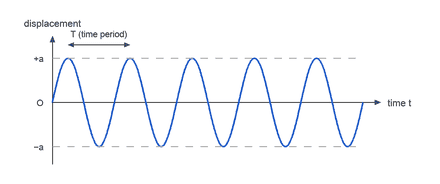
The equal heights show the constant amplitude, and the equal spacing shows the constant frequency.
Watch out: Do not draw the crests getting smaller: that is the graph of damped vibrations in air.
Therefore, the graph is a wave of constant amplitude and constant time period, as drawn above.
- 242 marks
Question 24
A sound wave travelling in water has wavelength 0.4 m. Is this wave audible in air? (The speed of sound in water = )
Solve with AIWritten solution
Solution:
Concept: For every wave, speed = frequency × wavelength, V = fλ. The frequency is fixed by the source; it does not change when the wave passes from one medium into another (only the speed and the wavelength change). A sound is audible if its frequency lies between 20 Hz and 20 kHz.
Given: λ = 0.4 m in water; V = 1400 m s⁻¹.
Step 1 — Find the frequency.
The frequency is the speed divided by the wavelength (speed in water 1400 m s⁻¹, wavelength 0.4 m).
Step 2 — Compare with the audible range.
The frequency is set by the source and does not change when the wave passes from water into air (only the speed and the wavelength change). So in air the frequency is still 3500 Hz, which lies between 20 Hz and 20,000 Hz.
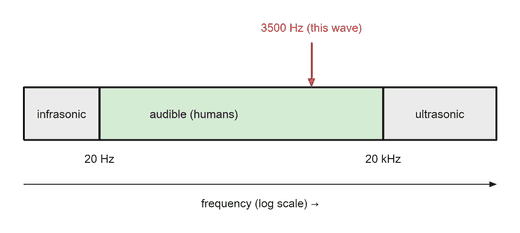
Watch out: Audibility depends on FREQUENCY, not on wavelength; the 0.4 m wavelength in water would change in air, but the frequency would not.
Therefore, yes, the wave is audible in air: its frequency is 3500 Hz, inside the audible range of 20 Hz to 20 kHz.
- 253 marks
Question 25
(i) Name the system which enables us to locate underwater objects by transmitting ultrasonic waves and detecting the reflecting impulse.
(ii) What are acoustically measurable quantities related to pitch and loudness?
Solve with AIWritten solution
Solution:
Concept: Ultrasonic waves are sound waves of frequency above 20 kHz, beyond the upper limit of human hearing (the audible range is 20 Hz to 20 kHz). Their wavelength is very short, so they can be sent as a narrow beam in one direction, and they are not easily absorbed by water. Pitch and loudness are what the listener feels; frequency and intensity are what instruments measure.
Step 1 — Name the system (part i).
Locating underwater objects with ultrasonic pulses and their echoes is done by SONAR (Sound Navigation And Ranging).
Step 2 — Name the quantity for pitch (part ii).
Pitch is a sensation; the measurable quantity behind it is the frequency of the sound wave.
Step 3 — Name the quantity for loudness (part ii).
Loudness is a sensation; the measurable quantity behind it is the intensity of the sound wave, the sound energy passing per second through unit area (in W m⁻²); the sound level is expressed in decibel.
Watch out: Intensity is measured; loudness depends also on the listener's ear.
Therefore, (i) SONAR; (ii) pitch is related to the frequency and loudness to the intensity of the sound wave.
- 264 marks
Question 26
(i) When a tuning fork [vibrating] is held close to ear, one hears a faint hum. The same [vibrating tuning fork] is held such that its stem is in contact with the table surface, then one hears a loud sound. Explain.
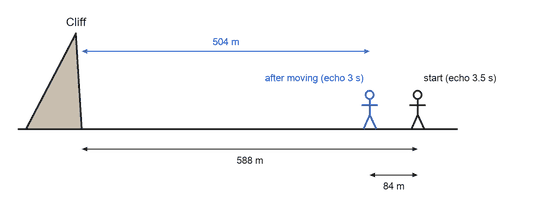
(ii) A man standing in front of a vertical cliff fires a gun. He hears the echo after 3.5 seconds. On moving closer to the cliff by 84 m, he hears the echo after 3 seconds. Calculate the distance of the cliff from the initial position of the man.
Solve with AIWritten solution
Solution:
Concept: Forced vibrations are the vibrations of a body under an external periodic force: the body vibrates with the frequency of the applied force, not with its own natural frequency, and usually with a small amplitude. An echo is the sound heard after reflection from a distant obstacle, after the original sound has ceased. The sensation of a sound stays in our ear for about 0.1 s, so the echo is heard separately only if it arrives at least 0.1 s after the original sound. If the obstacle is at a distance d and the speed of sound is V, the sound goes to the obstacle and comes back, covering 2d in the echo time t, so 2d = Vt, that is d = Vt ÷ 2.
Given: Echo after t₁ = 3.5 s; after moving 84 m closer, echo after t₂ = 3 s.
(i)
Step 1 — Fork held in air.
The prongs of the fork have a small surface area, so they set only a little air vibrating, and only a faint hum is heard.
Step 2 — Fork pressed on the table.
The stem makes the table top vibrate with the frequency of the fork (forced vibrations). The table top has a large surface area, so it sets a much larger mass of air vibrating and sends out much more sound energy, and a loud sound is heard.
(ii)
Step 3 — Write the two echo times.
Let the cliff be d metres from the first position and V be the speed of sound. Each echo time is the round trip divided by the speed.
Step 4 — Subtract to find V.
Subtracting the second equation from the first removes d.
Step 5 — Find d.
We put V = 336 m s⁻¹ in the first echo.
Step 6 — Check the answer.
From the new position the cliff is 84 m nearer, and the echo time comes out as given.
Watch out: Moving 84 m closer shortens the ROUND trip by 168 m, which is what saves the 0.5 s.
Therefore, (i) the table top is forced to vibrate and its large area sends out much more sound energy, so the sound is louder; (ii) the cliff was 588 m from the man's first position.
- 271 mark
Question 27
Free vibrations are :
Solve with AIAnswer
(A) the vibrations under the influence of a periodic force.
(B) the vibrations with larger amplitude.
(C) the vibrations when the frequency continuously decreases.
- Correct
(D) the vibrations with a constant frequency and constant amplitude.
Answer: (D) the vibrations with a constant frequency and constant amplitude.
Concept: Free (natural) vibrations are the vibrations of a body under its own restoring force only, with no resistive or external force. The body vibrates with its own natural frequency, and its amplitude and frequency stay constant. They are possible only in vacuum.
Step 1 — Recall what acts on the body.
In free vibrations only the body's own restoring force acts; there is no resistive force and no external force.
Step 2 — Decide the amplitude and the frequency.
No energy is lost, so the amplitude stays constant. The body vibrates at its own natural frequency, which depends on its size and shape, so the frequency also stays constant.
Watch out: A large amplitude is the mark of resonance, not of free vibrations.
Why the other options are wrong:
- (A) the vibrations under the influence of a periodic force: vibrations under a periodic force are forced vibrations.
- (B) the vibrations with larger amplitude: a large amplitude is the mark of resonance; free vibrations can have any amplitude, which stays constant.
- (C) the vibrations when the frequency continuously decreases: free vibrations keep a constant frequency, their natural frequency; it does not decrease.
Therefore, free vibrations are vibrations with a constant frequency and constant amplitude, option (D).
- 281 mark
Question 28
The diagram below shows four sound waves. Which sound has the highest pitch?
 Solve with AI
Answer
(A) Wave A
- Correct
(B) Wave B
(C) Wave C
(D) Wave D
Answer: (B) Wave B
Concept: Pitch depends on frequency. On a displacement–time graph, the wave that completes the most waves in the same time has the highest frequency.
Step 1 — Count the waves.
All four graphs cover the same time. Counting complete waves (crest and trough): A has about 1, B has 3, C has 1½ and D has 2.
Step 2 — Pick the highest pitch.
The wave with the most complete waves in the same time has the highest frequency. Pitch depends on frequency, so wave B, with 3 waves, has the highest pitch (the shrillest sound).
Watch out: Pitch is not decided by the height of the wave; that is the amplitude, which decides loudness.
Why the other options are wrong:
- (A) Wave A: wave A completes only about one wave, the fewest, so it has the lowest frequency and the lowest pitch.
- (C) Wave C: wave C completes about one and a half waves, a lower frequency than B.
- (D) Wave D: wave D completes two waves, more than A and C but still fewer than B.
Therefore, wave B has the highest pitch, option (B).
- 293 marks
Question 29
Rohit playing a flute and Anita playing a piano emit sounds of same pitch and loudness.
(a) Name one characteristic that is different for waves from the two different instruments.
(b) If now the loudness of the sound from flute becomes four times that of the sound from piano, then write the value of the ratio ( – amplitude of sound wave from flute, – amplitude of sound wave from piano)
(c) Define 'Pitch' of a sound.
Solve with AIWritten solution
Solution:
Concept: A musical sound has three characteristics: loudness depends on the amplitude (L ∝ a²), pitch on the frequency, and quality (timbre) on the waveform, that is, on the subsidiary notes present with the principal note and their relative amplitudes.
Step 1 — Find what differs (part a).
Same pitch means the same frequency, and same loudness means the same amplitude. What still differs is the waveform: each instrument produces its own set of subsidiary notes with the principal note. So the quality (timbre) of the two sounds is different.
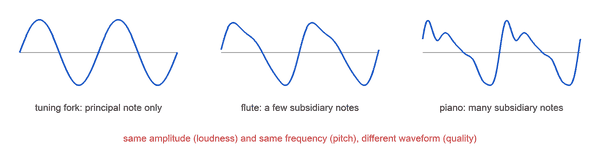
Step 2 — Write the loudness ratio (part b).
Loudness is proportional to the square of the amplitude, and the flute is now four times as loud as the piano.
Step 3 — Find the amplitude ratio (part b).
We take the square root of both sides.
Step 4 — Define pitch (part c).
Pitch is the characteristic of sound by which an acute (shrill) note can be told apart from a grave (flat) note of the same loudness and quality. It depends on the frequency of the sound.
Watch out: Four times the loudness needs only twice the amplitude (√4 = 2), not four times.
Therefore, (a) the quality (waveform) is different; (b) ; (c) pitch is the characteristic by which a shrill note is told apart from a grave note; it depends on frequency.
- 303 marks
Question 30
The diagram below shows a vibrating tuning fork E mounted on a sound box X. When the vibrating tuning forks A, B, C and D are placed on the sound box Y one by one, it is observed that a louder sound is produced when the tuning fork B is placed on Y.
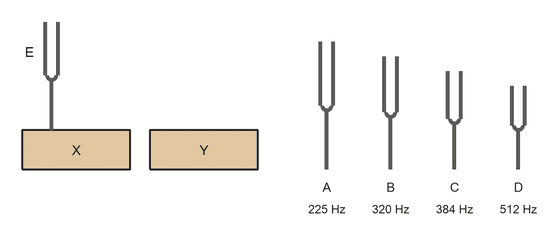
(a) What is the frequency of tuning fork E?
(b) Why does B produce a louder sound?
Solve with AIWritten solution
Solution:
Concept: Resonance is a special case of forced vibrations: when the frequency of the applied periodic force is equal to the natural frequency of the body, the body readily takes energy from the force and vibrates with a very large amplitude.
Step 1 — Find the frequency of E (part a).
A loud sound is heard only when the fork on box Y is in resonance with fork E, that is, when the two forks have the same frequency. The loud sound comes with fork B, of frequency 320 Hz, so E also has a frequency of 320 Hz.
Step 2 — Explain the loud sound with B (part b).
The frequency of B (320 Hz) equals the natural frequency of fork E. The vibrations of B, carried through the air of the sound boxes, set E vibrating with a large amplitude (resonance), and both boxes, with their large mass of air, vibrate strongly, so a loud sound is heard.
Step 3 — Compare with the other forks.
Forks A, C and D (225 Hz, 384 Hz and 512 Hz) have frequencies different from E's, so they make E perform only weak forced vibrations, and the sound is not loud.
Watch out: E resonates only with a fork of EXACTLY its own frequency; a fork of double frequency (like 512 Hz against 256 Hz) is a different case and is not what the question shows.
Therefore, (a) the frequency of E is 320 Hz; (b) B has the same frequency as E, so E resonates with it and a loud sound is produced.
- 313 marks
Question 31
Study the below figure and answer the following :
(a) What type of vibration does the figure represent?
(b) State one reason for which the amplitude of the vibration decreases with time.
(c) Write an example of natural vibrations.
 Solve with AI
Written solution
Solution:
Concept: Damped vibrations are vibrations of decreasing amplitude: in a real medium a resistive (frictional) force opposes the motion, energy is lost as heat in every vibration, and the amplitude keeps falling, while the frequency stays the same. Free (natural) vibrations are the vibrations of a body under its own restoring force only, with no resistive or external force. The body vibrates with its own natural frequency, and its amplitude and frequency stay constant. They are possible only in vacuum.
Step 1 — Read the graph (part a).
The displacement starts at 1 m and the swings get smaller and smaller, while the time for each swing stays the same. Vibrations whose amplitude decreases with time are damped vibrations.
Step 2 — Give a reason (part b).
The frictional (resistive) force of the surrounding medium (air) opposes the motion. In each vibration the body uses some of its energy in doing work against this force; that energy is lost as heat, so the amplitude keeps decreasing.
Step 3 — Give an example of natural vibrations (part c).
A simple pendulum (or a tuning fork) vibrating in vacuum: with no medium to resist it, it vibrates at its natural frequency with a constant amplitude.
Watch out: The frequency of damped vibrations does not fall; only the amplitude does.
Therefore, (a) damped vibrations; (b) the frictional force of the medium takes away energy in every vibration; (c) a simple pendulum oscillating in vacuum.
- 321 mark
Question 32
When a body vibrates under a periodic force, the vibrations of the body are always:
Solve with AIAnswer
(A) natural vibrations
(B) damped vibrations
- Correct
(C) forced vibrations
(D) resonant vibrations
Answer: (C) forced vibrations
Concept: Forced vibrations are the vibrations of a body under an external periodic force: the body vibrates with the frequency of the applied force, not with its own natural frequency, and usually with a small amplitude.
Step 1 — Apply the definition.
A body driven by an external periodic force vibrates with the frequency of that force, not with its own natural frequency. That is the definition of forced vibrations.
Step 2 — Check 'always'.
This holds whatever the frequency of the force. Resonance happens only in the one special case when the frequency of the force equals the natural frequency, so the vibrations are always forced, and only sometimes resonant.
Watch out: Resonance is a special case of forced vibrations, so it cannot be the answer for 'always'.
Why the other options are wrong:
- (A) natural vibrations: natural vibrations happen with no external force acting, but here a periodic force drives the body.
- (B) damped vibrations: damped vibrations are vibrations whose amplitude dies away because of friction; a periodic force can keep the amplitude steady.
- (D) resonant vibrations: resonant vibrations happen only when the frequency of the force equals the natural frequency of the body, not always.
Therefore, a body vibrating under a periodic force always performs forced vibrations, option (C).
- 331 mark
Question 33
Two notes are produced from two different musical instruments, such that they have same loudness and same pitch. The produced notes differ in their:
Solve with AIAnswer
- Correct
(A) Waveform
(B) Frequency
(C) Wavelength
(D) Speed
Answer: (A) Waveform
Concept: A musical sound has three characteristics: loudness depends on the amplitude (L ∝ a²), pitch on the frequency, and quality (timbre) on the waveform, that is, on the subsidiary notes present with the principal note and their relative amplitudes.
Step 1 — Use the equal pitch and loudness.
Same pitch means the same frequency, and same loudness means the same amplitude.
Step 2 — Find what is left.
Different instruments produce different subsidiary notes with the principal note, so their waveforms are different. This difference in quality (timbre) lets us tell the two notes apart.
Watch out: Two notes can match in pitch and loudness and still sound different: the difference is in the waveform.
Why the other options are wrong:
- (B) Frequency: the pitch is the same, so the frequency is the same.
- (C) Wavelength: both notes travel in the same air at the same speed with the same frequency, so λ = V ÷ f is the same.
- (D) Speed: the speed of sound depends on the medium (air), not on the instrument, so it is the same.
Therefore, the two notes differ in their waveform, option (A).
- 342 marks
Question 34
A metal foot ruler is held at the edge of a table. It is pressed at its free end and then released. It vibrates.
(a) Name the vibrations produced.
(b) State one way to increase the frequency of these vibrations.
Solve with AIWritten solution
Solution:
Concept: Free (natural) vibrations are the vibrations of a body under its own restoring force only, with no resistive or external force. The body vibrates with its own natural frequency, and its amplitude and frequency stay constant. They are possible only in vacuum. The natural frequency of a ruler clamped at one end is higher when its vibrating part is shorter.
Step 1 — Name the vibrations (part a).
Once released, the ruler vibrates on its own at its natural frequency, with no external periodic force: these are natural (free) vibrations. (In air their amplitude slowly falls, so in practice they are damped.)
Step 2 — Find a way to raise the frequency (part b).
The natural frequency of the ruler depends on the length of the part that sticks out beyond the table edge. Pushing more of the ruler onto the table shortens the vibrating part, which is stiffer and vibrates faster, so the frequency increases.
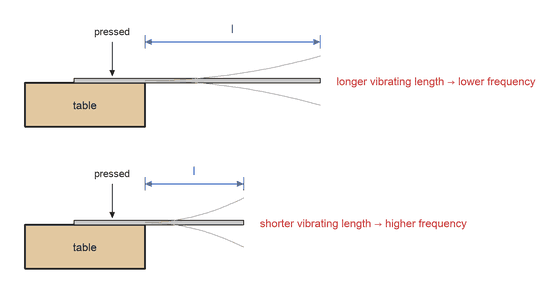
Watch out: Pressing the free end harder only gives a larger amplitude (louder sound), not a higher frequency.
Therefore, (a) natural (free) vibrations; (b) decrease the length of the ruler projecting beyond the table edge.
- 353 marks
Question 35
(a) Which characteristic of sound is affected due to the larger surface of a school bell?
(b) Calculate the distance covered by the Ultrasonic wave having a velocity of in 14 s, when it is received after reflection by the receiver of the SONAR.
Solve with AIWritten solution
Solution:
Concept: An echo is the sound heard after reflection from a distant obstacle, after the original sound has ceased. The sensation of a sound stays in our ear for about 0.1 s, so the echo is heard separately only if it arrives at least 0.1 s after the original sound. If the obstacle is at a distance d and the speed of sound is V, the sound goes to the obstacle and comes back, covering 2d in the echo time t, so 2d = Vt, that is d = Vt ÷ 2. A larger vibrating surface sends out more sound energy, so the sound is louder.
Given: V = 1.5 km s⁻¹; echo received after 14 s.
Step 1 — Name the characteristic (part a).
A bell with a larger surface sets a larger area of air vibrating and sends out more sound energy, so it is heard louder and farther. The characteristic affected is loudness.
Step 2 — Change the speed into m s⁻¹ (part b).
Since 1 km is 1000 m, we multiply the speed by 1000.
Step 3 — Find the distance covered (part b).
The wave travels to the obstacle and back in 14 s, and distance = speed × time.
That is 21 km, there and back.
Step 4 — Find the distance of the obstacle.
The obstacle is half of this distance away, since the wave covers the gap twice.
Watch out: Read the question carefully: the distance COVERED by the wave is the whole round trip; the DISTANCE of the obstacle is half of it.
Note: the question asks for the distance covered by the wave, which is 21 km; if it is read as the distance of the obstacle, the answer is 10.5 km.
Therefore, (a) loudness; (b) the wave covers 21,000 m (21 km) in going to the obstacle and back, so the obstacle is 10,500 m (10.5 km) from the SONAR.
- 364 marks
Question 36
We are able to see the T.V. channels clearly when we set T.V. on auto-tuning.
(a) Which phenomenon led to the clear visibility of the channels, due to auto tuning?
(b) Define the above phenomenon mentioned by you.
(c) Give any one more example of this phenomenon.
Solve with AIWritten solution
Solution:
Concept: Resonance is a special case of forced vibrations: when the frequency of the applied periodic force is equal to the natural frequency of the body, the body readily takes energy from the force and vibrates with a very large amplitude.
Step 1 — Name the phenomenon (part a).
Auto-tuning makes the natural frequency of the TV's receiving circuit equal to the frequency of a channel's signal, so this is resonance.
Step 2 — Define resonance (part b).
Resonance is a special case of forced vibrations: when the frequency of an externally applied periodic force on a body is equal to its natural frequency, the body readily begins to vibrate with a large amplitude.
During auto-tuning, the TV changes the natural frequency of its circuit until it equals a channel's frequency; that signal is then received strongly and the picture is clear.
Step 3 — Give one more example (part c).
Soldiers are asked to break step while crossing a suspension bridge: if the frequency of their marching equalled the natural frequency of the bridge, it would resonate and vibrate with a dangerously large amplitude. (Tuning a radio set is another example.)
Watch out: Resonance needs the two frequencies to be EQUAL; any other driving frequency gives only small forced vibrations.
Therefore, (a) resonance; (b) resonance is the large-amplitude vibration of a body when the frequency of the applied periodic force equals its natural frequency; (c) a suspension bridge set vibrating by soldiers marching in step.
- 371 mark
Question 37
When the stem of vibrating tuning fork is pressed on a table, the tabletop starts vibrating. These vibrations are definitely an example of:
Solve with AIAnswer
(A) resonance
(B) natural vibrations
- Correct
(C) forced vibrations
(D) damped vibrations
Answer: (C) forced vibrations
Concept: Forced vibrations are the vibrations of a body under an external periodic force: the body vibrates with the frequency of the applied force, not with its own natural frequency, and usually with a small amplitude.
Step 1 — See what makes the table vibrate.
The table top does not vibrate on its own: the vibrating stem pushes it to and fro, so it vibrates under an external periodic force, at the frequency of the fork. That is the definition of forced vibrations.
Step 2 — Check the word 'definitely'.
Nothing says that the natural frequency of the table top equals the fork's frequency, so resonance cannot be assumed. Forced vibrations are true in every case.
Watch out: The word 'definitely' rules out resonance, which needs a special match of frequencies.
Why the other options are wrong:
- (A) resonance: resonance would need the natural frequency of the table top to be exactly equal to the fork's frequency, and nothing says so.
- (B) natural vibrations: natural vibrations happen with no external force, but here the fork drives the table top.
- (D) damped vibrations: damped vibrations describe a body vibrating on its own and losing energy; the table top is driven by the fork at the fork's frequency.
Therefore, the vibrations of the table top are definitely forced vibrations, option (C).
- 382 marks
Question 38
Rohan conducted experiments on echo in different media. He observed that a minimum distance of ‘x’ meters is required for the echo to be heard in oxygen and ‘y’ meters in benzene. Compare ‘x’ and ‘y’. Justify your answer.
Speed of sound in oxygen:
Speed of sound in benzene:
Solve with AIWritten solution
Solution:
Concept: An echo is the sound heard after reflection from a distant obstacle, after the original sound has ceased. The sensation of a sound stays in our ear for about 0.1 s, so the echo is heard separately only if it arrives at least 0.1 s after the original sound. If the obstacle is at a distance d and the speed of sound is V, the sound goes to the obstacle and comes back, covering 2d in the echo time t, so 2d = Vt, that is d = Vt ÷ 2.
Given: Speed in oxygen 340 m s⁻¹; speed in benzene 200 m s⁻¹; persistence of hearing 0.1 s.
Step 1 — Write the rule for the least distance.
The echo must arrive at least 0.1 s after the sound, so in 0.1 s the sound covers twice the least distance.
Step 2 — Find x for oxygen.
The speed of sound in oxygen is 340 m s⁻¹.
Step 3 — Find y for benzene.
The speed of sound in benzene is 200 m s⁻¹.
Step 4 — Compare and justify.
Since 17 m is more than 10 m, x is greater than y. Sound travels faster in oxygen, so in 0.1 s it goes farther, and the reflector must be farther away for the echo to arrive 0.1 s late.
Watch out: The least distance is proportional to the speed: the FASTER medium needs the LARGER distance.
Therefore, x > y (x = 17 m and y = 10 m, so x : y = 17 : 10), because sound travels faster in oxygen.
- 393 marks
Question 39
(a) Name the waves used in SONAR.
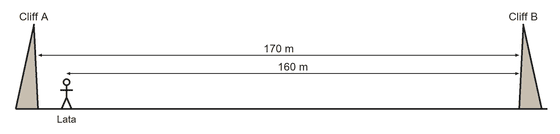
(b) In the below diagram Lata stands between two cliffs and claps her hands. Determine the time taken by her to hear the first echo. Speed of sound in air = .
 Solve with AI
Written solution
Solution:
Concept: An echo is the sound heard after reflection from a distant obstacle, after the original sound has ceased. The sensation of a sound stays in our ear for about 0.1 s, so the echo is heard separately only if it arrives at least 0.1 s after the original sound. If the obstacle is at a distance d and the speed of sound is V, the sound goes to the obstacle and comes back, covering 2d in the echo time t, so 2d = Vt, that is d = Vt ÷ 2. Ultrasonic waves are sound waves of frequency above 20 kHz, beyond the upper limit of human hearing (the audible range is 20 Hz to 20 kHz). Their wavelength is very short, so they can be sent as a narrow beam in one direction, and they are not easily absorbed by water.
Given: Cliffs 170 m apart; Lata 160 m from cliff B; V = 320 m s⁻¹.
Step 1 — Name the waves (part a).
SONAR uses ultrasonic waves, of frequency above 20 kHz.
Step 2 — Find Lata's distance from each cliff (part b).
The cliffs are 170 m apart and Lata is 160 m from cliff B, so she is 170 − 160 = 10 m from cliff A.
Step 3 — Check the reflection from cliff A.
The sound goes to cliff A and back, 2 × 10 m, at 320 m s⁻¹.
This is less than 0.1 s, so the reflected sound mixes with the clap and is not heard as a separate echo (cliff A is nearer than the 16 m needed at this speed).
Step 4 — Find the time of the echo from cliff B.
The sound goes to cliff B and back, 2 × 160 m.

Watch out: The nearest cliff does not always give the first ECHO: a reflection that returns within 0.1 s is not heard separately.
Therefore, (a) ultrasonic waves; (b) Lata hears the first echo after 1 s (from cliff B).
- 404 marks
Question 40
In the given diagram, a vibrating tuning fork is kept near the mouth of a burette filled with water. The length of the air column is adjusted by opening the tap of the burette. At a length of 5 cm of the air column, a loud sound is heard.
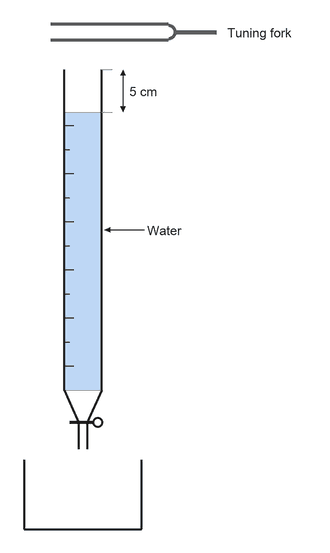
(a) Name the phenomenon illustrated by the above experiment.
(b) Why is a loud sound heard at this particular length?
(c) If the present tuning fork is replaced with a tuning fork of higher frequency, should the length of the air column increase or decrease to produce a loud sound? Give a reason.
Solve with AIWritten solution
Solution:
Concept: The note of a wind instrument or a jar comes from its vibrating air column. The natural frequency of an air column is inversely proportional to its length (f ∝ 1/l): a shorter air column gives a higher frequency, that is, a higher pitch (a shriller note). Resonance is a special case of forced vibrations: when the frequency of the applied periodic force is equal to the natural frequency of the body, the body readily takes energy from the force and vibrates with a very large amplitude.
Step 1 — Name the phenomenon (part a).
The loud sound at one particular length of the air column is resonance in an air column.
Step 2 — Explain the loud sound (part b).
At a length of 5 cm the natural frequency of the air column becomes equal to the frequency of the tuning fork. The fork then makes the air column vibrate with a large amplitude, so much more sound energy is sent out and a loud sound is heard. At other lengths the air column makes only small forced vibrations.
Step 3 — Decide the new length (part c).
To resonate with a fork of higher frequency, the air column must have a higher natural frequency. Since f ∝ 1/l, it must be shorter than 5 cm, so the length should decrease (the tap is opened less, keeping more water in the burette).
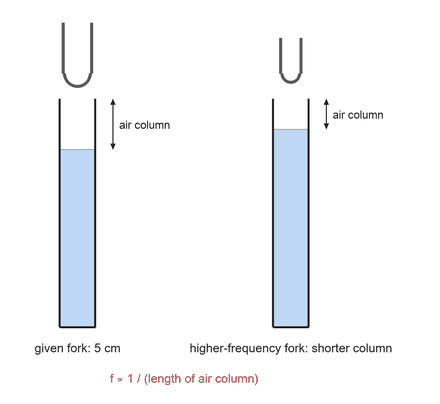
Watch out: A higher frequency needs a SHORTER air column, not a longer one.
Therefore, (a) resonance; (b) at 5 cm the natural frequency of the air column equals the frequency of the fork; (c) the length of the air column should decrease, because f ∝ 1/l.
- 411 mark
Question 41
Assertion (A) : As the level of water in a tall measuring cylinder kept under running tap rises, the pitch of sound gradually increases.
Reason (R) : Frequency of sound is inversely proportional to the length of the water column.
Solve with AIAnswer
(A) Both (A) and (R) are true and (R) is correct explanation of (A).
(B) Both (A) and (R) are true and (R) is not the correct explanation of (A).
- Correct
(C) (A) is true but (R) is false.
(D) (A) is false but (R) is true.
Answer: (C) (A) is true but (R) is false.
Concept: In an assertion–reason item, judge A and R separately, then decide whether R explains A. The note of a wind instrument or a jar comes from its vibrating air column. The natural frequency of an air column is inversely proportional to its length (f ∝ 1/l): a shorter air column gives a higher frequency, that is, a higher pitch (a shriller note).
Step 1 — Judge the Assertion.
As the cylinder fills, the air column above the water gets shorter, so its frequency rises and the pitch gradually increases. The Assertion is true.
Step 2 — Judge the Reason.
The Reason says the frequency is inversely proportional to the length of the WATER column. It is the length of the AIR column that matters; as the water column gets longer, the frequency rises, which is not an inverse relation with the water column. The Reason is false.
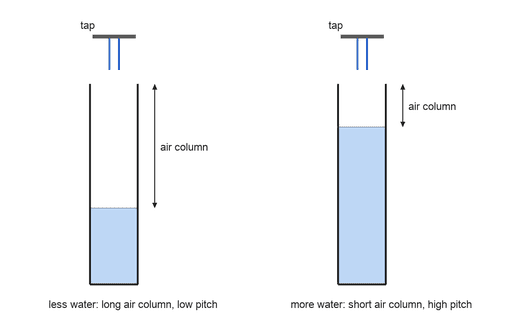
Watch out: The note comes from the air column above the water, not from the water.
Why the other options are wrong:
- (A) Both (A) and (R) are true and (R) is correct explanation of (A): it needs the Reason to be true, but the Reason is false.
- (B) Both (A) and (R) are true and (R) is not the correct explanation of (A): it also needs the Reason to be true.
- (D) (A) is false but (R) is true: it says the Assertion is false; in fact the pitch does rise as the cylinder fills.
Therefore, the Assertion is true but the Reason is false, option (C).
- 422 marks
Question 42
The displacement–time graph of a sound wave produced by a vibrating wire is shown below.

(a) How will you adjust the tension in the wire, to reduce the length of PR?
(b) Which characteristic of sound is affected by the reduction in the length of PR?
Solve with AIWritten solution
Solution:
Concept: The natural frequency of a stretched string is , where l is the vibrating length, T the tension and m the mass per unit length. So f ∝ 1/l (same tension and wire), f ∝ √T (same length and wire), and a thicker, heavier wire has a lower frequency. The time period is T = 1 ÷ f.
Step 1 — Identify PR.
On a displacement–time graph, P to R is one complete wave, so PR is the time period T. A shorter PR means a shorter time period, that is, a higher frequency (f = 1 ÷ T).
Step 2 — Adjust the tension (part a).
The frequency of a stretched wire is proportional to the square root of its tension, so to raise the frequency (shorten PR) the tension must be increased.

Step 3 — Name the characteristic (part b).
Pitch depends on frequency, so a higher frequency gives a higher (shriller) pitch.
Watch out: PR is a TIME (the period), not a wavelength; a shorter period means a higher frequency.
Therefore, (a) the tension in the wire should be increased; (b) the pitch is affected (it becomes higher).
- 433 marks
Question 43
A submarine in the sea, sends ultrasonic ping and a stopwatch is started simultaneously. The stopwatch stops on receiving the reflected wave from an obstacle and reads 1 minute 40 seconds. Calculate the distance of the obstacle from the submarine (Speed of sound in water 1500 )
Solve with AIWritten solution
Solution:
Concept: An echo is the sound heard after reflection from a distant obstacle, after the original sound has ceased. The sensation of a sound stays in our ear for about 0.1 s, so the echo is heard separately only if it arrives at least 0.1 s after the original sound. If the obstacle is at a distance d and the speed of sound is V, the sound goes to the obstacle and comes back, covering 2d in the echo time t, so 2d = Vt, that is d = Vt ÷ 2.
Given: t = 1 min 40 s; V = 1500 m s⁻¹ in sea water.
Step 1 — Change the time into seconds.
One minute is 60 s, so 1 minute 40 seconds is 60 s + 40 s.
Step 2 — Find the distance of the obstacle.
The stopwatch times the ping going to the obstacle and back, so the obstacle is half the distance covered.
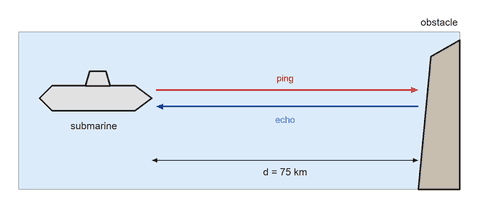
That is 75 km.
Watch out: Halve the distance covered: Vt = 150 km is the round trip.
Therefore, the obstacle is 75,000 m (75 km) from the submarine.
- 444 marks
Question 44
The diagrams given below show two sound boxes A and B with wires of same length (l) and tension (10 kgf) but different cross-sectional areas. Simultaneously, vibrating tuning forks of frequency 300 Hz are placed on the boxes A and B. The paper rider falls off in case of B but not in case of A.
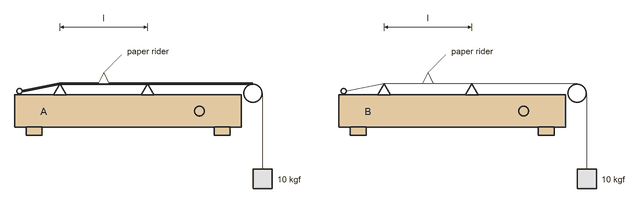
(a) Name and explain the phenomenon responsible for the falling off of the paper rider in B.
(b) The wire A resonates with a tuning fork of frequency ‘f’. Is ‘f’ greater than, less than or equal to 300 Hz? Justify your answer.
Solve with AIWritten solution
Solution:
Concept: The natural frequency of a stretched string is , where l is the vibrating length, T the tension and m the mass per unit length. So f ∝ 1/l (same tension and wire), f ∝ √T (same length and wire), and a thicker, heavier wire has a lower frequency. Resonance is a special case of forced vibrations: when the frequency of the applied periodic force is equal to the natural frequency of the body, the body readily takes energy from the force and vibrates with a very large amplitude.
Given: Same length l and tension 10 kgf; A thicker than B; forks of 300 Hz.
Step 1 — Name the phenomenon (part a).
The rider falls off in B because of resonance.
Step 2 — Explain it (part a).
The natural frequency of wire B is equal to 300 Hz, the frequency of the fork. The fork's vibrations, passed through the sound box, make wire B vibrate with a very large amplitude, and the vigorously vibrating wire throws the rider off. Wire A, whose natural frequency is different, makes only small forced vibrations, so its rider stays on.
Step 3 — Compare the two wires (part b).
Both wires have the same length and the same tension, but wire A has the larger cross-sectional area (it is thicker), so it has a greater mass per unit length m. Since f ∝ 1/√m, the natural frequency of A is lower than that of B, which is 300 Hz.
Step 4 — Conclude about f.
So wire A resonates with a fork of frequency f less than 300 Hz.
Watch out: A THICKER wire (larger m) has a LOWER frequency, other things being equal.
Therefore, (a) resonance: the natural frequency of wire B equals 300 Hz, so it vibrates with a very large amplitude; (b) f is less than 300 Hz, because the thicker wire A has a lower natural frequency.
- 451 mark
Question 45
The amplitude of a sound wave is reduced from 2 mm to 1 mm. The intensity of the sound will:
Solve with AIAnswer
(A) become four times the initial
(B) remain the same
(C) become half of the initial
- Correct
(D) become one fourth of the initial
Answer: (D) become one fourth of the initial
Concept: The intensity of a sound wave is proportional to the square of its amplitude, I ∝ a².
Step 1 — Find the change in amplitude.
The amplitude falls from 2 mm to 1 mm, so it becomes half of its initial value.
Step 2 — Find the change in intensity.
The intensity is proportional to the square of the amplitude.
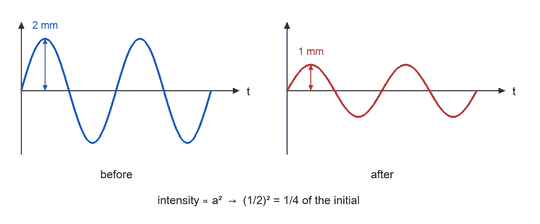
Watch out: Halving the amplitude quarters the intensity; it does not halve it.
Why the other options are wrong:
- (A) become four times the initial: four times would need the amplitude to be doubled, not halved.
- (B) remain the same: the intensity depends on the amplitude, so it cannot stay the same.
- (C) become half of the initial: half would be true only if the intensity were proportional to the amplitude itself; it goes as its square.
Therefore, the intensity becomes one fourth of the initial, option (D).
- 462 marks
Question 46
Calculate the minimum distance needed in water to hear the echo.
(Speed of sound in water is 1500 . Persistence of hearing is 0.1 s.)
Solve with AIWritten solution
Solution:
Concept: An echo is the sound heard after reflection from a distant obstacle, after the original sound has ceased. The sensation of a sound stays in our ear for about 0.1 s, so the echo is heard separately only if it arrives at least 0.1 s after the original sound. If the obstacle is at a distance d and the speed of sound is V, the sound goes to the obstacle and comes back, covering 2d in the echo time t, so 2d = Vt, that is d = Vt ÷ 2.
Given: V = 1500 m s⁻¹; persistence of hearing 0.1 s.
Step 1 — Write the condition.
The echo must reach the ear at least 0.1 s (the persistence of hearing) after the original sound. In that time the sound goes to the reflector and back.
Step 2 — Put in the values.
The speed of sound in water is 1500 m s⁻¹ and t = 0.1 s.
It is much more than 17 m in air, because sound travels much faster in water.
Watch out: Divide by 2: Vt = 150 m is the round trip, not the distance of the reflector.
Therefore, the minimum distance needed in water to hear an echo is 75 m.
- 473 marks
Question 47
(a) A man fires a gun and hears its echo after 3 s. The man then moves 80 m towards the hill and fires his gun again.
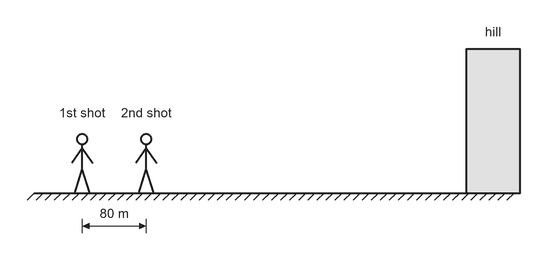
This time he hears the echo after 2.5 s. Calculate the speed of the sound.
(b) State one reason of using ultrasonic waves in SONAR.
Solve with AIWritten solution
Solution:
Concept: An echo is the sound heard after reflection from a distant obstacle, after the original sound has ceased. The sensation of a sound stays in our ear for about 0.1 s, so the echo is heard separately only if it arrives at least 0.1 s after the original sound. If the obstacle is at a distance d and the speed of sound is V, the sound goes to the obstacle and comes back, covering 2d in the echo time t, so 2d = Vt, that is d = Vt ÷ 2. Ultrasonic waves are sound waves of frequency above 20 kHz, beyond the upper limit of human hearing (the audible range is 20 Hz to 20 kHz). Their wavelength is very short, so they can be sent as a narrow beam in one direction, and they are not easily absorbed by water.
Given: First echo after 3 s; after moving 80 m towards the hill, echo after 2.5 s.
(a)
Step 1 — Write the two echo times.
Let the man be d metres from the hill at first, and V be the speed of sound. Each echo time is the round trip divided by the speed.
Step 2 — Subtract to remove d.
Subtracting the second equation from the first:
Step 3 — Solve for V.
The difference of the times is 0.5 s.
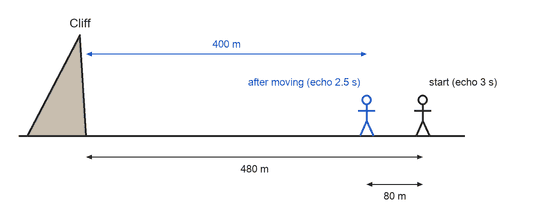
Step 4 — Check the answer.
With V = 320 m s⁻¹ the man is first 480 m from the hill, then 80 m nearer, and the second echo time comes out as given.
(b)
Step 5 — Give a reason for ultrasonic waves.
Ultrasonic waves have a very short wavelength, so they can be sent as a narrow beam that travels a long way without spreading, and they are not easily absorbed by water; the echo from a distant object is therefore clear.
Watch out: Moving 80 m closer shortens the round trip by 160 m, not 80 m.
Therefore, (a) the speed of sound is 320 m s⁻¹; (b) ultrasonic waves can be sent as a narrow beam and are not easily absorbed, so they give a clear echo.
- 484 marks
Question 48
The diagram below displays four solid plastic balls attached to wires, all mounted on a wooden base. When a person shakes the wooden base back and forth at a steady pace, the balls begin to vibrate as well. It is noted that while all the balls vibrate, only one of them vibrates vigorously.

(a) Explain why only one ball vibrates vigorously.
(b) If , , , and are the natural frequencies of vibration of the wires, then arrange them in the increasing order of their frequencies and justify.
Solve with AIWritten solution
Solution:
Concept: Forced vibrations are the vibrations of a body under an external periodic force: the body vibrates with the frequency of the applied force, not with its own natural frequency, and usually with a small amplitude. Resonance is a special case of forced vibrations: when the frequency of the applied periodic force is equal to the natural frequency of the body, the body readily takes energy from the force and vibrates with a very large amplitude. The natural frequency of a ball on a wire is lower for a longer wire.
Step 1 — Explain the vigorous vibration (part a).
Shaking the base applies a periodic force to all four wires at one frequency, so all the balls perform forced vibrations. Only one wire has a natural frequency equal to the frequency of the shaking; that ball is in resonance, takes energy readily and vibrates with a large amplitude. The others vibrate with small amplitudes.
Step 2 — Read the lengths from the figure (part b).
From the figure, the wire of D is the longest, then A, then C, and B is the shortest.
Step 3 — Relate length to frequency (part b).
A longer wire carrying a ball is less stiff and swings more slowly, so it has a lower natural frequency: the longer the wire, the lower the frequency. Arranging from the longest wire to the shortest gives the increasing order of frequency.
Watch out: Increasing order of FREQUENCY means decreasing order of LENGTH; do not list the wires shortest first.
Therefore, (a) only the ball whose natural frequency equals the frequency of shaking resonates; (b) , because the longer the wire, the lower its natural frequency.
- 491 mark
Question 49
Equal volumes of water are added to three cylindrical jars A, B and C of same height and radii , and respectively with < < . If you blow air into the mouth of these jars, which tube will produce the shrillest note?
Solve with AIAnswer
(A) A
- Correct
(B) B
(C) C
(D) All will produce the notes of same shrillness
Answer: (B) B
Concept: The note of a wind instrument or a jar comes from its vibrating air column. The natural frequency of an air column is inversely proportional to its length (f ∝ 1/l): a shorter air column gives a higher frequency, that is, a higher pitch (a shriller note).
Step 1 — Find where the water stands highest.
Equal volumes of water are poured in. The height of the water is volume ÷ (πr²), so the water stands highest in the narrowest jar. Since , jar B has the highest water level.
Step 2 — Find the shortest air column.
The jars have the same height, so jar B, with the highest water level, has the shortest air column.

Step 3 — Find the shrillest note.
The shortest air column has the highest natural frequency (f ∝ 1/l), and the highest frequency gives the shrillest note. So jar B gives the shrillest note.
Watch out: A narrower jar does not give a longer air column: the same volume of water stands HIGHER in it, leaving less air.
Why the other options are wrong:
- (A) A: jar A is wider than B, so its water is lower and its air column longer, giving a lower frequency than B.
- (C) C: jar C is the widest: lowest water level, longest air column, so it gives the least shrill note.
- (D) All will produce the notes of same shrillness: the air columns have different lengths, so the notes cannot all be equally shrill.
Therefore, jar B produces the shrillest note, option (B).
- 501 mark
Question 50
Complete the following by choosing the correct answers from the bracket:
Quality of sound depends on its ............... [amplitude / waveform].
Solve with AIWritten solution
Solution:
Concept: A musical sound has three characteristics: loudness depends on the amplitude (L ∝ a²), pitch on the frequency, and quality (timbre) on the waveform, that is, on the subsidiary notes present with the principal note and their relative amplitudes.
Step 1 — Recall what decides quality.
Loudness depends on amplitude, pitch on frequency, and quality on the waveform.
Step 2 — Fill in the blank.
Two notes of the same loudness (same amplitude) and the same pitch (same frequency) from two different instruments still sound different because their waveforms differ. So quality depends on the waveform.
Watch out: Amplitude decides loudness, not quality.
Therefore, quality of sound depends on its waveform.
- 512 marks
Question 51
(a) Define natural vibrations.
(b) How is this vibration different from damped vibrations in terms of their amplitudes?
Solve with AIWritten solution
Solution:
Concept: Free (natural) vibrations are the vibrations of a body under its own restoring force only, with no resistive or external force. The body vibrates with its own natural frequency, and its amplitude and frequency stay constant. They are possible only in vacuum. Damped vibrations are vibrations of decreasing amplitude: in a real medium a resistive (frictional) force opposes the motion, energy is lost as heat in every vibration, and the amplitude keeps falling, while the frequency stays the same.
Step 1 — Define natural vibrations (part a).
The periodic vibrations of a body in the absence of any resistive or external force, under its own restoring force only, are called natural (free) vibrations. Their frequency is the natural frequency of the body, which depends on its shape and size.
Step 2 — Compare the amplitudes (part b).
In natural vibrations no energy is lost, so the amplitude remains constant with time. In damped vibrations energy is lost in overcoming friction, so the amplitude gradually decreases with time and the vibrations finally stop.
Watch out: Both kinds have (practically) the same frequency; they differ in amplitude.
Therefore, (a) natural vibrations are the vibrations of a body under its own restoring force alone, with no resistive or external force; (b) their amplitude stays constant, while in damped vibrations the amplitude keeps decreasing.
- 523 marks
Question 52
(a) One end of a plastic foot ruler is held tightly at the edge of a table and the other end is plucked. Name the vibrations produced in the ruler.
(b) Now the ruler is pushed inside partially and plucked again from its free end. State with a reason whether the frequency of vibration increases or decreases.
Solve with AIWritten solution
Solution:
Concept: Free (natural) vibrations are the vibrations of a body under its own restoring force only, with no resistive or external force. The body vibrates with its own natural frequency, and its amplitude and frequency stay constant. They are possible only in vacuum. The natural frequency of a ruler clamped at one end is higher when its vibrating part is shorter.
Step 1 — Name the vibrations (part a).
After being plucked, the ruler vibrates on its own with its natural frequency: natural (free) vibrations. (In air the amplitude slowly dies away, so in practice they are damped.)
Step 2 — Decide the change in frequency (part b).
Pushing the ruler in shortens the part that vibrates beyond the table edge. A shorter vibrating part is stiffer and lighter, so it vibrates faster: its natural frequency is higher, and the note heard is shriller.
Watch out: The frequency changes because the vibrating LENGTH changes, not because the ruler is plucked harder.
Therefore, (a) natural (free) vibrations; (b) the frequency increases, because the vibrating length of the ruler becomes shorter.
- 534 marks
Question 53
Two persons A and B are standing in front of a cliff in the same line 170 m apart as shown in the diagram.
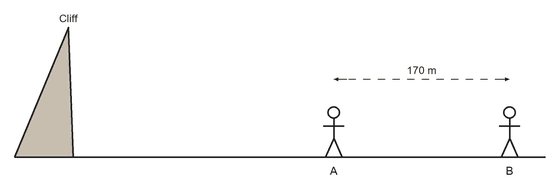
Person B fires the gun and hears the echo in 3 s. Then the person A standing in front of the person B fires the gun.
(Speed of sound in air is 340 )
(a) Calculate:
(1) the distance of the person B from the cliff.
(2) the minimum time in which B hears the gunshot fired by A.
(b) Fill in the blank.
The echo is softer (less loud) than the original sound due to the decrease in ............... [amplitude / frequency] of the wave.
Solve with AIWritten solution
Solution:
Concept: An echo is the sound heard after reflection from a distant obstacle, after the original sound has ceased. The sensation of a sound stays in our ear for about 0.1 s, so the echo is heard separately only if it arrives at least 0.1 s after the original sound. If the obstacle is at a distance d and the speed of sound is V, the sound goes to the obstacle and comes back, covering 2d in the echo time t, so 2d = Vt, that is d = Vt ÷ 2.
Given: A and B 170 m apart in line with the cliff; B's echo after 3 s; V = 340 m s⁻¹.
(a)(1)
Step 1 — Find B's distance from the cliff.
B hears his own echo after 3 s, and the sound covers twice his distance from the cliff.
A is 170 m nearer, so A is 510 − 170 = 340 m from the cliff.
(a)(2)
Step 2 — Find the least time for B to hear A's shot.
The shortest path for A's sound is straight from A to B, 170 m; any path by way of the cliff is longer.
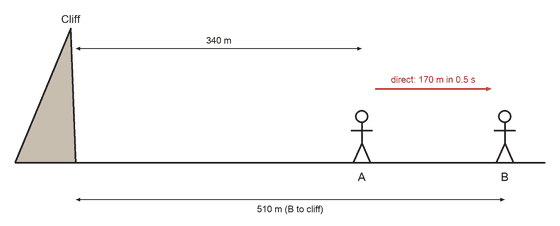
The echo of A's shot travels 340 m + 510 m = 850 m and reaches B later, after 2.5 s.
(b)
Step 3 — Fill in the blank.
Part of the sound energy is absorbed by the cliff and the air, so the reflected wave has a smaller amplitude and sounds softer. Its frequency does not change on reflection.
Watch out: The minimum time is for the DIRECT sound from A to B, not for the echo.
Therefore, (a)(1) B is 510 m from the cliff; (a)(2) B hears A's gunshot after a minimum of 0.5 s; (b) the echo is softer due to the decrease in amplitude of the wave.
- 541 mark
Question 54
Assertion (A): The buzzing of a mosquito is shriller than the roar of a lion.
Reason (R): The frequency of sound produced by a mosquito is greater than the frequency of sound produced by the roar of a lion.
Solve with AIAnswer
(A) (A) is true but (R) is false.
(B) (A) is false but (R) is true.
- Correct
(C) Both (A) and (R) are true and (R) is the correct explanation of (A).
(D) Both (A) and (R) are true but (R) is not the correct explanation of (A).
Answer: (C) Both (A) and (R) are true and (R) is the correct explanation of (A).
Concept: Shrillness is pitch, and pitch depends on frequency: the higher the frequency, the shriller the sound. In an assertion–reason item, judge A and R separately, then decide whether R explains A.
Step 1 — Judge the Assertion.
A mosquito's buzz is shrill (high-pitched); a lion's roar is grave (low-pitched), though very loud. The Assertion is true.
Step 2 — Judge the Reason.
The wings of a mosquito vibrate with a much higher frequency than the vocal cords of a lion. The Reason is true.
Step 3 — Decide whether R explains A.
Shrillness is pitch, and a higher frequency gives a higher pitch, so the Reason correctly explains the Assertion.
Watch out: A louder sound is not a shriller one: the lion is louder, the mosquito shriller.
Why the other options are wrong:
- (A) (A) is true but (R) is false: it says the Reason is false, but the mosquito's frequency really is higher.
- (B) (A) is false but (R) is true: it says the Assertion is false, but the buzz really is shriller.
- (D) Both (A) and (R) are true but (R) is not the correct explanation of (A): it says R does not explain A, but shrillness (pitch) is decided by frequency, so it does.
Therefore, both A and R are true, and R is the correct explanation of A, option (C).
- 551 mark
Question 55
Complete the following by choosing the correct answers from the bracket:
250 dB is ............... [shriller / louder] than 10 dB.
Solve with AIWritten solution
Solution:
Concept: The sound level (loudness) is measured in decibel (dB); shrillness is pitch, which depends on frequency.
Step 1 — Recall what the decibel measures.
The decibel (dB) is the unit of the sound level, that is, of how loud a sound is. It says nothing about the frequency, so it says nothing about shrillness.
Step 2 — Fill in the blank.
A sound of 250 dB has a much higher sound level than one of 10 dB, so it is louder.
Watch out: A larger dB value means louder, not shriller.
Therefore, 250 dB is louder than 10 dB.
- 563 marks
Question 56
It is observed during an earthquake, that the short period seismic waves damage low rise buildings while long period waves damage high rise buildings.
(a) Name the phenomenon responsible for the damage of the buildings.
(b) Why do long period seismic waves damage high rise buildings?
Solve with AIWritten solution
Solution:
Concept: Resonance is a special case of forced vibrations: when the frequency of the applied periodic force is equal to the natural frequency of the body, the body readily takes energy from the force and vibrates with a very large amplitude. The frequency of a wave is f = 1 ÷ T, so a long period means a low frequency.
Step 1 — Name the phenomenon (part a).
Each building has its own natural frequency. A seismic wave whose frequency matches it makes the building vibrate with a very large amplitude: resonance.
Step 2 — Relate period to frequency (part b).
A long-period seismic wave has a low frequency, since f = 1 ÷ T.
Step 3 — Explain the damage to tall buildings (part b).
A tall building has a low natural frequency (it sways slowly). The low frequency of long-period waves is close to or equal to this natural frequency, so the ground pushes the building at its own natural frequency and it vibrates with a very large amplitude (resonance), which can crack or collapse it. Low-rise buildings have a higher natural frequency, so they resonate with the short-period waves instead.
Watch out: A LONG period means a LOW frequency, not a high one.
Therefore, (a) resonance; (b) the low frequency of long-period waves matches the low natural frequency of a tall building, which then resonates with a very large amplitude.
- 574 marks
Question 57
A person standing between two vertical cliffs produces a sound and hears the first echo after 3 s. If the distance between the cliffs is 1760 m, then after how much time will he hear the second echo?
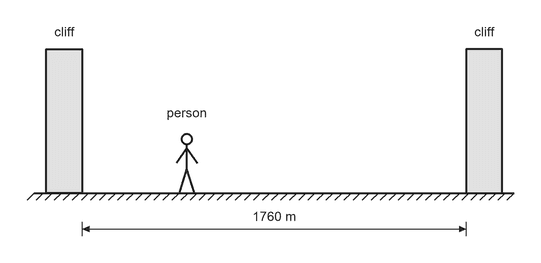
(The speed of sound = 320 )
Solve with AIWritten solution
Solution:
Concept: An echo is the sound heard after reflection from a distant obstacle, after the original sound has ceased. The sensation of a sound stays in our ear for about 0.1 s, so the echo is heard separately only if it arrives at least 0.1 s after the original sound. If the obstacle is at a distance d and the speed of sound is V, the sound goes to the obstacle and comes back, covering 2d in the echo time t, so 2d = Vt, that is d = Vt ÷ 2.
Given: First echo after 3 s; cliffs 1760 m apart; V = 320 m s⁻¹.
Step 1 — Find the distance of the nearer cliff.
The first echo comes from the nearer cliff, after 3 s.
Step 2 — Find the distance of the farther cliff.
The rest of the 1760 m is the distance to the farther cliff.
Step 3 — Find the time of the second echo.
The sound goes to the farther cliff and back.
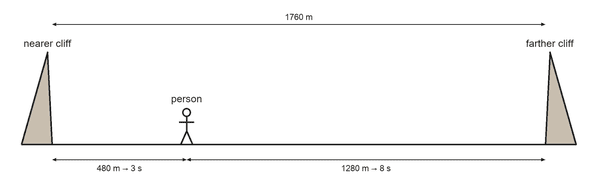
That is 5 s after the first echo.
Watch out: The second echo comes from the FARTHER cliff; its distance is 1760 − 480 m, not 1760 m.
Therefore, he hears the second echo 8 s after producing the sound.