Solution:
Concept: An echo is the sound heard after reflection from a distant obstacle, after the original sound has ceased. The sensation of a sound stays in our ear for about 0.1 s, so the echo is heard separately only if it arrives at least 0.1 s after the original sound. If the obstacle is at a distance d and the speed of sound is V, the sound goes to the obstacle and comes back, covering 2d in the echo time t, so 2d = Vt, that is d = Vt ÷ 2. Ultrasonic waves are sound waves of frequency above 20 kHz, beyond the upper limit of human hearing (the audible range is 20 Hz to 20 kHz). Their wavelength is very short, so they can be sent as a narrow beam in one direction, and they are not easily absorbed by water.
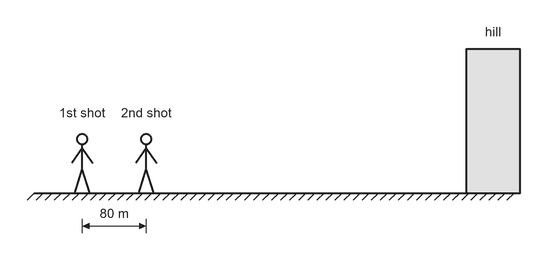
Given: First echo after 3 s; after moving 80 m towards the hill, echo after 2.5 s.
(a)
Step 1 — Write the two echo times.
Let the man be d metres from the hill at first, and V be the speed of sound. Each echo time is the round trip divided by the speed.
3=V2d
2.5=V2(d−80)
Step 2 — Subtract to remove d.
Subtracting the second equation from the first:
3−2.5=V2d−2(d−80)=V160
Step 3 — Solve for V.
The difference of the times is 0.5 s.
V=0.5160=320 m s−1
Step 4 — Check the answer.
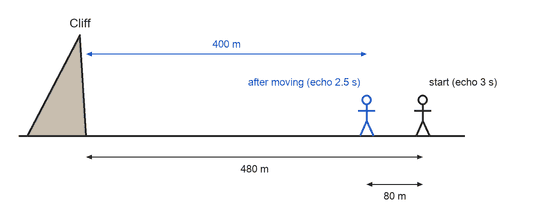
With V = 320 m s⁻¹ the man is first 480 m from the hill, then 80 m nearer, and the second echo time comes out as given.
d=2320×3=480 m
d−80=480−80=400 m
t2=3202×400=2.5 s
(b)
Step 5 — Give a reason for ultrasonic waves.
Ultrasonic waves have a very short wavelength, so they can be sent as a narrow beam that travels a long way without spreading, and they are not easily absorbed by water; the echo from a distant object is therefore clear.
Watch out: Moving 80 m closer shortens the round trip by 160 m, not 80 m.
Therefore, (a) the speed of sound is 320 m s⁻¹; (b) ultrasonic waves can be sent as a narrow beam and are not easily absorbed, so they give a clear echo.