
Question 172 marksAsked 2019Easy
A man playing a flute is able to produce notes of different frequencies. If he closes the holes near his mouth, will the pitch of the note produced, increase or decrease? Give a reason.
Confirming your payment
Sign up now and get 250 free tokens.
Previous Year Questions · Question 17 of 57
A man playing a flute is able to produce notes of different frequencies. If he closes the holes near his mouth, will the pitch of the note produced, increase or decrease? Give a reason.
Solution:
Concept: The note of a wind instrument or a jar comes from its vibrating air column. The natural frequency of an air column is inversely proportional to its length (f ∝ 1/l): a shorter air column gives a higher frequency, that is, a higher pitch (a shriller note).
Step 1 — Find the vibrating air column.
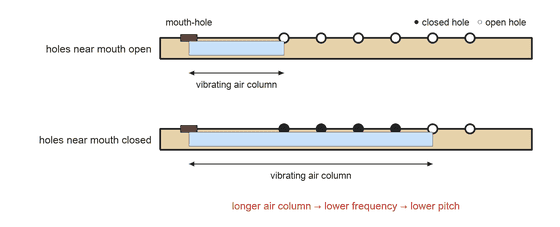
In a flute the note comes from the air column between the mouth-hole and the first open hole. Closing the holes near the mouth makes the first open hole farther from the mouth-hole, so the vibrating air column becomes longer.
Step 2 — Decide the change in pitch.
Since f ∝ 1/l, a longer air column vibrates with a lower frequency, and a lower frequency gives a lower pitch (a flatter note).
Watch out: It is the AIR column that vibrates, not the flute's tube; a longer air column lowers the pitch.
Therefore, the pitch decreases, because the vibrating air column becomes longer and its frequency falls.